A Retrospective Cohort Analysis Shows that Coadministration of Minocycline with Colistin in Critically Ill Patients Is Associated with Reduced Frequency of Acute Renal Failure
- PMID: 29038261
- PMCID: PMC5740356
- DOI: 10.1128/AAC.01165-17
A Retrospective Cohort Analysis Shows that Coadministration of Minocycline with Colistin in Critically Ill Patients Is Associated with Reduced Frequency of Acute Renal Failure
Abstract
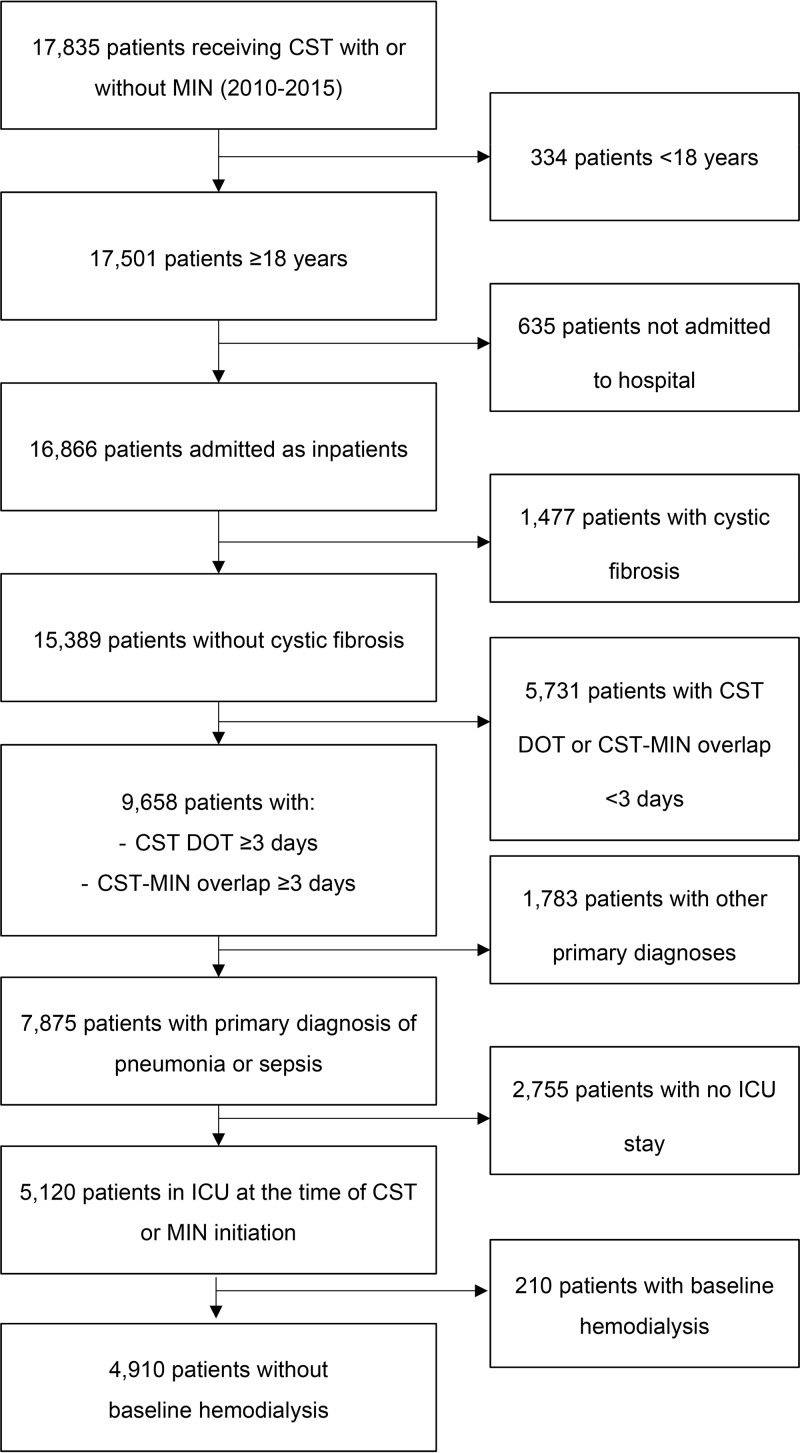
Nonclinical studies have suggested that oxidative damage, caspase-mediated apoptosis, and inducible nitric oxide synthase levels may be involved in the pathogenesis of colistin (CST)-associated acute renal failure. MIN inhibits caspase 1, caspase 3, and inducible nitric oxide synthase, leading to the hypothesis that coadministration of CST with MIN (CST-MIN) may reduce the incidence of acute renal failure as well as produce additive or synergistic antimicrobial effects. A multicenter retrospective cohort study was conducted using the Premier Research database to examine the impact of CST-MIN on acute renal failure. Inclusion criteria were as follows: age of ≥18 years, intensive care unit admission at CST initiation, primary International Classification of Diseases 9 (ICD-9) diagnosis of pneumonia or sepsis, nondialysis at hospital admission, and discharge between January 2010 and December 2015. ICD-9 code 584.XX or ICD-10 code N17 was used to define acute renal failure. Baseline comparisons, 1:8 propensity score matching, and confirmatory logistic regression analyses were conducted. In total, 4,817 patients received CST and met inclusion criteria; 93 received CST-MIN. Unadjusted frequency of acute renal failure was significantly lower in patients receiving CST-MIN than CST (11.8% versus 23.7%, P = 0.007). Similar results were seen in propensity score matching (12.0% versus 22.3%, P = 0.031) and logistic regression analyses (odds ratio of 0.403, P = 0.006). Mortalities and 30-day readmission rates were similar between groups. The acute renal failure rate was not impacted by prevalence of baseline renal disease. CST-MIN in critically ill patients may reduce CST-associated acute renal failure. Further evaluation of this combination in prospective clinical studies is warranted.
Keywords: acute renal failure; colistin; minocycline; multidrug resistance; nephrotoxicity.
Copyright © 2017 Lodise et al.
Figures
Comment in
-
Should We Accept Colistin-Induced Nephrotoxicity To Ensure Attainment of a Therapeutic Steady State in Those with Good Renal Function?Antimicrob Agents Chemother. 2018 May 25;62(6):e00351-18. doi: 10.1128/AAC.00351-18. Print 2018 Jun. Antimicrob Agents Chemother. 2018. PMID: 29802204 Free PMC article. No abstract available.
References
-
- Vincent JL, Rello J, Marshall J, Silva E, Anzueto A, Martin CD, Moreno R, Lipman J, Gomersall C, Sakr Y, Reinhart K, EPIC II Group of Investigators. 2009. International study of the prevalence and outcomes of infection in intensive care units. JAMA 302:2323–2329. doi: 10.1001/jama.2009.1754. - DOI - PubMed
-
- Centers for Disease Control and Prevention. 2013. Antibiotic resistance threats in the United States, 2013. Available at http://www.cdc.gov/drugresistance/threat-report-2013/pdf/ar-threats-2013... Accessed 23 February 2017.
Publication types
MeSH terms
Substances
LinkOut - more resources
Full Text Sources
Other Literature Sources
Research Materials
Miscellaneous