


Differential presentation and survival of de novo and recurrent metastatic breast cancer over time: 1990-2010
- PMID: 29039120
- PMCID: PMC5790843
- DOI: 10.1007/s10549-017-4529-5
Differential presentation and survival of de novo and recurrent metastatic breast cancer over time: 1990-2010
Abstract
Background: Differences in de novo (dnMBC) and recurrent metastatic breast cancer (rMBC) presentation and survival over time have not been adequately described.
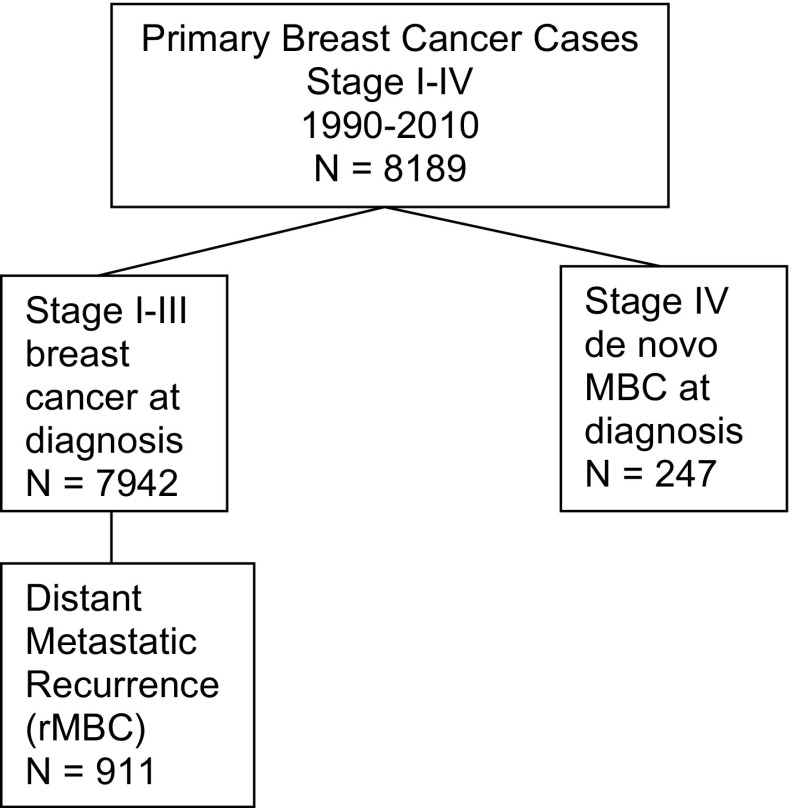
Methods: A retrospective cohort study, 1990-2010, with follow up through 2015 of dnMBC patients (stage IV at diagnosis) and rMBC patients with subsequent distant metastatic recurrence (stage I-III initial diagnosis) [dnMBC = 247, rMBC = 911)]. Analysis included Chi squared tests of categorical variables, Kaplan-Meier survival estimates, and Cox proportional adjusted hazard ratios (HzR) and 95% confidence intervals (CI). Disease specific survival (DSS) was time from diagnosis or distant recurrence to BC death.
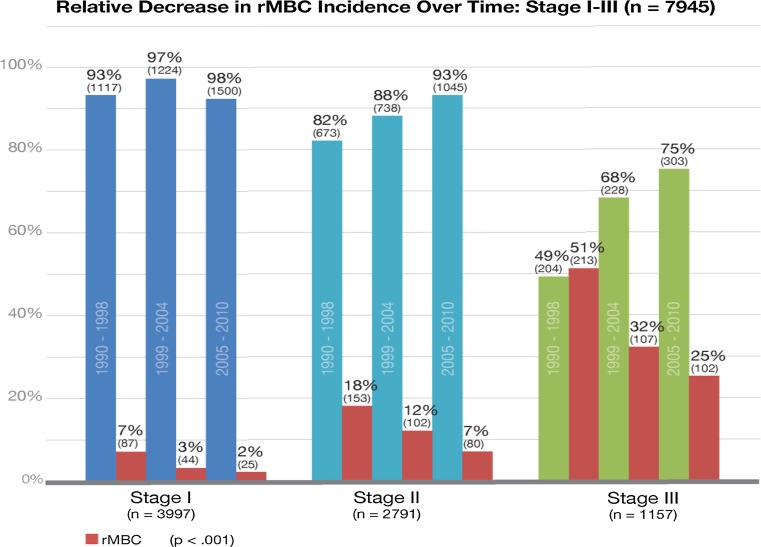
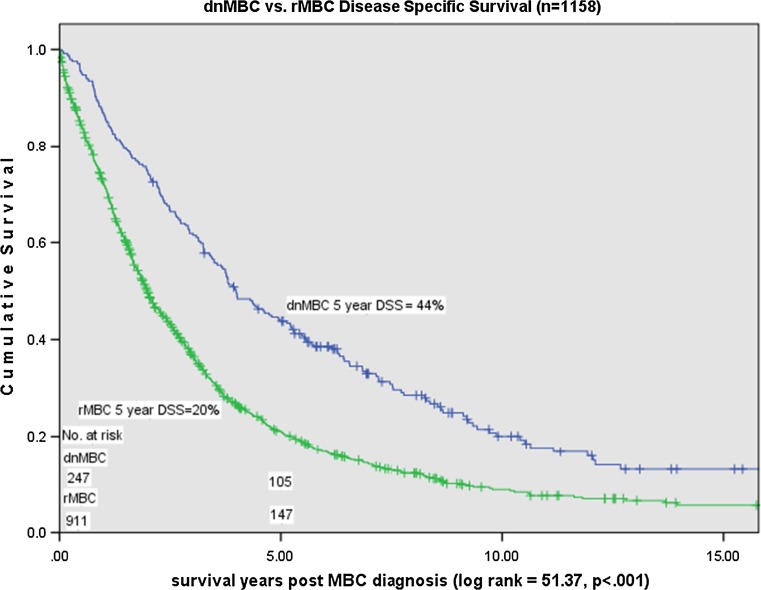
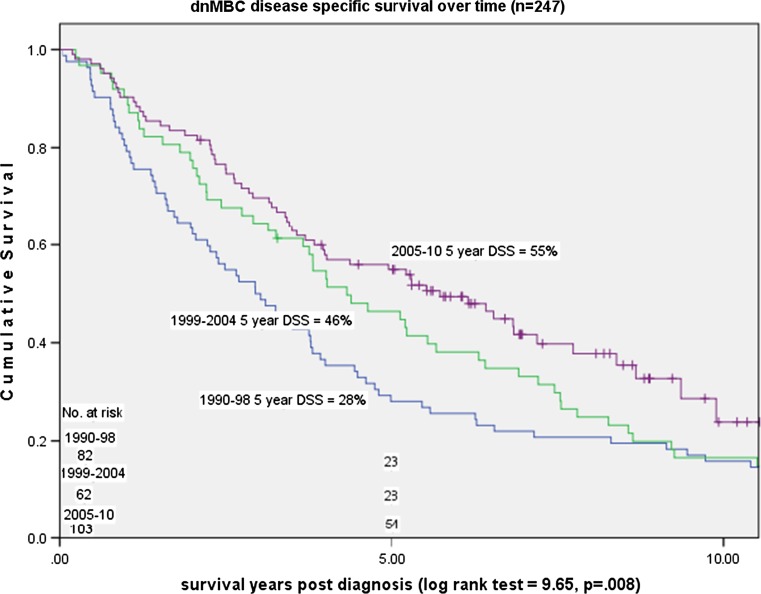
Results: Over time, 1990-1998, 1999-2004, and 2005-2010, dnMBC incidence was constant (3%) and rMBC incidence decreased [18% to 7% (p < 0.001)] with no change in dnMBC hormone receptor (HR) or her2-neu (HER2) status but a decrease in rMBC HER2-positive cases and increase in triple negative breast cancer (HR-negative/HER2-negative) (p = 0.049). Five-year dnMBC DSS was 44% vs. 21% for rMBC (p < 0.001). Five-year dnMBC DSS improved over time [28% to 55% (p = 0.008)] and rMBC worsened [23% to 13%, p = 0.065)]. Worse DSS was associated with HR-negative status (HzR = 1.63; 1.41, 1.89), rMBC (HzR = 1.88; 1.58, 2.23), older age (70 +) (HzR = 1.88; 1.58, 2.24), > 1 distant metastases (HzR 1.39; 1.20, 1.62), and visceral dominant disease (HzR 1.22; 1.05, 1.43). After 1998, HER2-positive disease was associated with better DSS (HzR = 0.72, 95% CI 0.56, 0.93).
Conclusions: Factors associated with the widening survival gap and non-equivalence between dnMBC and rMBC and decreased rMBC incidence warrant further study.
Keywords: De novo; Distant relapse; Metastases; Metastatic breast cancer; Outcomes; Recurrence; Stage IV; Survival.
Conflict of interest statement
The authors declare that they have no conflict of interest.
Figures


References
-
- Edge SB, Byrd DR, Compton CC, Fritz AG, Greene FL, Trotti A, editors. AJCC cancer staging manual. 7. New York: Springer; 2010.
-
- American Cancer Society: cancer Facts and Figures 2017. Atlanta, Ga: American Cancer Society, 2016. Accessed February 2, 2017
-
- SEER Cancer Statistics Factsheets: female Breast Cancer. National Cancer Institute. Bethesda, MD. http://seer.cancer.gov/statfacts/html/breast.html. Accessed 9/30/2016
-
- Howlader N, Noone AM, Krapcho M, et al. (2015) SEER cancer statistics review, 1975–2012. http://seer.cancer.gov/csr/1975_2012/, based on November 2014 SEER data submission, posted to the SEER web site, April 2015. National Cancer Institute, Bethesda
Publication types
MeSH terms
Substances
LinkOut - more resources
Full Text Sources
Other Literature Sources
Medical
Research Materials
Miscellaneous
