


Phenotype, disease severity and pain are major determinants of quality of life in Fabry disease: results from a large multicenter cohort study
- PMID: 29039131
- PMCID: PMC5786653
- DOI: 10.1007/s10545-017-0095-6
Phenotype, disease severity and pain are major determinants of quality of life in Fabry disease: results from a large multicenter cohort study
Abstract
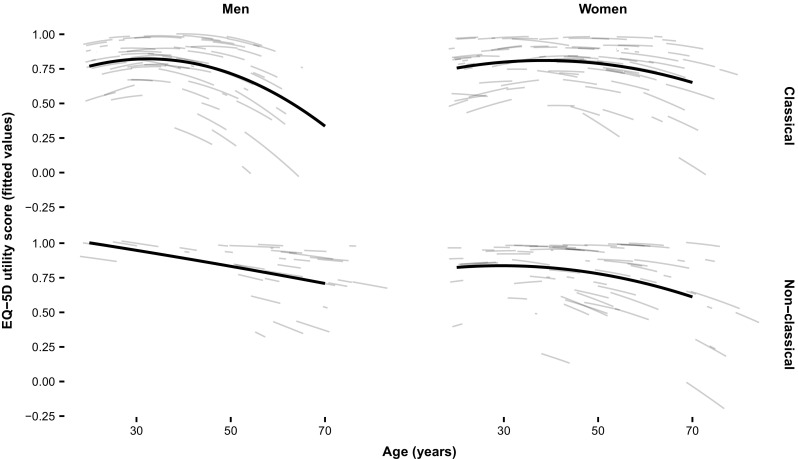
Quality of life (QoL) is decreased in patients with Fabry disease (FD). To improve QoL, it is important to understand the influence of FD related characteristics, symptoms, and complications. In this retrospective cohort study we explored the effect of pain (measured by the Brief Pain Inventory), phenotype, treatment, and FD-related complications on QoL. QoL data of Fabry patients as assessed by the EuroQol five dimension questionnaire (EQ-5D) from two international centers of excellence were collected. The aim of this study was to evaluate the effect of sex, phenotype, age, different states of disease severity, pain, and ERT on EQ-5D utilities. For 286 adult FD patients (mean age 42.5 years, 40% men, 60% classical phenotype) 2240 EQ-5Ds were available. QoL is decreased in men as well as women with FD, especially in older men with a classical phenotype. At age 50, utility was lower in men with classical FD compared to those with non-classical disease (β = -0.12, 95% CI: -0.23 - 0.01, p = 0.037) with further difference in the years thereafter. Cardiovascular complications, stroke or transient ischemic attacks, multiple FD-related complications and pain were also associated with decreased utilities. Overall, no change in utility was seen in patients on ERT over a mean follow-up of 6.1 years. FD leads to a decreased QoL compared to the general population. Disease complications and pain both negatively influence QoL. Adequate assessment and treatment of pain as well as improved strategies to prevent disease complications are needed to improve QoL in the FD population.
Conflict of interest statement
Maarten Arends and Simon Körver declare that they have no conflict of interest. Marieke Biegstraaten and Carla Hollak have received travel support, honoraria for consultancies, and educational grants from Sanofi Genzyme, Shire HGT, Protalix, Actelion, and Amicus. All financial arrangements are made with the AMC Medical Research BV, in accordance with the AMC Research Code. Derralynn Hughes has received honoraria for speaking and advisory boards and support for research from Shire HGT, Sanofi Genzyme, Amicus, and Protalix. Also, Deralynn Hughes has a consultancy arrangement through UCL Consultants (London, United Kingdom) to support, in part, laboratory research. Atul Mehta has received honoraria for consultancy and educational activities as well as research grant support from Shire HGT, Sanofi Genzyme, Protalix/Pfizer, and Amicus.
Figures
References
-
- Arends Maarten, Wanner Christoph, Hughes Derralynn, Mehta Atul, Oder Daniel, Watkinson Oliver T., Elliott Perry M., Linthorst Gabor E., Wijburg Frits A., Biegstraaten Marieke, Hollak Carla E. Characterization of Classical and Nonclassical Fabry Disease: A Multicenter Study. Journal of the American Society of Nephrology. 2016;28(5):1631–1641. doi: 10.1681/ASN.2016090964. - DOI - PMC - PubMed
-
- Cleeland CS, Ryan KM. Pain assessment: global use of the Brief Pain Inventory. Ann Acad Med Singap. 1994;23:129–138. - PubMed
Publication types
MeSH terms
LinkOut - more resources
Full Text Sources
Other Literature Sources
Medical
