


Prospective risk factors for post-deployment heavy drinking and alcohol or substance use disorder among US Army soldiers
- PMID: 29039285
- PMCID: PMC6620021
- DOI: 10.1017/S0033291717003105
Prospective risk factors for post-deployment heavy drinking and alcohol or substance use disorder among US Army soldiers
Abstract
Background: Investigations of drinking behavior across military deployment cycles are scarce, and few prospective studies have examined risk factors for post-deployment alcohol misuse.
Methods: Prevalence of alcohol misuse was estimated among 4645 US Army soldiers who participated in a longitudinal survey. Assessment occurred 1-2 months before soldiers deployed to Afghanistan in 2012 (T0), upon their return to the USA (T1), 3 months later (T2), and 9 months later (T3). Weights-adjusted logistic regression was used to evaluate associations of hypothesized risk factors with post-deployment incidence and persistence of heavy drinking (HD) (consuming 5 + alcoholic drinks at least 1-2×/week) and alcohol or substance use disorder (AUD/SUD).
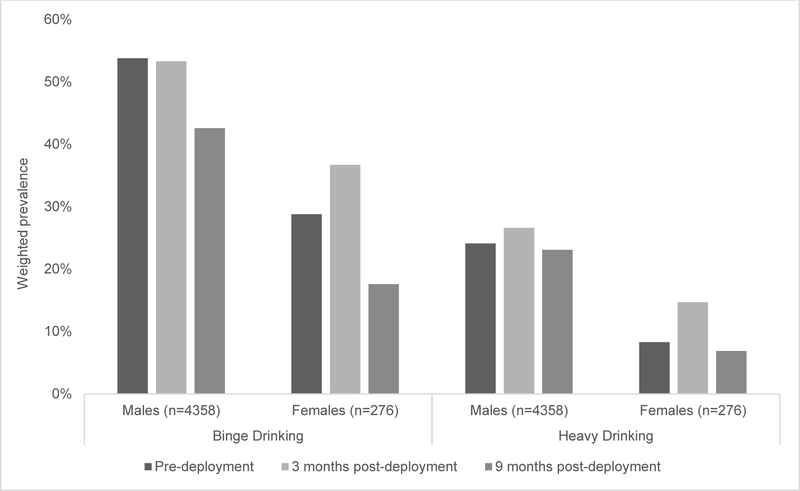
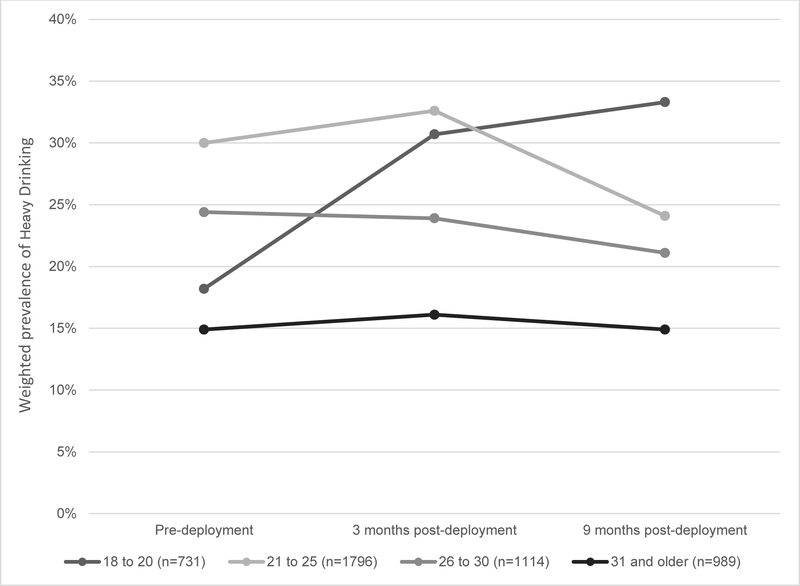
Results: Prevalence of past-month HD at T0, T2, and T3 was 23.3% (s.e. = 0.7%), 26.1% (s.e. = 0.8%), and 22.3% (s.e. = 0.7%); corresponding estimates for any binge drinking (BD) were 52.5% (s.e. = 1.0%), 52.5% (s.e. = 1.0%), and 41.3% (s.e. = 0.9%). Greater personal life stress during deployment (e.g., relationship, family, or financial problems) - but not combat stress - was associated with new onset of HD at T2 [per standard score increase: adjusted odds ratio (AOR) = 1.20, 95% CI 1.06-1.35, p = 0.003]; incidence of AUD/SUD at T2 (AOR = 1.54, 95% CI 1.25-1.89, p < 0.0005); and persistence of AUD/SUD at T2 and T3 (AOR = 1.30, 95% CI 1.08-1.56, p = 0.005). Any BD pre-deployment was associated with post-deployment onset of HD (AOR = 3.21, 95% CI 2.57-4.02, p < 0.0005) and AUD/SUD (AOR = 1.85, 95% CI 1.27-2.70, p = 0.001).
Conclusions: Alcohol misuse is common during the months preceding and following deployment. Timely intervention aimed at alleviating/managing personal stressors or curbing risky drinking might reduce risk of alcohol-related problems post-deployment.
Keywords: Alcohol-related disorders; binge drinking; life stress; military personnel; risk factors.
Conflict of interest statement
Conflict of Interest: Dr. Stein has in the past three years been a consultant for Actelion, Dart Neuroscience, Healthcare Management Technologies, Janssen, Oxeia Biopharmaceuticals, Pfizer, Resilience Therapeutics, and Tonix Pharmaceuticals. In the past 3 years, Dr. Kessler received support for his epidemiological studies from Sanofi Aventis; was a consultant for Johnson & Johnson Wellness and Prevention, Shire, Takeda; and served on an advisory board for the Johnson & Johnson Services Inc. Lake Nona Life Project. Kessler is a co-owner of DataStat, Inc., a market research firm that carries out healthcare research. The remaining authors have no financial disclosures.
Figures
References
-
- Bray RM, Brown JM & Williams J (2013). Trends in binge and heavy drinking, alcohol-related problems, and combat exposure in the U.S. military. Substance Use & Misuse 48, 799–810. - PubMed
-
- Fink DS, Calabrese JR, Liberzon I, Tamburrino MB, Chan P, Cohen GH, Sampson L, Reed PL, Shirley E, Goto T, D’Arcangelo N, Fine T & Galea S (2016). Retrospective age-of-onset and projected lifetime prevalence of psychiatric disorders among U.S. Army National Guard soldiers. Journal of Affective Disorders 202, 171–7. - PMC - PubMed
Publication types
MeSH terms
Grants and funding
LinkOut - more resources
Full Text Sources
Other Literature Sources
Medical
Miscellaneous
