Rivaroxaban attenuates thrombosis by targeting the NF-κB signaling pathway in a rat model of deep venous thrombus
- PMID: 29039441
- PMCID: PMC5716436
- DOI: 10.3892/ijmm.2017.3166
Rivaroxaban attenuates thrombosis by targeting the NF-κB signaling pathway in a rat model of deep venous thrombus
Retraction in
-
[Retracted] Rivaroxaban attenuates thrombosis by targeting the NF-κB signaling pathway in a rat model of deep venous thrombus.Int J Mol Med. 2018 Jun;41(6):3736. doi: 10.3892/ijmm.2018.3565. Epub 2018 Mar 14. Int J Mol Med. 2018. PMID: 29568957 Free PMC article.
Abstract
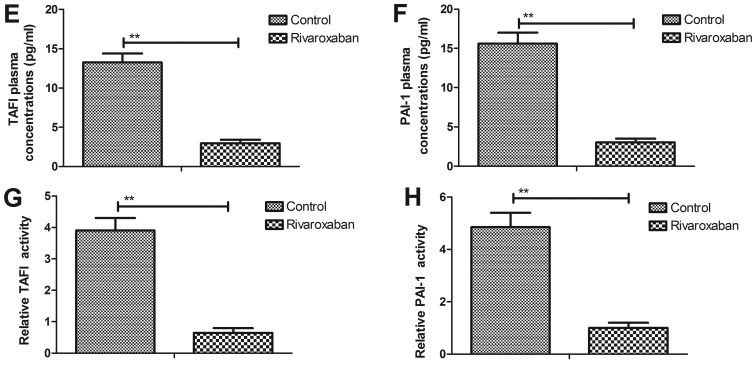
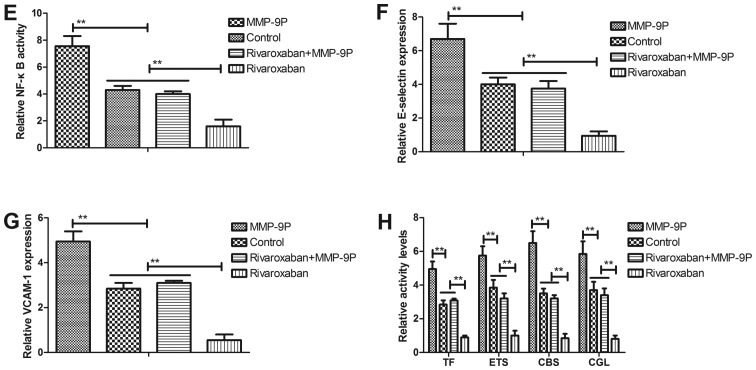
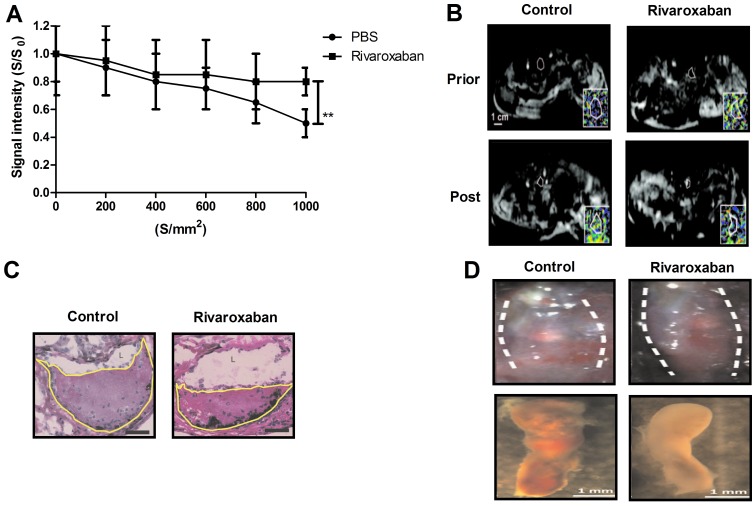
Anticoagulant therapy is commonly used for the prevention and treatment of patients with deep venous thrombus. Evidence has shown that rivaroxaban is a potential oral anticoagulant drug for the acute treatment of venous thromboembolism. However, the rivaroxaban-mediated molecular mechanism involved in the progression of deep venous thrombosis has not been investigated. In the present study, we investigated the efficacy of rivaroxaban and the underlying signaling pathways in the prevention and treatment of rats with deep venous thrombosis. A rat model with deep vein thrombus formation was established and received treatment with rivaroxaban or PBS as control. The thrombin-activatable fibrinolysis inhibitor (TAFI) and plasminogen activator inhibitor-1 (PAI-1) were analyzed both in vitro and in vivo. The progression of thrombosis and stroke was evaluated after treatment with rivaroxaban or PBS. Nuclear factor-κB (NF-κB) signaling pathway in venous endothelial cells and in the rat model of deep venous thrombus was assessed. The therapeutic effects of rivaroxaban were evaluated as determined by changes in deep venous thrombosis in the rat model. Our results showed that rivaroxaban markedly inhibited TAFI and PAI-1 expression levels, neutrophils, tissue factor, neutrophil extracellular traps (NETs), myeloperoxidase and macrophages in venous endothelial cells and in the rat model of deep venous thrombus. Expression levels of ADP, PAIs, von Willebrand factor (vWF) and thromboxane were downregulated in vein endothelial cells and in serum from the experimental rats. Importantly, the incidences of inferior vena cava filter thrombus were protected by rivaroxaban during heparin-induced thrombolysis deep venous thrombosis in the rat model. We observed that activity of the NF-κB signaling pathway was inhibited by rivaroxaban in vein endothelial cells both in vitro and in vivo. Notably, immunohistology indicated that rivaroxaban attenuated deep venous thrombosis and the accumulation of inflammatory factors in the lesions in venous thrombus. Matrix metalloproteinase (MMP) expression and activity were downregulated in rivaroxaban-treated rats with deep venous thrombus. Rivaroxaban inhibited the elasticity of the extracellular matrix and collagen-elastin fibers. On the whole, these results indicate that rivaroxaban attenuates deep venous thrombus through MMP-9-mediated NF-κB signaling pathway.
Figures




References
-
- Meissner MH, Gloviczki P, Comerota AJ, Dalsing MC, Eklof BG, Gillespie DL, Lohr JM, McLafferty RB, Murad MH, Padberg F, et al. Society for Vascular Surgery. American Venous Forum Early thrombus removal strategies for acute deep venous thrombosis: Clinical practice guidelines of the Society for Vascular Surgery and the American Venous Forum. J Vasc Surg. 2012;55:1449–1462. doi: 10.1016/j.jvs.2011.12.081. - DOI - PubMed
-
- Santin BJ, Lohr JM, Panke TW, Neville PM, Felinski MM, Kuhn BA, Recht MH, Muck PE. Venous duplex and pathologic differences in thrombus characteristics between de novo deep vein thrombi and endovenous heat-induced thrombi. J Vasc Surg Venous Lymphat Disord. 2015;3:184–189. doi: 10.1016/j.jvsv.2014.08.004. - DOI - PubMed
Publication types
MeSH terms
Substances
LinkOut - more resources
Full Text Sources
Other Literature Sources
Medical
Research Materials
Miscellaneous