


Is patient empowerment the key to promote adherence? A systematic review of the relationship between self-efficacy, health locus of control and medication adherence
- PMID: 29040335
- PMCID: PMC5645121
- DOI: 10.1371/journal.pone.0186458
Is patient empowerment the key to promote adherence? A systematic review of the relationship between self-efficacy, health locus of control and medication adherence
Abstract
Background: Current health policies emphasize the need for an equitable doctor-patient relationship, and this requires a certain level of patient empowerment. However, a systematic review of the empirical evidence on how empowerment affects medication adherence-the extent to which patients follow the physician's prescription of medication intake-is still missing. The goal of this systematic review is to sum up current state-of-the-art knowledge concerning the relationship between patient empowerment and medication adherence across medical conditions. As our conceptualization defines health locus of control and self-efficacy as being crucial components of empowerment, we explored the relationship between these two constructs and medication adherence.
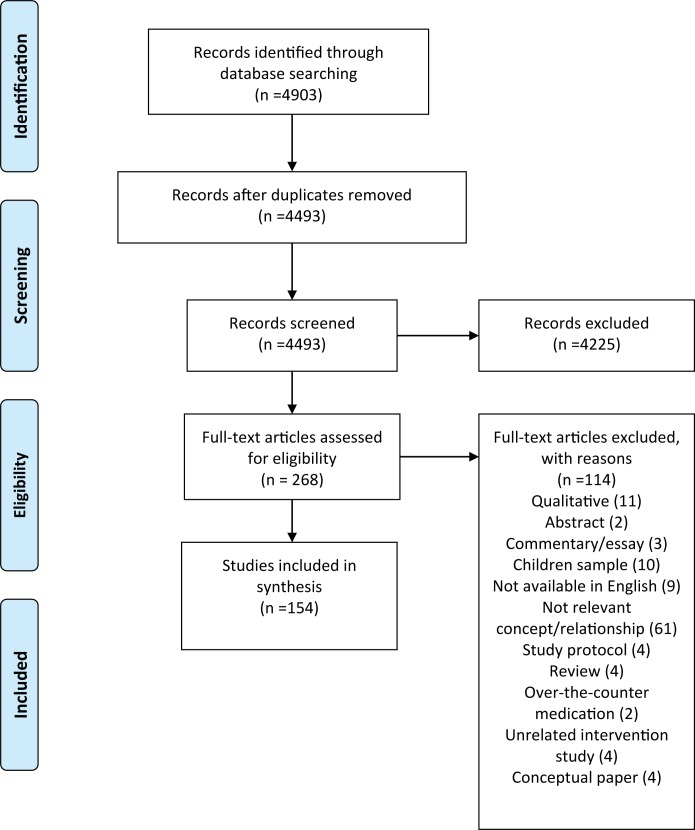
Methods: Relevant studies were retrieved through a comprehensive search of Medline and PsychINFO databases (1967 to 2017). In total, 4903 publications were identified. After applying inclusion and exclusion criteria and quality assessment, 154 articles were deemed relevant. Peer-reviewed articles, written in English, addressing the relationship between empowerment (predictor) and medication adherence (outcome) were included.
Findings: High levels of self-efficacy and Internal Health Locus of Control are consistently found to promote medication adherence. External control dimensions were found to have mainly negative (Chance and God attributed control beliefs) or ambiguous (Powerful others attributed control beliefs) links to adherence, except for Doctor Health Locus of Control which had a positive association with medication adherence. To fully capture how health locus of control dimensions influence medication adherence, the interaction between the sub-dimensions and the attitudinal symmetry between the doctor and patient, regarding the patient's control over the disease management, can provide promising new alternatives.
Discussion: The beneficial effect of patients' high internal and concurrent physician-attributed control beliefs suggests that a so-called "joint empowerment" approach can be suitable in order to foster medication adherence, enabling us to address the question of control as a versatile component in the doctor-patient relationship.
Conflict of interest statement
Figures
References
-
- Brown MT, Bussell JK. Medication adherence: WHO cares? Mayo Clin Proc. 2011;86:304–14. doi: 10.4065/mcp.2010.0575 - DOI - PMC - PubMed
-
- De Geest S, Sabaté E. Adherence to long-term therapies: Evidence for action. Eur J Cardiovasc Nurs. 2003;2:323 doi: 10.1016/S1474-5151(03)00091-4 - DOI - PubMed
-
- McHorney CA, Zhang NJ, Stump T, Zhao X. Structural equation modeling of the proximal-distal continuum of adherence drivers. Patient Prefer Adherence. 2012;6:789–804. doi: 10.2147/PPA.S36535 - DOI - PMC - PubMed
-
- Tibaldi G, Clatworthy J, Torchio E, Argentero P, Munizza C, Horne R. The utility of the Necessity—Concerns Framework in explaining treatment non-adherence in four chronic illness groups in Italy. Chronic Illn. 2009;5:129–33. doi: 10.1177/1742395309102888 - DOI - PubMed
-
- Rappaport J. Terms of empowerment/exemplars of prevention: Toward a theory for community psychology. Am J Community Psychol. 1987;15(2):121–48. - PubMed
Publication types
MeSH terms
LinkOut - more resources
Full Text Sources
Other Literature Sources
Medical
Research Materials
