. 2017 Dec 15;26(24):4873-4885.
doi: 10.1093/hmg/ddx367.

Mutation-specific downregulation of CFTR2 variants by gating potentiators

Affiliations

Mutation-specific downregulation of CFTR2 variants by gating potentiators

Radu G Avramescu et al. Hum Mol Genet. .

Abstract

Approximately 50% of cystic fibrosis (CF) patients are heterozygous with a rare mutation on at least one allele. Several mutants exhibit functional defects, correctable by gating potentiators. Long-term exposure (≥24 h) to the only available potentiator drug, VX-770, leads to the biochemical and functional downregulation of F508del-CFTR both in immortalized and primary human airway cells, and possibly other CF mutants, attenuating its beneficial effect. Based on these considerations, we wanted to determine the effect of chronic VX-770 exposure on the functional and biochemical expression of rare CF processing/gating mutants in human airway epithelia. Expression of CFTR2 mutants was monitored in the human bronchial epithelial cell line (CFBE41o-) and in patient-derived conditionally reprogrammed bronchial and nasal epithelia by short-circuit current measurements, cell surface ELISA and immunoblotting in the absence or presence of CFTR modulators. The VX-770 half-maximal effective (EC50) concentration for G551D-CFTR activation was ∼0.63 μM in human nasal epithelia, implying that comparable concentration is required in the lung to attain clinical benefit. Five of the twelve rare CFTR2 mutants were susceptible to ∼20-70% downregulation by chronic VX-770 exposure with an IC50 of ∼1-20 nM and to destabilization by other investigational potentiators, thereby diminishing the primary functional gain of CFTR modulators. Thus, chronic exposure to VX-770 and preclinical potentiators can destabilize CFTR2 mutants in human airway epithelial models in a mutation and compound specific manner. This highlights the importance of selecting potentiator drugs with minimal destabilizing effects on CF mutants, advocating a precision medicine approach.


Figures

Figure 1.
Figure 1.
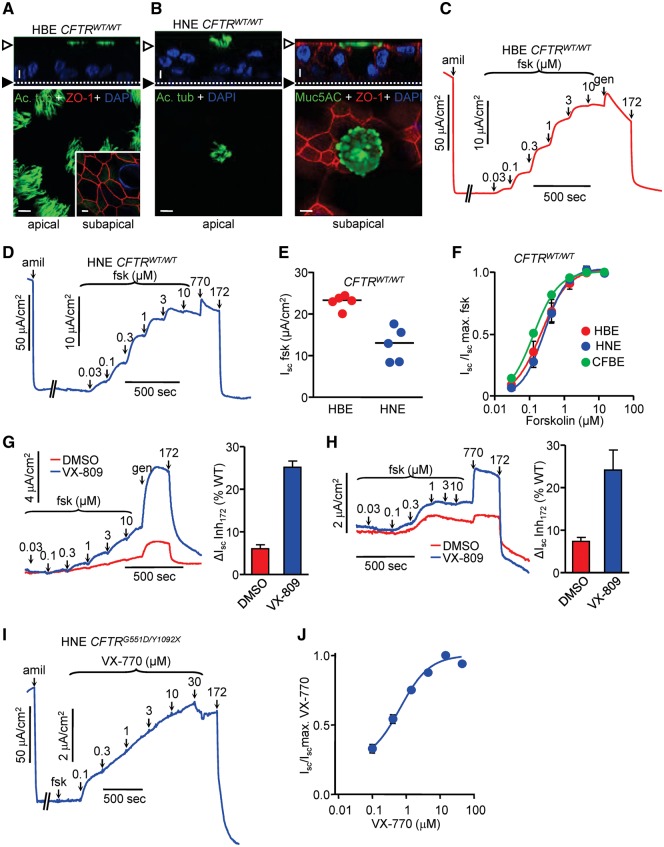
Conditionally reprogrammed (CR) HNE and HBE have similar functional and morphological characteristics. (A,B) HBE and HNE with CFTRWT/WT genotype were expanded using CR, followed by differentiation on filter supports under ALI culture for ≥ 4 weeks. Representative laser confocal immunofluorescence micrographs are shown for HBE (A) and HNE (B). Epithelia were immunostained with goblet cell marker mucin5AC (green), ciliated cell marker acetylated tubulin (green) and tight junctional protein zonula occludens-1 (red). Nuclei were stained with DAPI. Top is the transverse (xz) plane and bottom is the frontal (xy) plane. (A) and (B, left) show the apical level; (A, insert) and (B, right) show the subapical level. Along the z-axis, the empty arrowheads and filled arrowheads indicate the apical and basal PM, respectively. Size bar is 10 µm. (C,D) Representative short-circuit current (Isc) traces for HBE (C) and HNE (D), with CFTRWT/WT genotype. After ENaC inhibition with amiloride (amil, 100 µM), WT-CFTR was stimulated by forskolin (fsk) titration and genistein (gen, 50 μM) or VX-770 (770, 10 µM), followed by specific inhibition of CFTR with CFTRinh-172 (172, 20 μM). Measurements were performed with equimolar chloride concentrations in both chambers (C) or in presence of a basolateral-to-apical chloride gradient (D). (E) Maximal forskolin response of HBE and HNE each from 5 CFTRWT/WT donors. (F) Dose-response to forskolin stimulation of HBE (EC50 = 0.22 µM), HNE (EC50 = 0.27 µM), each from 5 CFTRWT/WT donors and WT-CFTR overexpressing CFBE (EC50 = 0.13 µM). (G,H) HBE (G) and HNE (H) with CFTRΔF508/ΔF508 genotype were expanded and differentiated as described, followed by treatment with VX-809 (3 µM) for 24 h. Isc of ΔF508-CFTR was stimulated as in (C) and measurements were performed with equimolar chloride concentrations in both chambers (G) or in presence of a basolateral-to-apical chloride gradient (H). Bar graphs show maximal forskolin + potentiator responses of HBE and HNE from 3 CFTRΔF508/ΔF508 donors each as percentage of the respective WT controls. (I) HNE with CFTRG551D/Y1092X genotype were expanded and differentiated as described. Isc of G551D-CFTR was stimulated by forskolin (20 μM) and VX-770 titration, followed by CFTR inhibition. Measurements were performed with equimolar chloride concentrations in both chambers. (J) Dose-response to VX-770 stimulation of HNE (EC50 = 0.63 ±0.07 µM) with CFTRG551D/Y1092X genotype. Unless otherwise specified, all experiments are n = 3; error bars are SEM.
Figure 2.
Figure 2.
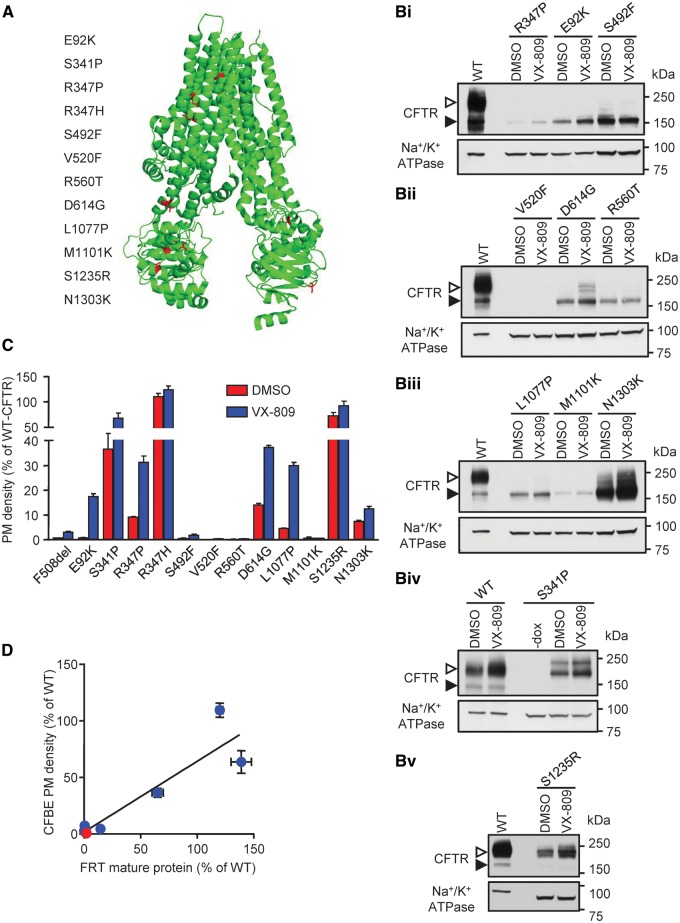
Biochemical analysis of selected CFTR2 processing/gating mutants shows different levels of protein biogenesis. (A) Electron cryo-microscopy model (38) of human CFTR showing the positions of the selected CFTR2 mutations in red. (B) Immunoblot of CFBE expressing inducible CFTR mutants with an extracellular 3HA tag under the control of the TetON doxycycline (dox) regulated transactivator with or without (-) dox (500 ng/ml) induced expression for 3 days. The cells were incubated for 24 h with DMSO or VX-809 (3 μM). CFTR was visualized with anti-HA antibody, and anti–Na+/K+-ATPase antibody served as loading control. The empty arrowheads show the mature, complex glycosylated CFTR (C-band), and the filled arrowhead show the immature, core glycosylated protein (B-band). (C) PM density measurements of CFTR2 mutant expression by cell-surface ELISA, with and without 24 h correction with VX-809 (3 μM). The PM density is expressed as % of WT DMSO treated cells. The expression was normalized to viability, determined by AlamarBlue assay and to CFTR mRNA expression, measured by RT-qPCR, to account for differences in cell seeding concentration and viral transduction/induction efficiency, respectively. (D) PM density, as shown in (B) correlated (R2 = 0.8593, P < 0.0001) to the mature protein (C-band) of CFTR mutants (F508del (red), CFTR2 mutants (blue)) expressed in FRT cells, published by Van Goor. (25). All experiments are n = 3; error bars are SEM.
Figure 3.
Figure 3.
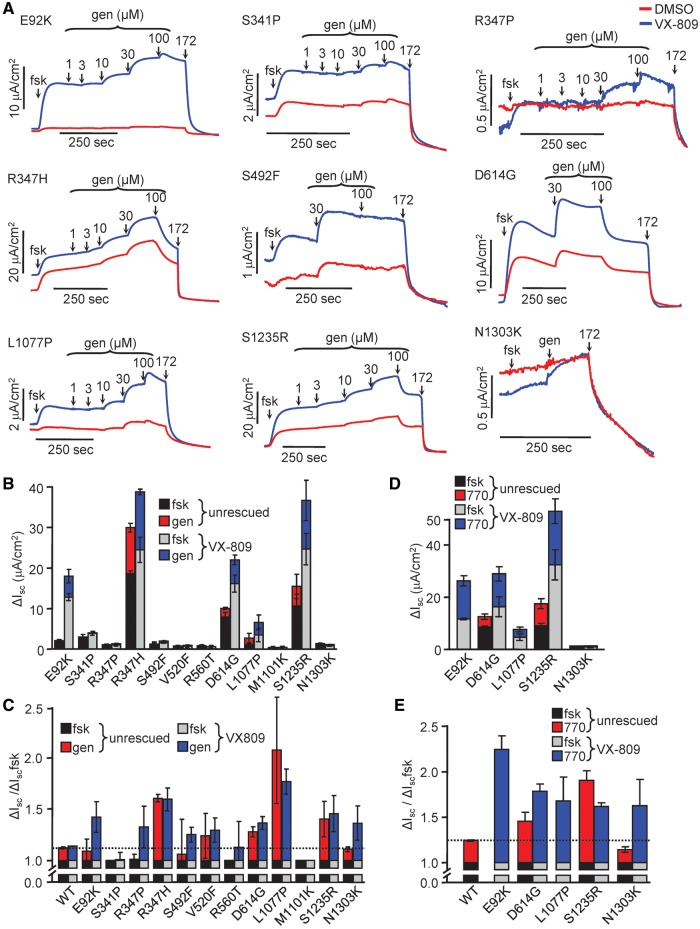
Functional analysis of CFTR2 mutants. (A) Representative Isc traces of CFBE cells expressing the indicated CFTR2 mutants. Cells grown on filter supports were incubated for 24 h with DMSO (red traces) or VX-809 (3 μM, blue traces). Isc of mutant CFTR was stimulated with forskolin (20 μM) and increasing concentrations of genistein until saturation, or a single high concentration of genistein (gen, 100 μM), followed by inhibition of CFTR with CFTRinh-172 (20 μM). Measurements were performed in the presence of a basolateral-to-apical chloride gradient after basolateral permeabilization with amphotericin B (100 μM). (B) Quantification of currents in (A); forskolin was measured relative to initial baseline; genistein was measured relative to fsk plateau. (C) Normalization of data from B showing fold increase of Isc in the presence of forskolin plus genistein relative to that in the presence of forskolin alone. Dotted line is relative genistein response of WT-CFTR. (D) Quantification of CFTR2 Isc potentiated with VX-770 (3 μM). Forskolin was measured relative to initial baseline; VX-770 was measured relative to fsk. (E) Normalization of data from D as described in C to display VX-770 effect relative to forskolin. Dotted line is relative VX-770 response of WT-CFTR. All experiments are n = 3; error bars are SEM.
Figure 4.
Figure 4.
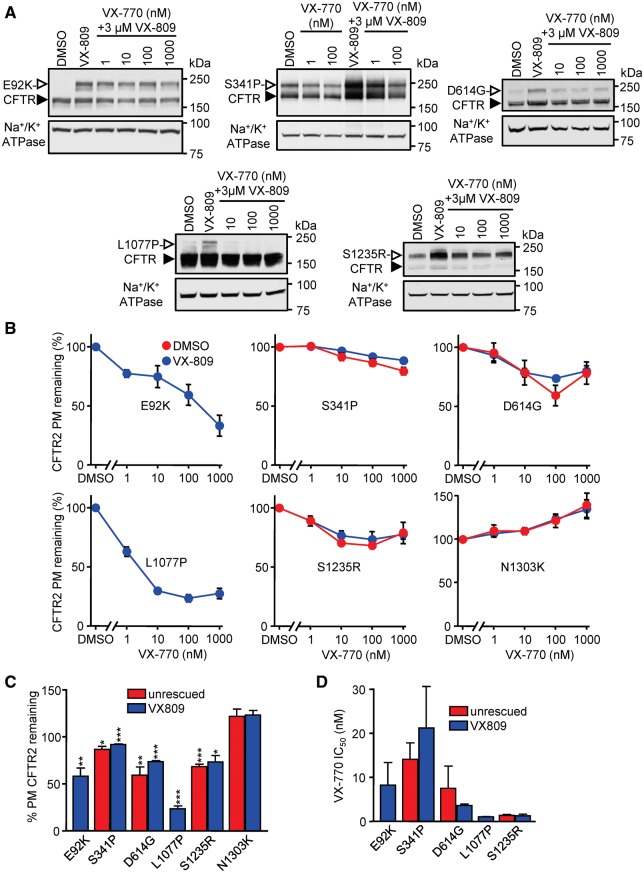
Extended exposure to VX-770 leads to downregulation of a subset of CFTR mutants in a dose-dependent manner. (A) CFBE cells expressing the indicated CFTR mutants were incubated for 24 h with VX-809 (3 μM) and increasing concentrations of VX-770 and subsequently lysed to collect protein samples. Protein was detected by immunoblotting with anti-HA antibody. Na+/K+ ATPase was used as loading control. The empty arrowheads show the mature, complex glycosylated CFTR protein (C-band), and the filled arrowhead show the immature, core glycosylated protein (B-band). (B) PM density of CFTR2 mutants expressed in CFBE cells. Cells were treated with VX-770 for 24 h in the presence or absence of 3 µM VX-809, and the values, normalized with cell viability, are expressed as percentage of non–VX-770-treated controls (n = 3). (C) Quantification of remaining CFTR2 PM density, shown in B, after chronic treatment with 100 nM VX-770, as percent of DMSO control. Half maximal inhibitory concentration (IC50) of VX-770 on PM expression of CFTR2 mutants, calculated on the basis of the measurements shown in panel B. Experiments in B, C and D are n = 3; error bars are SEM. *P < 0.05, **P < 0.01, ***P < 0.001.
Figure 5.
Figure 5.
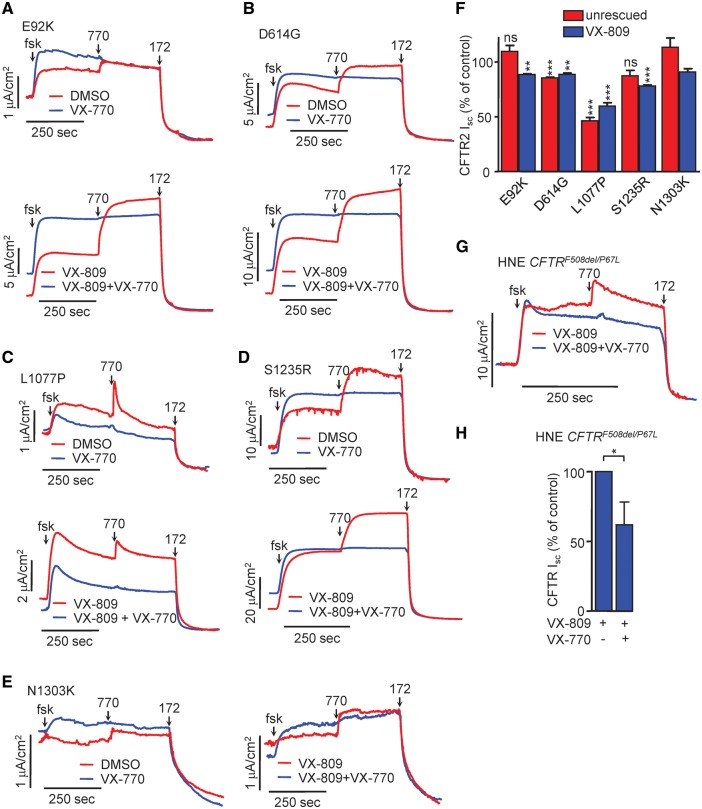
Long-term treatment with VX-770 leads to CFTR2 mutant functional downregulation in CFBE and HNE. (A–E) Representative Isc traces of CFBE cells expressing the indicated CFTR2 mutants under the control of the TetON inducible promoter. Polarized CFBE were incubated for 24 h with DMSO or VX-770 (100 nM, top), VX-809 (3 μM) or VX-809 + VX-770 combination (bottom). Isc of mutant CFTR was stimulated with forskolin (20 μM) and VX-770 (3 μM) and measurements were performed in the presence of a basolateral-to-apical chloride gradient after basolateral permeabilization with Amphotericin B (100 μM). (F) Quantification of maximal currents expressed as % of DMSO control for each mutant. The currents were measured as the difference between maximal induced by VX-770 and the baseline current after CFTRinh-172 addition. (G) HNE with CFTRF508del/P67L genotype were expanded and differentiated as described, followed by treatment with VX-809 (3 µM) and VX-770 (1 μM) for 24 h. Isc of CFTR was stimulated by forskolin (20 μM) and VX-770 (10 μM), followed by CFTR inhibition with CFTRinh-172 (20 μM). Measurements were performed in the presence of a basolateral-to-apical chloride gradient. (H) Quantification of maximal currents expressed as % of control. All experiments are n = 3; error bars are SEM; ns: not significant, *P < 0.05, **P < 0.01, ***P < 0.001.
Figure 6.
Figure 6.
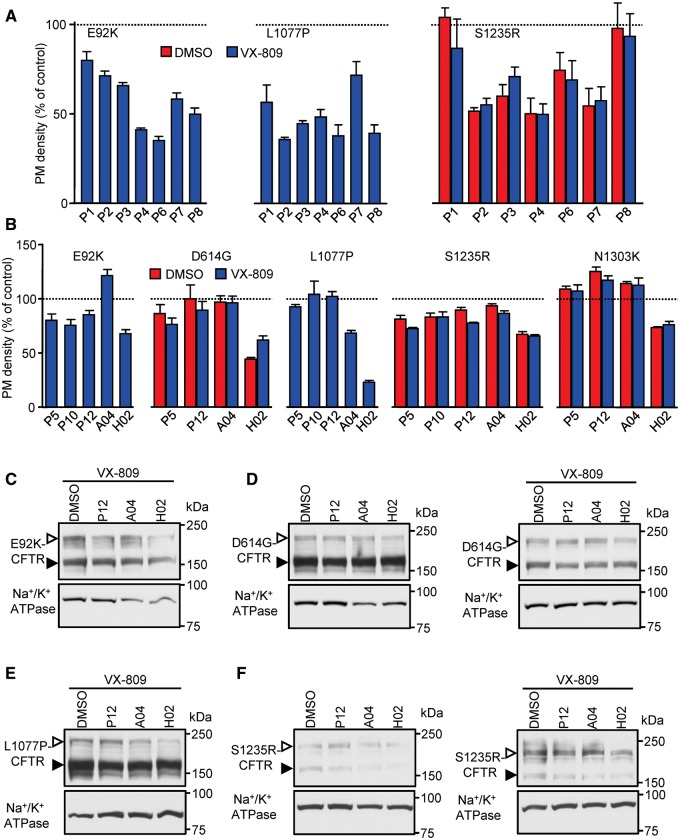
Other classes of potentiators have widely varying effects on CFTR2 mutant expression. (A) PM densities of CFTR2 mutants expressed in CFBE cells after 24 h treatment with potentiators from the CFFT panel that downregulate F508del expression (22), with and without VX-809 (3 μM). Potentiators were used at the following concentrations: P2, P3—3 µM; P8—20 µM; P1, P4, P7–30 µM, P6–100 µM. The PM densities were normalized for cell viability and are expressed as % of DMSO control (dotted line). (B) Cell surface expression of CFBE cells expressing a subset of CFTR2 mutants performed after 24 h incubation with P5, P10, P12, A04 or H02 (10 μM), five potentiators that do not downregulate F508del-CFTR (42). The dotted line represents the expression in DMSO treated cells. (C) Immunoblots of CFBE cells expressing the indicated CFTR mutants after incubation for 24 h with P12, A04 or H02 (10 μM), with and without VX-809 (3 μM). CFTR was detected with anti-HA antibody, Na+/K+ ATPase served as loading control. The empty arrowheads show the mature, complex glycosylated CFTR protein (C-band), and the filled arrowhead show the immature, core glycosylated protein (B-band). All experiments are n = 3; error bars are SEM.
Figure 7.
Figure 7.
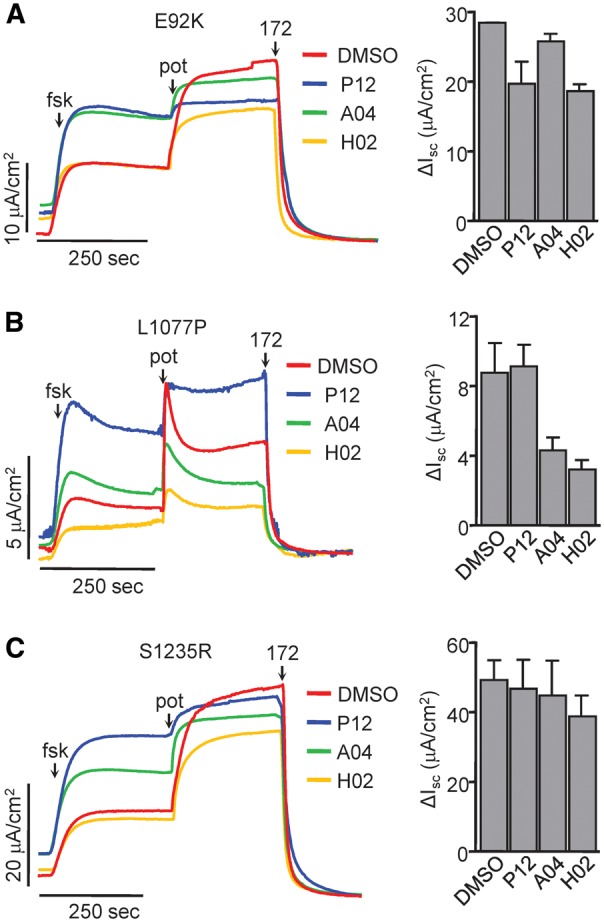
Identification of non-downregulating potentiators with efficacy similar to VX-770. (A–C,left) Representative Isc traces of polarized CFBE cells expressing the indicated CFTR2 mutants. The cells were incubated for 24 h with VX-809 (3 μM, red traces) with and without 10 μM P12 (blue), A04 (green) or H02 (yellow). Isc of mutant CFTR was stimulated with forskolin (20 μM) and 10 μM of the respective long-term treatment potentiator. Non-potentiator pre-treated cells were stimulated with 3 μM VX-770. CFTR was inhibited with CFTRinh-172 (20 μM). Measurements were performed in the presence of a basolateral-to-apical chloride gradient after basolateral permeabilization with amphotericin B (100 μM). (A–C, right) Quantification of maximal currents performed similarly as in Fig. 5 F. All experiments are n = 2, error bars are SEM.

References

    1. Rowe S.M., Miller S., Sorscher E.J. (2005) Cystic fibrosis. N. Engl. J. Med., 352, 1992–2001. - PubMed
    1. Cutting G.R. (2015) Cystic fibrosis genetics: from molecular understanding to clinical application. Nat. Rev. Genet., 16, 45–56. - PMC - PubMed
    1. Riordan J.R. (2008) CFTR function and prospects for therapy. Annu. Rev. Biochem., 77, 701–726. - PubMed
    1. CFTR2 Database. Available: http://www.cftr2.org; date last accessed September 27, 2017.
    1. Cystic Fibrosis Mutation Database. Available: http://www.genet.sickkids.on.ca/app; date last accessed September 27, 2017.

Publication types

MeSH terms