


Cultural determinants influence assisted reproduction usage in Europe more than economic and demographic factors
- PMID: 29040579
- PMCID: PMC5850226
- DOI: 10.1093/humrep/dex298
Cultural determinants influence assisted reproduction usage in Europe more than economic and demographic factors
Abstract
Study question: To what extent do financial, demographic and cultural determinants explain the vast cross-national differences in ART treatments in Europe?
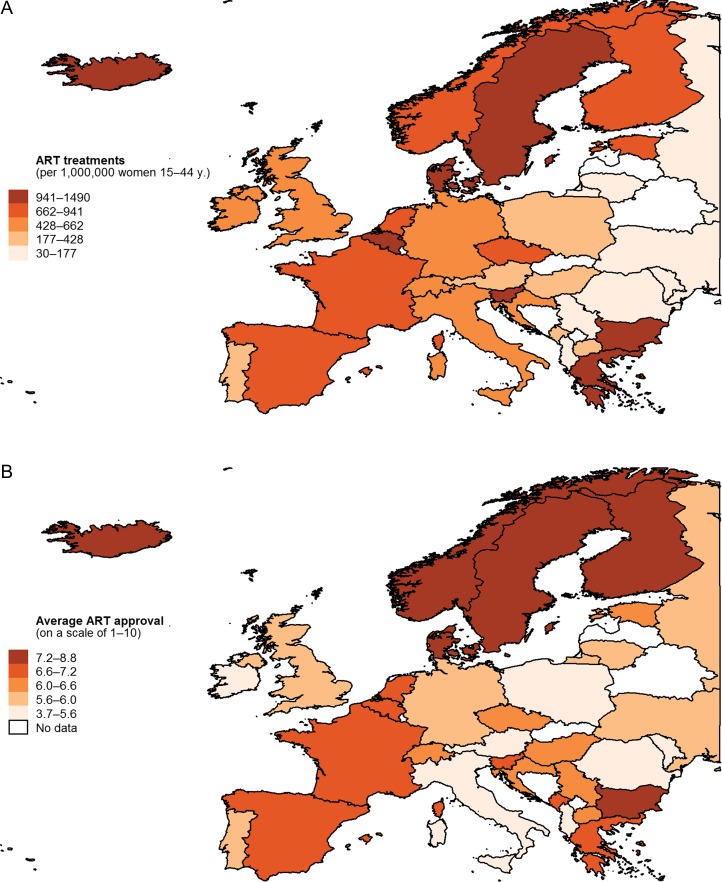
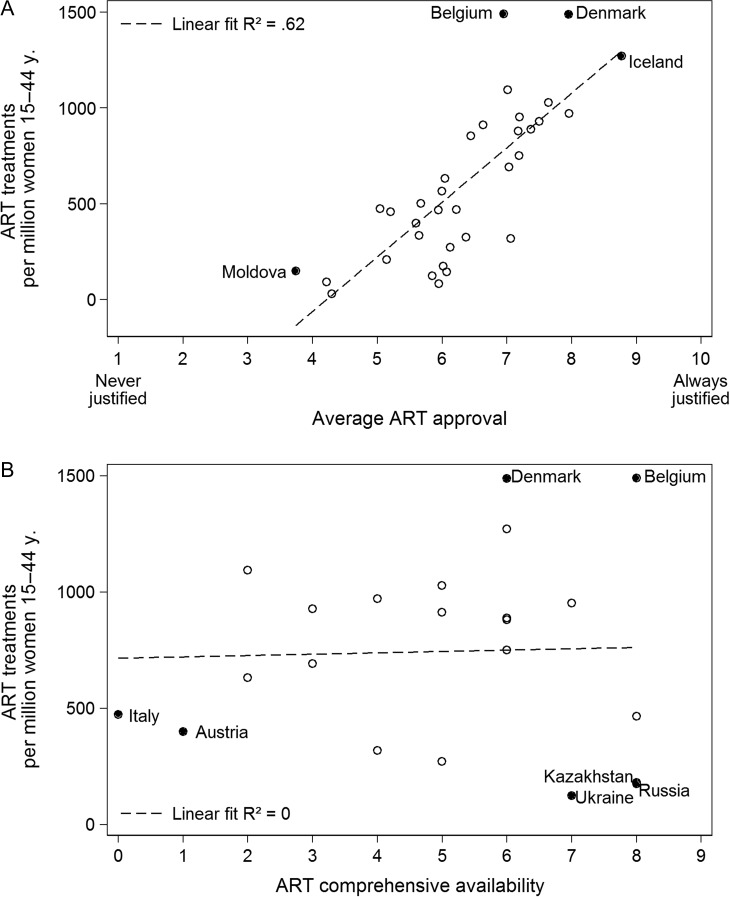
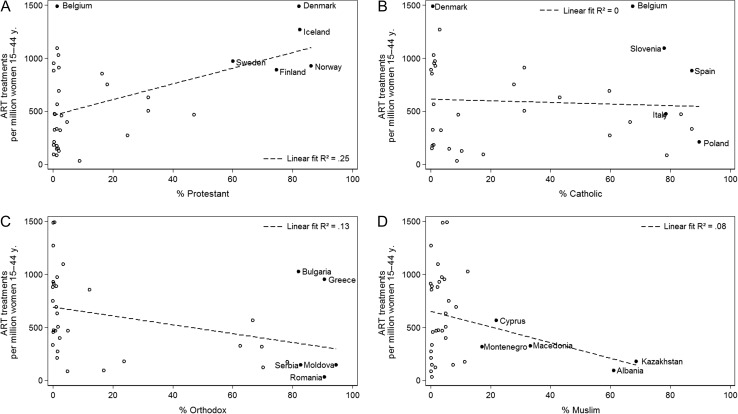
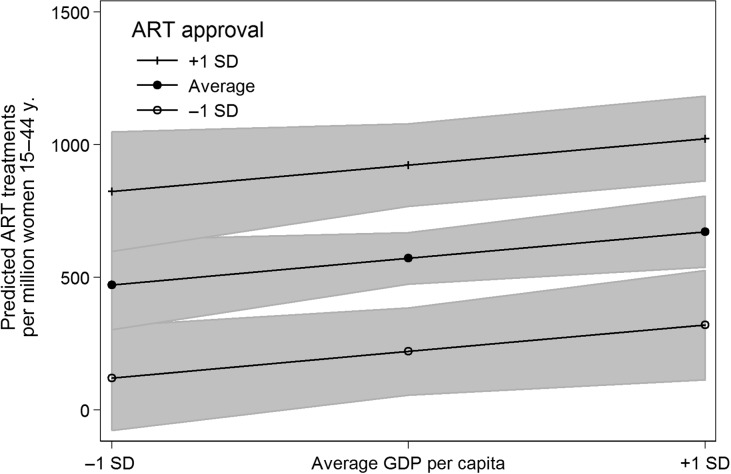
Summary answer: The normative cultural acceptance of ART is a major driver of ART treatments in Europe, above and beyond differences in country wealth, demographic aspects and religious composition.
What is known already: There are vast differences in the number of ART treatments across European countries, which are to some extent related to country affluence, regulation, and insurance coverage and costs. The role and impact of cultural and normative factors has not been explored in a larger cross-national comparison.
Study design, size, duration: A descriptive and comparative cross-national analysis of ART treatment prevalence in over 30 European countries in 2010, with the outcome defined as the total number of ART cycles per million women of reproductive age (15-44 years). Data is drawn from multiple sources (ICMART, US Census Bureau Library, World Bank, Barro-Lee Educational Attainment Dataset, IFFS Surveillance reports, European Values Study and World Religion Database).
Participants/materials, setting, methods: Our sample includes data from 35 European countries, where we describe the associations between demographic and cultural factors and the prevalence of ART treatments. Bivariate correlation and ordinary least squares multiple regression analysis serves to establish the relationships between predictor variables and the number of ART treatments per million women aged 15-44 years in a country.
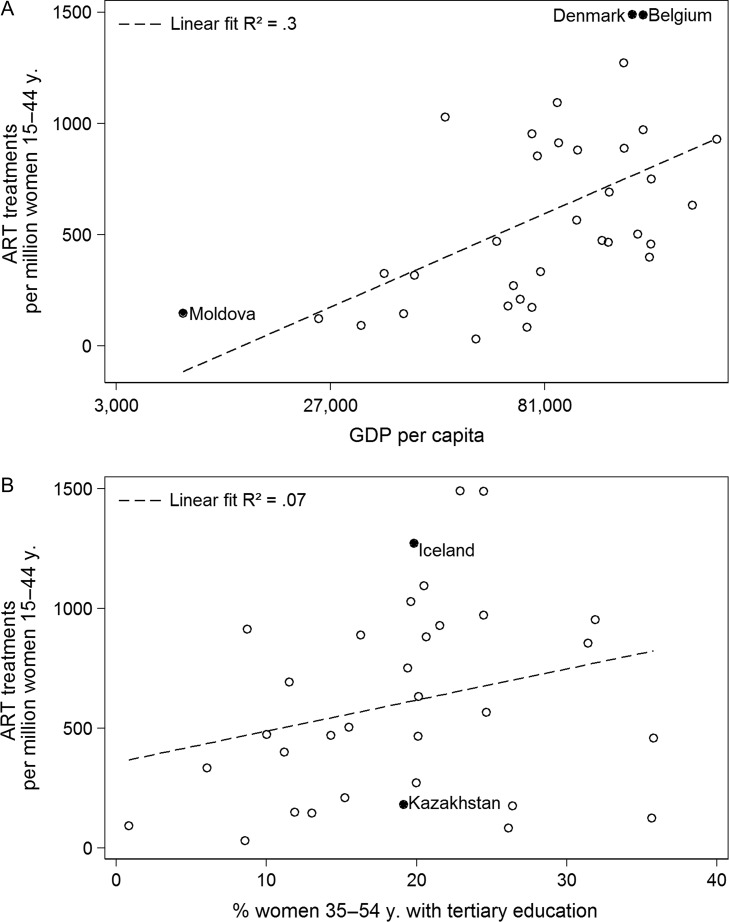
Main results and the role of chance: A one-percent increase in national GDP is associated with 382 (95% CI: 177-587) additional ART procedures per million women of reproductive age, yet this effect is reduced to 99 (-92 to 290) treatments once cultural values and demographic factors are accounted for. In our fully adjusted model, normative cultural values measuring the acceptability of ART are the strongest predictor of ART usage, with a one-point increase of average approval in a country associated with 276 (167-385) additional ART treatments per million women of reproductive age.
Limitations, reasons for caution: Findings are based on a cross-sectional, cross-national analysis, making formal tests of causality impossible and prohibiting inferences to the individual level.
Wider implications of the findings: Results indicate that reproductive health policy should openly acknowledge the importance of cultural norms in informally shaping and regulating the wider availability of ART treatment.
Study funding/competing interest(s): Funding for this project was provided by the European Union's Seventh Framework Program (FP7 2007-2013) (No. 320116 Families and Societies), European Research Council for the SOCIOGENOME Consolidator Grant (ERC-2013-CoG-615603) and the Wellcome Trust Institutional Strategic Support Fund (all to M.C.M.). The authors have no conflicts of interest to declare.
Trial registration number: N/A.
Keywords: ART; ART usage; Europe; demography; social norms.
© The Author 2017. Published by Oxford University Press on behalf of the European Society of Human Reproduction and Embryology.
Figures
References
-
- Adamson GD. Global cultural and socioeconomic factors that influence access to assisted reproductive technologies. Women's Health 2009;5:351–358. doi:10.2217/whe.09.28. - DOI - PubMed
-
- Balbo N, Billari FC, Mills MC. Fertility in advanced societies. A review of research. Eur J Popul 2013;29:1–38. doi:10.1007/s10680-012-9277-y. - DOI - PMC - PubMed
-
- Barbuscia A, Mills MC. Cognitive development in children up to age 11 years born after ART. A longitudinal cohort study. Hum Reprod 2017;32:1482–1488. doi:10.1093/humrep/dex102. - DOI - PMC - PubMed
-
- Barro RJ, Lee JW. A new data set of educational attainment in the world, 1950–2010. J Dev Econ 2013;104:184–198. doi:10.1016/j.jdeveco.2012.10.001. - DOI
-
- Benagiano G. Symposium: religion in assisted reproduction. Reprod Biomed Online 2008;17:6–8. doi:10.1016/S1472-6483(10)60324-0. - DOI - PubMed
MeSH terms
Grants and funding
LinkOut - more resources
Full Text Sources
Other Literature Sources
Medical
