


Pathways to increased coverage: an analysis of time trends in contraceptive need and use among adolescents and young women in Kenya, Rwanda, Tanzania, and Uganda
- PMID: 29041936
- PMCID: PMC5645984
- DOI: 10.1186/s12978-017-0393-3
Pathways to increased coverage: an analysis of time trends in contraceptive need and use among adolescents and young women in Kenya, Rwanda, Tanzania, and Uganda
Abstract
Background: Despite efforts to make contraceptive services more "youth friendly," unmet need for contraception among young women in sub-Saharan Africa remains high. For health systems to effectively respond to the reproductive health needs of a growing youth population, it is imperative to understand their contraceptive needs and service seeking practices. This paper describes changes over time in contraceptive need, use, and sources of care among young women in four East African countries.
Methods: We used three rounds of DHS data from Kenya, Rwanda, Tanzania, and Uganda to examine time trends from 1999 to 2015 in met need for modern contraception, method mix, and source of care by sector (public or private) and type of provider among young women aged 15-24 years. We assessed disparities in contraceptive coverage improvements over time between younger (15-24 years) and older women (25-49 years) using a difference-in-differences approach.
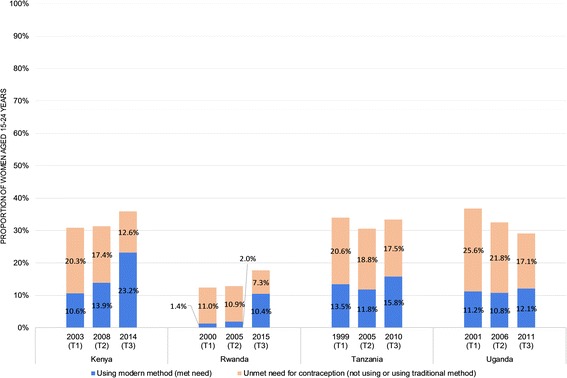
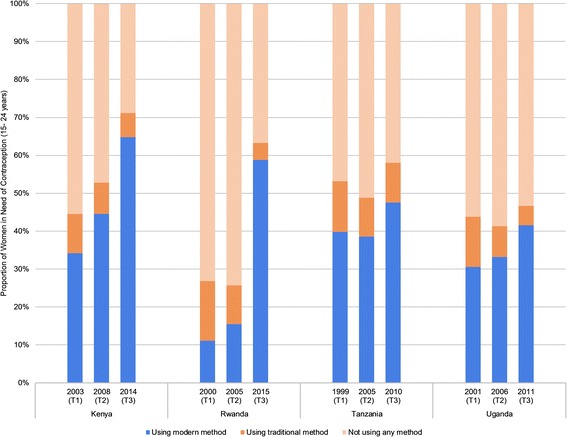
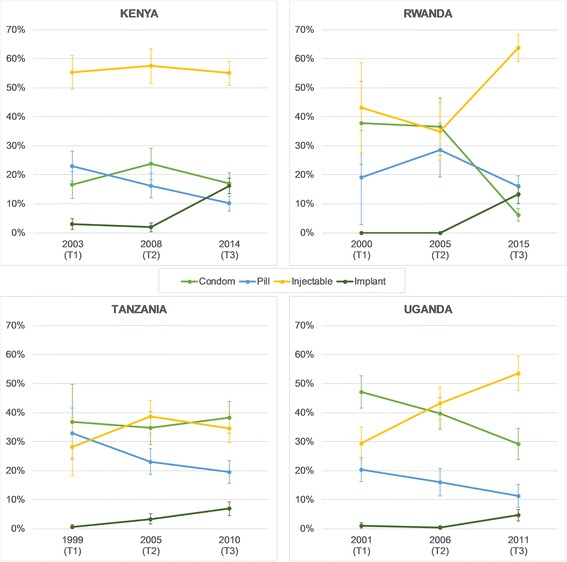
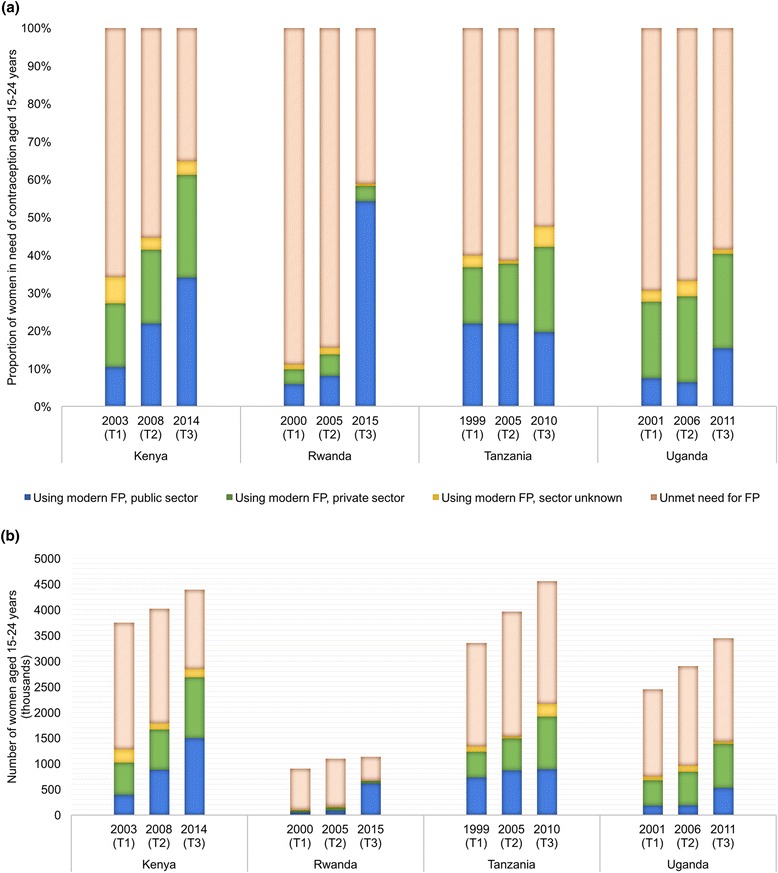
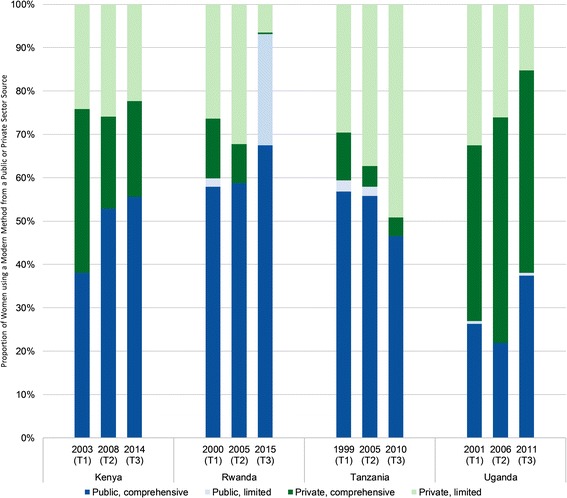
Results: Met need for contraception among women aged 15-24 years increased over time, ranging from a 20% increase in Tanzania to more than a 5-fold increase in Rwanda. Improvements in met need were greater among older women compared to younger women in Rwanda and Uganda, and higher among younger women in Kenya. Injectables have become the most popular contraceptive choice among young women, with more than 50% of modern contraceptive users aged 15-24 years currently using the method in all countries except for Tanzania, where condoms and injectables are used by 38% and 35% of young users, respectively. More than half of young women in Tanzania and Uganda receive contraceptives from the private sector; however, while the private sector played an important role in meeting the growing contraceptive needs among young women in Tanzania, increased use of public sector services drove expanded access in Kenya, Rwanda, and Uganda.
Conclusions: Our study shows that contraceptive use increased among young East African women, yet, unmet need remains high. As youth populations continue to grow, governments must develop more targeted strategies for expanding access to reproductive health services for young women. Engaging the private sector and task-shifting to lower-level providers offer promising approaches; however, additional research is needed to identify the key facilitators and barriers to the success of these strategies in different contexts.
Keywords: Adolescents; Contraception; Family planning; Kenya; Private sector; Rwanda; Tanzania; Uganda.
Conflict of interest statement
Ethics approval and consent to participate
This study used de-identified DHS data and aggregated population statistics. The DHS received government permission to conduct the surveys, obtained informed consent, and assured the confidentiality of participants’ responses. Ethical approval for the secondary analysis of these data was received from the Institutional Review Board at the London School of Hygiene and Tropical Medicine.
Consent for publication
Not applicable
Competing interests
The authors declare that they have no competing interests.
Publisher’s Note
Springer Nature remains neutral with regard to jurisdictional claims in published maps and institutional affiliations.
Figures
References
-
- Das Gupta M, Engelman R, Levy J, Luchsinger G, Merrick T, Rosen JE. State of world population 2014 the power of 1,8 billion adolescents, Youth and the Transformation of the Future. 2014.
-
- Patton GC, Sawyer SM, Santelli JS, Ross DA, Afifi R, Allen NB, Arora M, Azzopardi P, Baldwin W, Bonell C, Kakuma R, Kennedy E, Mahon J, McGovern T, Mokdad AH, Patel V, Petroni S, Reavley N, Taiwo K, Waldfogel J, Wickremarathne D, Barroso C, Bhutta Z, Fatusi AO, Mattoo A, Diers J, Fang J, Ferguson J, Ssewamala F, Viner RM. Our future: a lancet commission on adolescent health and wellbeing. Lancet. 2016;6736:3-57. - PMC - PubMed
-
- Campbell OMR, Benova L, Macleod D, Goodman C, Footman K, Pereira AL, Lynch CA. Who, what, where: an analysis of private sector family planning provision in 57 low- and middle-income countries. Trop Med Int Heal. 2015;0:1–18. - PubMed
-
- Edilberto L, Mengjia L. Adolescent pregnancy: a review of the evidence. 2013.
-
- Woog V, Singh S, Browne A, Philbin J: Adolescent Women’s need for and use of sexual and reproductive health Services in Developing Countries. New York: Guttmacher Institute; 2015.
MeSH terms
LinkOut - more resources
Full Text Sources
Other Literature Sources
Medical
Miscellaneous
