


Finnish physicians' stress related to information systems keeps increasing: a longitudinal three-wave survey study
- PMID: 29041971
- PMCID: PMC5646125
- DOI: 10.1186/s12911-017-0545-y
Finnish physicians' stress related to information systems keeps increasing: a longitudinal three-wave survey study
Abstract
Background: Poorly functioning, time-consuming, and inadequate information systems are among the most important work-related psychosocial factors causing stress in physicians. The present study examined the trend in the perceived stress that was related to information systems (SRIS) among Finnish physicians during a nine-year follow-up. In addition, we examined the associations of gender, age, employment sector, specialization status, leadership position, on-call burden, and time pressure with SRIS change and levels.
Methods: A longitudinal design with three survey data collection waves (2006, 2010 and 2015) based on a random sample of Finnish physicians in 2006 was used. The study sample included 1095 physicians (62.3% women, mean age 54.4 years) who provided data on SRIS in every wave. GLM repeated measures analyses were used to examine the associations between independent variables and the SRIS trend during the years 2006, 2010, and 2015.
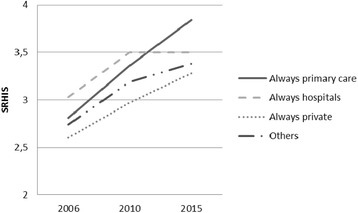
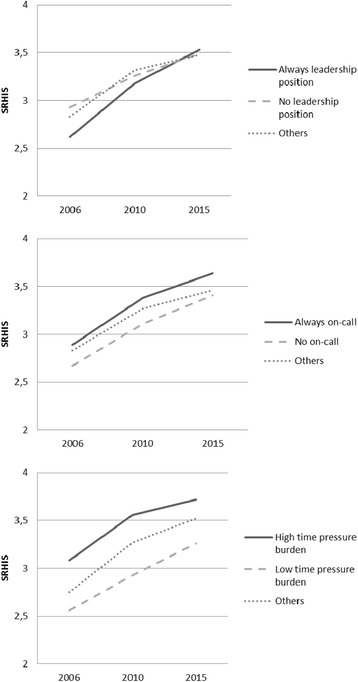
Results: SRIS increased during the study period. The estimated marginal mean of SRIS in 2006 was 2.80 (95% CI = 2.68-2.92) and the mean increase was 0.46 (95% CI = 0.30-0.61) points from 2006 to 2010 and 0.25 (95% CI = 0.11-0.39) points from 2010 to 2015. Moreover, our results show that the increase was most pronounced in primary care, whereas in hospitals SRIS did not increase between 2010 and 2015. SRIS increased more among those in a leadership position. On-call duties and high time-pressures were associated with higher SRIS levels during all waves.
Conclusions: Changing, difficult, and poorly functioning information systems (IS) are a prominent source of stress among Finnish physicians and this perceived stress continues to increase. Organizations should implement arrangements to ease stress stemming from IS especially for those with a high workload and on-call or leadership duties. To decrease IS-related stress, it would be important to study in more detail the main IS factors that contribute to SRIS. Earlier studies indicate that the usability and stability of information systems as well as end-user involvement in system development and work-procedure planning may be significant factors.
Keywords: Electronic health records; Information systems; Longitudinal research; Physicians; Stress.
Conflict of interest statement
Ethics approval and consent to participate
Ethical approval for the study was obtained from National Institute for Health and Welfare (former National Research and Development Centre for Welfare and Health). The respondents were asked their consent in the first wave in 2006. The survey script also reminded the participants that they were under no obligation to complete and/or submit the survey.
Consent for publication
Not applicable.
Competing interests
The authors declare that they have no competing interests.
Publisher’s Note
Springer Nature remains neutral with regard to jurisdictional claims in published maps and institutional affiliations.
Figures
References
-
- Töyry S, Räsänen K, Kujala S, Husman K, Juntunen J, Kalimo R, Luhtala R, Myllymäki K, Seuri M, Äärimaa M. Lääkärien työolot ja kuormittuneisuus -tutkimus [Physicians' working conditions and strain] Finn med J. 1999;18-19:2423–2430.
-
- Chong A, Killeen O, Clarke T. Work-related stress among paediatric non-consultant hospital doctors. Irish. Med J. 2004;97:203–205. - PubMed
-
- Dowell A, Hamilton S. Job satisfaction, psychological morbidity, and job stress among New Zealand general practitioners. New Zealand. Med J. 2000;113:269–272. - PubMed
-
- Vänskä J, Viitanen J, Hyppönen H, Elovainio M, Winblad I, Reponen J, Lääveri T. Lääkärien arviot potilastietojärjestelmistä kriittisiä [doctors critical of electronic patient record systems] Finn Med J. 2010;50-52:4177–4183.
MeSH terms
LinkOut - more resources
Full Text Sources
Other Literature Sources
Medical
Miscellaneous
