


Optimal blood pressure during cardiopulmonary bypass defined by cerebral autoregulation monitoring
- PMID: 29042040
- PMCID: PMC5685671
- DOI: 10.1016/j.jtcvs.2017.04.091
Optimal blood pressure during cardiopulmonary bypass defined by cerebral autoregulation monitoring
Abstract
Objectives: We sought to define the lower and upper limits of cerebral blood flow autoregulation and the optimal blood pressure during cardiopulmonary bypass. We further sought to identify variables predictive of these autoregulation end points.
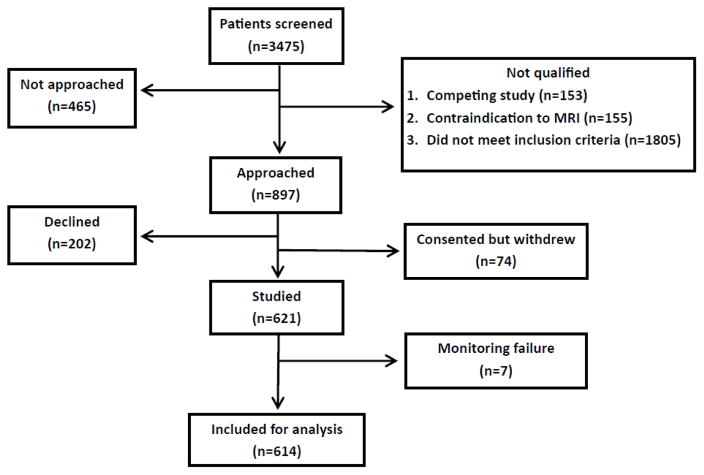
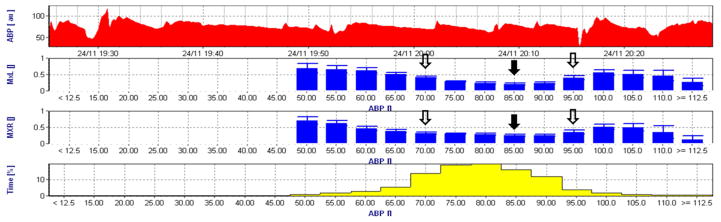
Methods: Cerebral autoregulation was monitored continuously with transcranial Doppler in 614 patients during cardiopulmonary bypass enrolled in 3 investigations. A moving Pearson's correlation coefficient was calculated between cerebral blood flow velocity and mean arterial pressure to generate the variable mean velocity index. Optimal mean arterial pressure was defined as the mean arterial pressure with the lowest mean velocity index indicating the best autoregulation. The lower and upper limits of cerebral blood flow autoregulation were defined as the mean arterial pressure at which mean velocity index was increasingly pressure passive (ie, mean velocity index ≥0.4) with declining or increasing blood pressure, respectively.
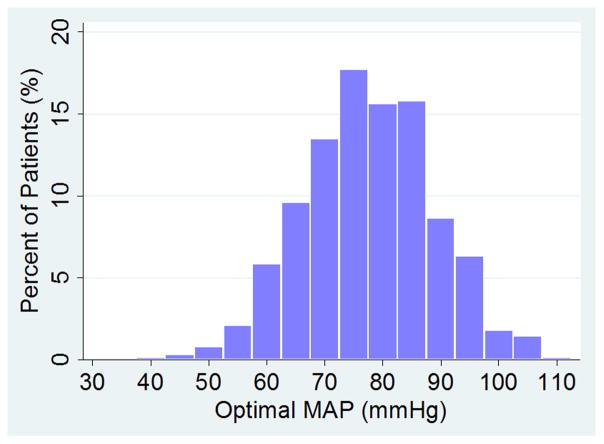
Results: The mean (± standard deviation) lower and upper limits of cerebral blood flow autoregulation, and optimal mean arterial pressure were 65 ± 12 mm Hg, 84 ± 11 mm Hg, and 78 ± 11 mm Hg, respectively, after adjusting for study enrollment. In 17% of patients, though, the lower limit of cerebral autoregulation was above this optimal mean arterial pressure, whereas in 29% of patients the upper limit of autoregulation was below the population optimal mean arterial pressure. Variables associated with optimal mean arterial pressure based on multivariate regression analysis were nonwhite race (increased 2.7 mm Hg; P = .034), diuretics use (decreased 1.9 mm Hg; P = .049), prior carotid endarterectomy (decreased 5.5 mm Hg; P = .019), and duration of cardiopulmonary bypass (decreased 1.28 per 60 minutes of cardiopulmonary bypass). The product of the duration and magnitude that mean arterial pressure during cardiopulmonary bypass was below the lower limit of cerebral autoregulation was associated with the risk for stroke (P = .02).
Conclusions: Real-time monitoring of autoregulation may improve individualizing mean arterial pressure during cardiopulmonary bypass and improving patient outcomes.
Keywords: blood pressure; cardiopulmonary bypass; cerebral autoregulation.
Copyright © 2017 The American Association for Thoracic Surgery. Published by Elsevier Inc. All rights reserved.
Conflict of interest statement
Conflict of Interest: Dr. Hogue receives consulting fees, lecture honorarium, and research funding from Medtronics, Inc, Minneapolis, MN.
Figures
Comment in
-
Chasing the elusive cerebral autoregulation curve in pursuit of intraoperative brain protection.J Thorac Cardiovasc Surg. 2017 Nov;154(5):1599-1600. doi: 10.1016/j.jtcvs.2017.05.055. Epub 2017 May 24. J Thorac Cardiovasc Surg. 2017. PMID: 28623095 No abstract available.
-
Optimizing cerebral blood flow: Hitting the sweet spot on cardiopulmonary bypass.J Thorac Cardiovasc Surg. 2017 Nov;154(5):1588-1589. doi: 10.1016/j.jtcvs.2017.05.032. Epub 2017 May 19. J Thorac Cardiovasc Surg. 2017. PMID: 28629838 No abstract available.
-
Discussion.J Thorac Cardiovasc Surg. 2017 Nov;154(5):1597-1598. doi: 10.1016/j.jtcvs.2017.04.095. J Thorac Cardiovasc Surg. 2017. PMID: 29042041 No abstract available.
-
Targeting optimal blood pressure monitoring: what's next?J Thorac Dis. 2018 Sep;10(Suppl 26):S3281-S3285. doi: 10.21037/jtd.2018.08.115. J Thorac Dis. 2018. PMID: 30370138 Free PMC article. No abstract available.
Similar articles
-
Predicting the limits of cerebral autoregulation during cardiopulmonary bypass.Anesth Analg. 2012 Mar;114(3):503-10. doi: 10.1213/ANE.0b013e31823d292a. Epub 2011 Nov 21. Anesth Analg. 2012. PMID: 22104067 Free PMC article.
-
Real-time continuous monitoring of cerebral blood flow autoregulation using near-infrared spectroscopy in patients undergoing cardiopulmonary bypass.Stroke. 2010 Sep;41(9):1951-6. doi: 10.1161/STROKEAHA.109.575159. Epub 2010 Jul 22. Stroke. 2010. PMID: 20651274 Free PMC article.
-
Blood pressure excursions below the cerebral autoregulation threshold during cardiac surgery are associated with acute kidney injury.Crit Care Med. 2013 Feb;41(2):464-71. doi: 10.1097/CCM.0b013e31826ab3a1. Crit Care Med. 2013. PMID: 23263580 Free PMC article.
-
Monitoring of cerebral blood flow autoregulation: physiologic basis, measurement, and clinical implications.Br J Anaesth. 2024 Jun;132(6):1260-1273. doi: 10.1016/j.bja.2024.01.043. Epub 2024 Mar 12. Br J Anaesth. 2024. PMID: 38471987 Review.
-
Journal of clinical monitoring and computing 2016 end of year summary: monitoring cerebral oxygenation and autoregulation.J Clin Monit Comput. 2017 Apr;31(2):241-246. doi: 10.1007/s10877-017-9980-7. Epub 2017 Jan 24. J Clin Monit Comput. 2017. PMID: 28120178 Free PMC article. Review.
Cited by
-
Real-Time Intraoperative Determination and Reporting of Cerebral Autoregulation State Using Near-Infrared Spectroscopy.Anesth Analg. 2020 Nov;131(5):1520-1528. doi: 10.1213/ANE.0000000000004614. Anesth Analg. 2020. PMID: 33079875 Free PMC article.
-
Optical monitoring of cerebral perfusion and metabolism in adults during cardiac surgery with cardiopulmonary bypass.Biomed Opt Express. 2020 Sep 29;11(10):5967-5981. doi: 10.1364/BOE.404101. eCollection 2020 Oct 1. Biomed Opt Express. 2020. PMID: 33149999 Free PMC article.
-
2024 EACTS/EACTAIC/EBCP Guidelines on cardiopulmonary bypass in adult cardiac surgery.Interdiscip Cardiovasc Thorac Surg. 2025 Feb 5;40(2):ivaf002. doi: 10.1093/icvts/ivaf002. Interdiscip Cardiovasc Thorac Surg. 2025. PMID: 39949317 Free PMC article. No abstract available.
-
Quick Assessment of the Lower Limit of Cerebral Autoregulation Using Transcranial Doppler during Cardiopulmonary Bypass in Cardiac Surgery: A Feasibility Study.Rev Cardiovasc Med. 2023 May 31;24(6):156. doi: 10.31083/j.rcm2406156. eCollection 2023 Jun. Rev Cardiovasc Med. 2023. PMID: 39077528 Free PMC article.
-
Cerebral Hemodynamic Evaluation After Cerebral Recanalization Therapy for Acute Ischemic Stroke.Front Neurol. 2019 Jul 3;10:719. doi: 10.3389/fneur.2019.00719. eCollection 2019. Front Neurol. 2019. PMID: 31333570 Free PMC article. Review.
References
-
- Gibbon JH., Jr Application of a mechanical heart and lung apparatus to cardiac surgery. Minn Med. 1954;37:171–185. passim. - PubMed
-
- Hannan EL, Wu C, Walford G, et al. Drug-eluting stents vs. coronary-artery bypass grafting in multivessel coronary disease. N Engl J Med. 2008;358:331–341. - PubMed
-
- Hogue CW, Jr, Palin CA, Arrowsmith JE. Cardiopulmonary bypass management and neurologic outcomes: an evidence-based appraisal of current practices. Anesth Analg. 2006;103:21–37. - PubMed
-
- Murkin JM, Farrar JK, Tweed WA, McKenzie FN, Guiraudon G. Cerebral autoregulation and flow/metabolism coupling during cardiopulmonary bypass: the influence of PaCO2. Anesth Analg. 1987;66:825–832. - PubMed
MeSH terms
Grants and funding
LinkOut - more resources
Full Text Sources
Other Literature Sources
Medical
