


Health education for patients with acute coronary syndrome and type 2 diabetes mellitus: an umbrella review of systematic reviews and meta-analyses
- PMID: 29042383
- PMCID: PMC5652525
- DOI: 10.1136/bmjopen-2017-016857
Health education for patients with acute coronary syndrome and type 2 diabetes mellitus: an umbrella review of systematic reviews and meta-analyses
Abstract
Objectives: This umbrella review aimed to identify the current evidence on health education-related interventions for patients with acute coronary syndrome (ACS) or type two diabetes mellitus (T2DM); identify the educational content, delivery methods, intensity, duration and setting required. The purpose was to provide recommendations for educational interventions for high-risk patients with both ACS and T2DM.
Design: Umbrella review of systematic reviews and meta-analyses.
Setting: Inpatient and postdischarge settings.
Participants: Patients with ACS and T2DM.
Data sources: CINAHL, Cochrane Library, Joanna Briggs Institute, Journals@Ovid, EMBase, Medline, PubMed and Web of Science databases from January 2000 through May 2016.
Outcomes measures: Clinical outcomes (such as glycated haemoglobin), behavioural outcomes (such as smoking), psychosocial outcomes (such as anxiety) and medical service use.
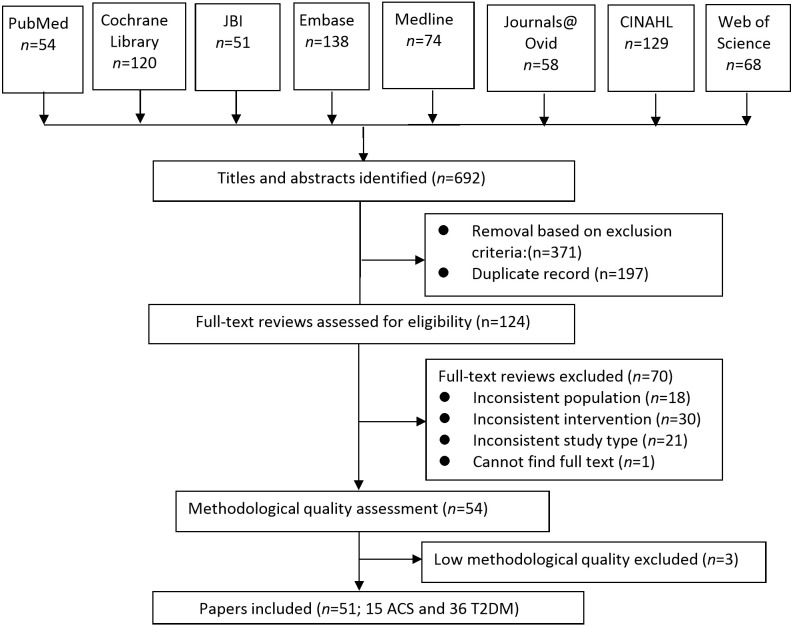
Results: Fifty-one eligible reviews (15 for ACS and 36 for T2DM) consisting of 1324 relevant studies involving 2 88 057 patients (15 papers did not provide the total sample); 30 (58.8%) reviews were rated as high quality. Nurses only and multidisciplinary teams were the most frequent professionals to provide education, and most educational interventions were delivered postdischarge. Face-to-face sessions were the most common delivery formats, and many education sessions were also delivered by telephone or via web contact. The frequency of educational sessions was weekly or monthly, and an average of 3.7 topics was covered per education session. Psychoeducational interventions were generally effective at reducing smoking and admissions for patients with ACS. Culturally appropriate health education, self-management educational interventions, group medical visits and psychoeducational interventions were generally effective for patients with T2DM.
Conclusions: Results indicate that there is a body of current evidence about the efficacy of health education, its content and delivery methods for patients with ACS or T2DM. These results provide recommendations about the content for, and approach to, health education intervention for these high-risk patients.
Keywords: acute coronary syndrome; health education; type 2 diabetes mellitus; umbrella review.
© Article author(s) (or their employer(s) unless otherwise stated in the text of the article) 2017. All rights reserved. No commercial use is permitted unless otherwise expressly granted.
Conflict of interest statement
Competing interests: None declared.
Figures
References
-
- Scarborough P, Wickramasinghe K, Bhatnagar P, et al. . Trends in coronary heart disease, 1961-2011. London: British Heart Foundation, 2011.
-
- Amsterdam EA, Wenger NK, Brindis RG, et al. . 2014 AHA/ACC guideline for the management of patients with Non-ST-Elevation acute coronary syndromes: a report of the American College of Cardiology/American Heart Association Task Force on practice guidelines. J Am Coll Cardiol 2014;64:e139–228. 10.1016/j.jacc.2014.09.017 - DOI - PubMed
-
- Kahn M, Wheatcroft S. Acute coronary syndromes in diabetes Fisher M, Heart Disease and Diabetes. Oxford: Oxford University Press, 2008.
Publication types
MeSH terms
Substances
LinkOut - more resources
Full Text Sources
Other Literature Sources
Medical
