. 2017 Oct 17;7(1):13375.
doi: 10.1038/s41598-017-13803-4.

An Integrin-Targeted, Highly Diffusive Construct for Photodynamic Therapy

Affiliations

An Integrin-Targeted, Highly Diffusive Construct for Photodynamic Therapy

Oliver J Klein et al. Sci Rep. .

Abstract

Targeted antineoplastic agents show great promise in the treatment of cancer, having the ability to impart cytotoxicity only to specific tumor types. However, these therapies do not experience uniform uptake throughout tumors, leading to sub-lethal cell killing that can impart treatment resistance, and cause problematic off-target effects. Here we demonstrate a photodynamic therapy construct that integrates both a cyclic RGD moiety for integrin-targeting, as well as a 5 kDa PEG chain that passivates the construct and enables its rapid diffusion throughout tumors. PEGylation of the photosensitizer construct was found to prevent photosensitizer aggregation, boost the generation of cytotoxic reactive radical species, and enable the rapid uptake of the construct into cells throughout large (>500 µm diameter) 3D tumor spheroids. Replacing the cyclic RGD with the generic RAD peptide led to the loss of cellular uptake in 3D culture, demonstrating the specificity of the construct. Photodynamic therapy with the construct was successful in inducing cytotoxicity, which could be competitively blocked by a tenfold concentration of free cyclic RGD. This construct is a first-of-its kind theranostic that may serve as a new approach in our growing therapeutic toolbox.


Conflict of interest statement

The authors declare that they have no competing interests.

Figures
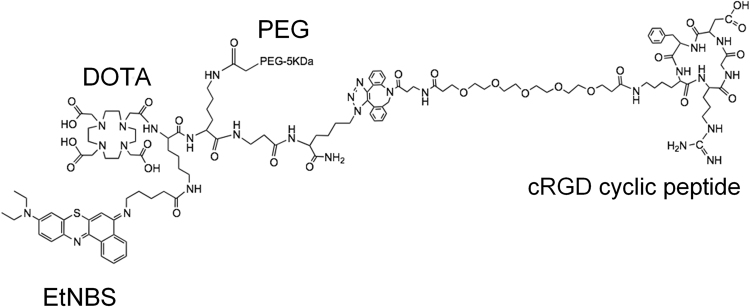
Figure 1
Figure 1
Structure of the EtNBS-cRGD-DOTA-PEG construct. Synthesis of the construct was carried out in two separate synthetic runs to ensure the synthesis could be accurately replicated.
Figure 2
Figure 2
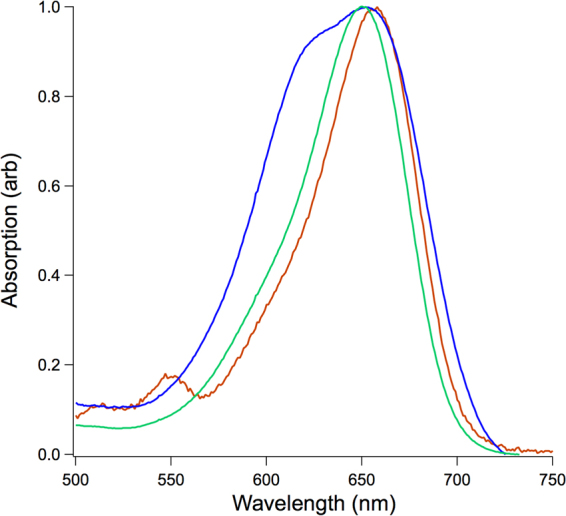
Normalized absorption spectra of EtNBS and the EtNBS-cRGD-DOTA-PEG construct. EtNBS in acidified methanol (green) contains one absorption peak, while the formation of aggregates distorts the spectrum when EtNBS is dissolved in water (blue). The EtNBS construct does not show aggregation in water at a concentration of 87.8 µM (red).
Figure 3
Figure 3
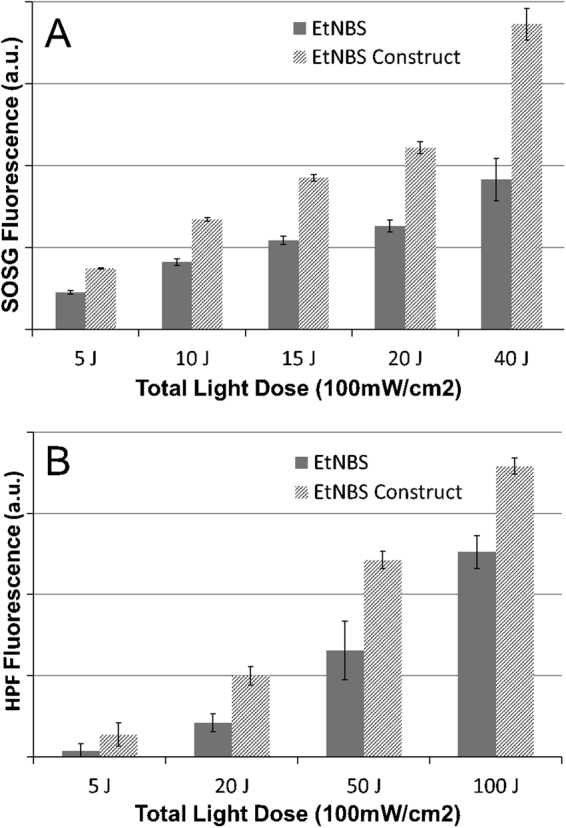
The EtNBS construct create greater levels of reactive oxygen species than free EtNBS under the 100 mW/cm2 irradiance conditions. The EtNBS construct is found to generate greater singlet oxygen sensor green (SOSG) signals at all tested light doses (A). Similarly, the reactive oxygen levels indicated by HPF were all greater for the EtNBS construct at all light doses (B). All experiments were carried out in triplicate; the data presented is the mean of the measurements with the error bars are derived from the standard deviation.
Figure 4
Figure 4
The EtNBS construct experiences greater uptake in cells that overexpress the α5 integrin. To better show the range of construct uptake, the images are false colored in a blue-green-white color scale. The contrast in both images arises from the native near-infrared fluorescence of the EtNBS molecule when excited at 635 nm. Both the normal OVCAR5 (A) and an OVCAR5 cell line engineered to ectopically overexpress the α5 integrin (B) were incubated with the EtNBS construct. The cell line with greater integrin expression demonstrated greater uptake of the construct via confocal fluorescence microscopy (B).
Figure 5
Figure 5
The construct is taken up into cells specifically via its integrin targeting. While the construct incorporating cRGD sees widespread uptake in 3D ovarian cancer spheroids (A), the same construct containing the cRAD moiety experiences only weak nonspecific uptake (B).
Figure 6
Figure 6
PEGylation dramatically improves the penetration of the construct into 3D tumor spheroids. The construct lacking the PEG chain only reaches cells at the nodule periphery and is mostly bound to the layer of extracellular matrix that surrounds the spheroid (A). The PEGylated construct, on the other hand, has minimal extracellular matrix binding and is taken up within cells throughout the spheroid (B).
Figure 7
Figure 7
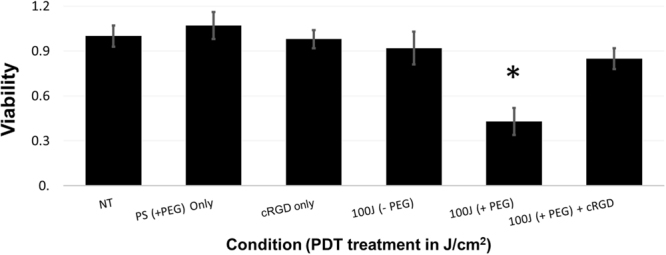
The cRGD-EtNBS-PEG construct is an effective PDT agent. No treatment cells (NT), cells given the cRGD-EtNBS-PEG construct only (PS only), and cells given cRGD only were not exposed to light. Cells treated with unPEGylated cRGD-EtNBS (−PEG) or the full construct EtNBS-cRGD-PEG (+PEG) were irradiated with 660 nm light at 100 mW/cm2 for a total dose of 100 J/cm2. The far-right bar corresponds to cells first pre-incubated with free cRGD before treatment with EtNBS-cRGD-PEG and subsequent irradiation (100 J (+PEG) + cRGD). Percentage cell viability as determined by the MTT assay is plotted for each group. All experiments were carried out in triplicate; the data presented is the mean of the measurements with the error bars are derived from the standard deviation. The 100 J +PEG treatment condition was found to be statistically significant against all other conditions by t-test (p < 0.05).

References

    1. Sawyers C. Targeted cancer therapy. Nature. 2004;432:294–297. doi: 10.1038/nature03095. - DOI - PubMed
    1. Jain RK. Antiangiogenic therapy for cancer: current and emerging concepts. Oncology. 2005;19:7–16. - PubMed
    1. Ebos JML, Kerbel RS. Antiangiogenic therapy: impact on invasion, disease progression, and metastasis. Nat. Rev. Clin. Oncol. 2011;8:210–221. doi: 10.1038/nrclinonc.2011.21. - DOI - PMC - PubMed
    1. Chen X-L, et al. Angiogenesis inhibitor bevacizumab increases the risk of ischemic heart disease associated with chemotherapy: a meta-analysis. PLoS One. 2013;8:e66721. doi: 10.1371/journal.pone.0066721. - DOI - PMC - PubMed
    1. Hasan T, Ortel B, Solban N, Pogue B. Photodynamic therapy of cancer. Cancer Med. 2003;7:537–548.

Publication types

MeSH terms

LinkOut - more resources