


Practical recommendations for the use of therapeutic drug monitoring of biopharmaceuticals in inflammatory diseases
- PMID: 29042821
- PMCID: PMC5633318
- DOI: 10.2147/CPAA.S138414
Practical recommendations for the use of therapeutic drug monitoring of biopharmaceuticals in inflammatory diseases
Abstract
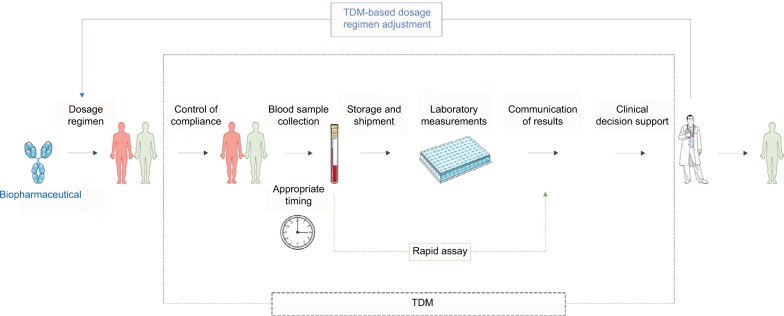
Biopharmaceuticals directed against tumor necrosis factor-alpha, integrins, interleukins, interferons and their receptors have become key agents for the management of inflammatory diseases in the fields of gastroenterology, rheumatology, dermatology and neurology. However, response to these treatments is far from optimal. Therapeutic failure has been attributed in part to inadequate serum concentrations of the drug and the formation of antidrug antibodies (ADA). Therapeutic drug monitoring (TDM) based on drug concentrations and ADA represents a pharmacologically sound tool for guiding dosage adjustments to optimize exposure. Although becoming standard practice in tertiary care centers, the widespread accessibility and recognition of TDM is hindered by several hurdles, including a lack of education of health care providers on TDM. In this paper, the Monitoring of monoclonal Antibodies Group in Europe (MAGE) provides an introduction on the fundamental principles of the concept of TDM, aiming to educate clinicians and assist them in the process of implementing TDM of anti-inflammatory biopharmaceuticals.
Keywords: antidrug antibodies; biopharmaceuticals; immunogenicity; inflammatory diseases; therapeutic drug monitoring; trough concentration.
Conflict of interest statement
Disclosure PB has served as a speaker for AbbVie and Takeda and as a consultant for Merck Sharp & Dohme (MSD), Janssen Biologicals, Hospira, Mundipharma, Roche, Takeda and AbbVie. DM participated on behalf of his institution in clinical trials sponsored by Abbvie, Roche, Bristol-Myers Squibb, Pfizer, Union Chimique Belge and MSD; his hospital received a grant for research from AbbVie in 2004 and from Nordic Pharma in 2012; he has acted as a consultant and given lectures on behalf of his institution for MSD, Novartis, Union Chimique Belge and Pfizer; and he has been invited to attend international congresses by MSD, Roche, BMS, AbbVie and Janssen-Cilag. AG has served as a speaker for MSD, Janssen Biologicals, Pfizer and AbbVie, as a consultant for Union Chimique Belge and has received investigator-initiated research grants from Pfizer. KU Leuven licensed the infliximab ELISA to apDia and R-Biopharm AG and the use of monoclonal antibody mAb-IFX6B7 in the lateral flow assay to R-Biopharm AG. KU Leuven licensed the anti-infliximab and adalimumab ELISA to apDia. DPS has served as a speaker for MSD, Pfizer, Novartis and AbbVie, as a consultant for AbbVie, Novartis and Takeda and has received research grants from Pfizer, Novartis and Progenika. ED reports no conflicts of interest in this work.
Figures
References
-
- Gils A, Bertolotto A, Mulleman D, Bejan-Angoulvant T, Declerck PJ. Biopharmaceuticals: reference products and biosimilars to treat inflammatory diseases. Ther Drug Monit. 2017;39(4):308–315. - PubMed
-
- Papamichael K, Gils A, Rutgeerts P, et al. Role for therapeutic drug monitoring during induction therapy with TNF antagonists in IBD: evolution in the definition and management of primary nonresponse. Inflamm Bowel Dis. 2015;21(1):182–197. - PubMed
-
- Gisbert JP, Panés J. Loss of response and requirement of infliximab dose intensification in Crohn’s disease: a review. Am J Gastroenterol. 2009;104(3):760–767. - PubMed
-
- Billioud V, Sandborn WJ, Peyrin-Biroulet L. Loss of response and need for adalimumab dose intensification in Crohn’s disease: a systematic review. Am J Gastroenterol. 2011;106(4):674–684. - PubMed
-
- Ben-Horin S, Chowers Y. Review article: loss of response to anti-TNF treatments in Crohn’s disease. Aliment Pharmacol Ther. 2011;33(9):987–995. - PubMed
Publication types
LinkOut - more resources
Full Text Sources
Other Literature Sources
Research Materials
