Screening Ability of Subjective Memory Complaints, Informant-Reports for Cognitive Decline, and Their Combination in Memory Clinic Setting
- PMID: 29042889
- PMCID: PMC5639132
- DOI: 10.4306/pi.2017.14.5.640
Screening Ability of Subjective Memory Complaints, Informant-Reports for Cognitive Decline, and Their Combination in Memory Clinic Setting
Abstract
Objective: This study aimed to compare the accuracy of subjective memory complaints, informant-reports for cognitive declines, and their combination for screening cognitive disorders in memory clinic setting.
Methods: One-hundred thirtytwo cognitively normal (CN), 136 mild cognitive impairment (MCI), and 546 dementia who visited the memory clinic in the Seoul National University Hospital underwent standardized clinical evaluation and comprehensive neuropsychological assessment. The Subjective Memory Complaints Questionnaire (SMCQ) and the Seoul Informant Report Questionnaire for Dementia (SIRQD) were used to assess subjective memory complaints and informant-reports for cognitive declines, respectively.
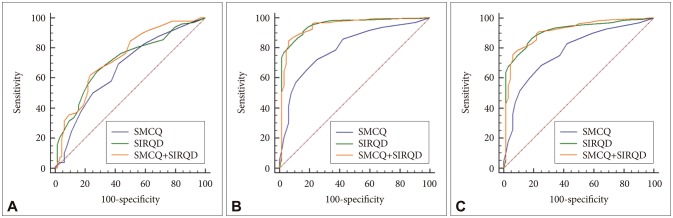
Results: Both SMCQ and SIRQD showed significant screening ability for MCI, dementia, and overall cognitive disorder (CDall: MCI plus dementia) (screening accuracy: 60.1-94.6%). The combination of SMCQ and SIRQD (SMCQ+SIRQD) was found to have significantly better screening accuracy compared to SMCQ alone for any cognitive disorders. SMCQ+SIRQD also significantly improved screening accuracy of SIRQD alone for MCI and CDall, but not for dementia.
Conclusion: Our findings suggest that the combined information of both subjective memory complaints and informant-reports for cognitive declines can improve MCI screening by each individual information, while such combination appears not better than informant-reports in regard of dementia screening.
Keywords: Cognitive disorder; Elderly; Informant-report; Memory; Screening; Subjective complaints.
Figures
References
-
- Albert MS, DeKosky ST, Dickson D, Dubois B, Feldman HH, Fox NC, et al. The diagnosis of mild cognitive impairment due to Alzheimer's disease: recommendations from the National Institute on Aging-Alzheimer's Association workgroups on diagnostic guidelines for Alzheimer's disease. Alzheimers Dement. 2011;7:270–279. - PMC - PubMed
-
- Jessen F. Subjective and objective cognitive decline at the pre-dementia stage of Alzheimer's disease. Eur Arch Psychiatry Clin Neurosci. 2014;264(Suppl 1):S3–S7. - PubMed
-
- Geerlings MI, Jonker C, Bouter LM, Ader HJ, Schmand B. Association between memory complaints and incident Alzheimer's disease in elderly people with normal baseline cognition. Am J Psychiatry. 1999;156:531–537. - PubMed
LinkOut - more resources
Full Text Sources
Other Literature Sources