Classical strong metal-support interactions between gold nanoparticles and titanium dioxide
- PMID: 29043293
- PMCID: PMC5640381
- DOI: 10.1126/sciadv.1700231
Classical strong metal-support interactions between gold nanoparticles and titanium dioxide
Abstract
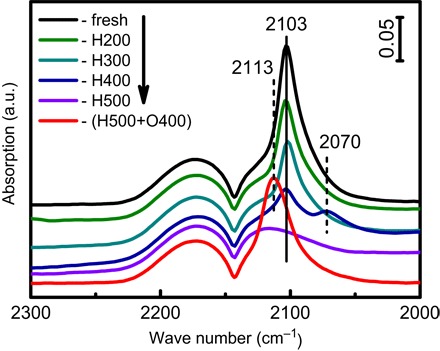
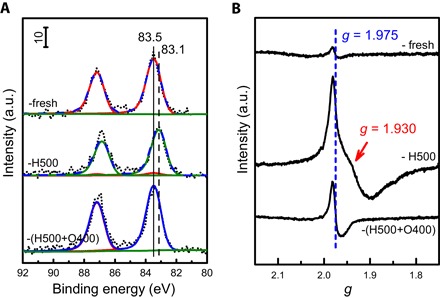
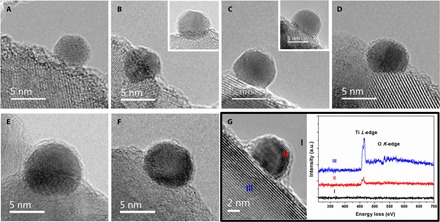
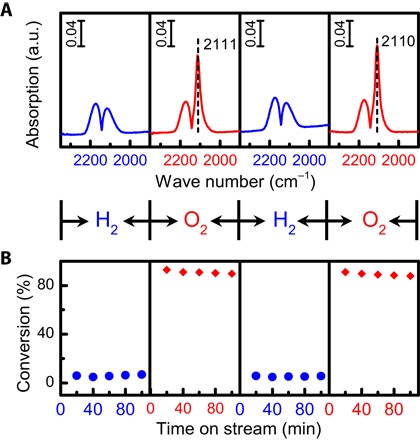
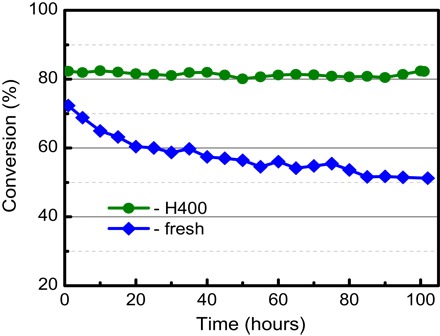
Supported metal catalysts play a central role in the modern chemical industry but often exhibit poor on-stream stability. The strong metal-support interaction (SMSI) offers a route to control the structural properties of supported metals and, hence, their reactivity and stability. Conventional wisdom holds that supported Au cannot manifest a classical SMSI, which is characterized by reversible metal encapsulation by the support upon high-temperature redox treatments. We demonstrate a classical SMSI for Au/TiO2, evidenced by suppression of CO adsorption, electron transfer from TiO2 to Au nanoparticles, and gold encapsulation by a TiO x overlayer following high-temperature reduction (reversed by subsequent oxidation), akin to that observed for titania-supported platinum group metals. In the SMSI state, Au/TiO2 exhibits markedly improved stability toward CO oxidation. The SMSI extends to Au supported over other reducible oxides (Fe3O4 and CeO2) and other group IB metals (Cu and Ag) over titania. This discovery highlights the general nature of the classical SMSI and unlocks the development of thermochemically stable IB metal catalysts.
Figures
References
-
- Boudart M., Catalysis by supported metals. Adv. Catal. 20, 153–166 (1969).
-
- Cinneide A. D. O., Clarke J. K. A., Catalysis on supported metals. Catal. Rev. 7, 213–232 (1972).
-
- Bell A. T., The impact of nanoscience on heterogeneous catalysis. Science 299, 1688–1691 (2003). - PubMed
-
- G. Ertl, H. Knözinger, F. Schüth, J. Weitkamp, Eds., Handbook of Heterogeneous Catalysis (Wiley-VCH Verlag GmbH & Co. KGaA, ed. 2, 2008), vol. 8, p. 4270.
-
- Solymosi F., Importance of the electric properties of supports in the carrier effect. Catal. Rev. 1, 233–255 (1968).
Publication types
LinkOut - more resources
Full Text Sources
Other Literature Sources