. 2017 Oct 18;8(1):1026.
doi: 10.1038/s41467-017-01114-1.

Controlling the bioactivity of a peptide hormone in vivo by reversible self-assembly

Affiliations

Controlling the bioactivity of a peptide hormone in vivo by reversible self-assembly

Myriam M Ouberai et al. Nat Commun. .

Abstract

The use of peptides as therapeutic agents is undergoing a renaissance with the expectation of new drugs with enhanced levels of efficacy and safety. Their clinical potential will be only fully realised once their physicochemical and pharmacokinetic properties have been precisely controlled. Here we demonstrate a reversible peptide self-assembly strategy to control and prolong the bioactivity of a native peptide hormone in vivo. We show that oxyntomodulin, a peptide with potential to treat obesity and diabetes, self-assembles into a stable nanofibril formulation which subsequently dissociates to release active peptide and produces a pharmacological effect in vivo. The subcutaneous administration of the nanofibrils in rats results in greatly prolonged exposure, with a constant oxyntomodulin bioactivity detectable in serum for at least 5 days as compared to free oxyntomodulin which is undetectable after only 4 h. Such an approach is simple, cost-efficient and generic in addressing the limitations of peptide therapeutics.


Conflict of interest statement

The authors declare no competing financial interests.

Figures
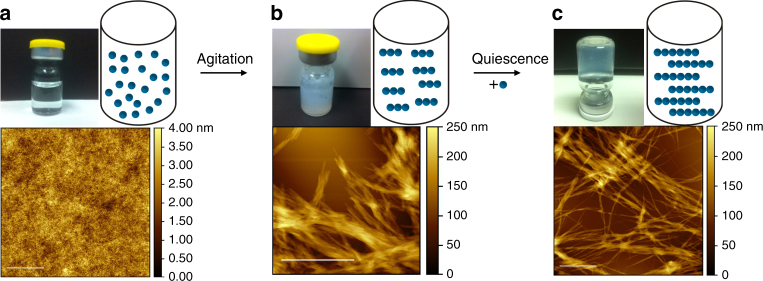
Fig. 1
Fig. 1
Self-assembly of Oxm. ac Photographs, schematic representations and AFM images of freshly prepared peptide at 10 mg mL−1 in 0.09% saline a, after 5 days of incubation with orbital shaking b and after incubation of 0.1 mg mL−1 fibrils with a 10 mg mL−1 free peptide solution in water c. Scale bar, 1 μm
Fig. 2
Fig. 2
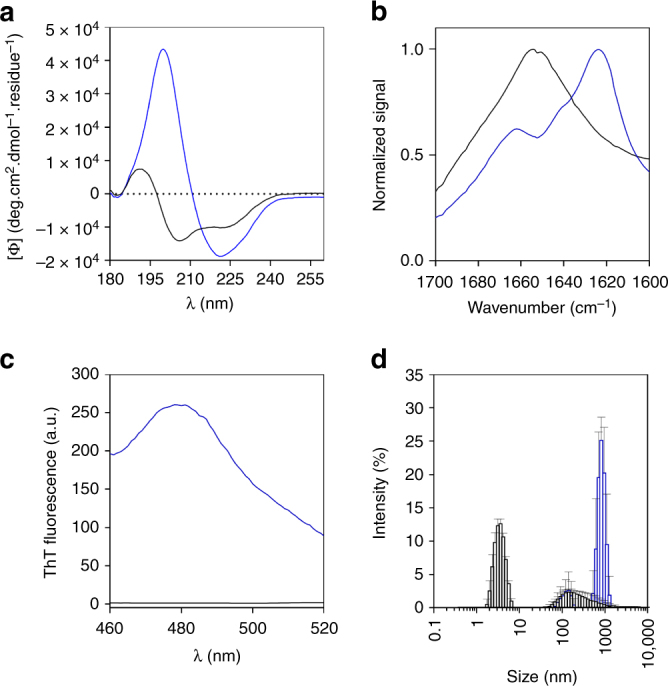
Structural properties of free and fibrillar Oxm. ad Free (black) and fibrillar (blue) Oxm at 1 mg mL−1 in 0.09% saline. Far-UV CD a, ATR-FT-IR, b and ThT emission spectra c, and DLS analysis (Error bars represent standard deviations obtained from eight measurements of the same sample) d
Fig. 3
Fig. 3
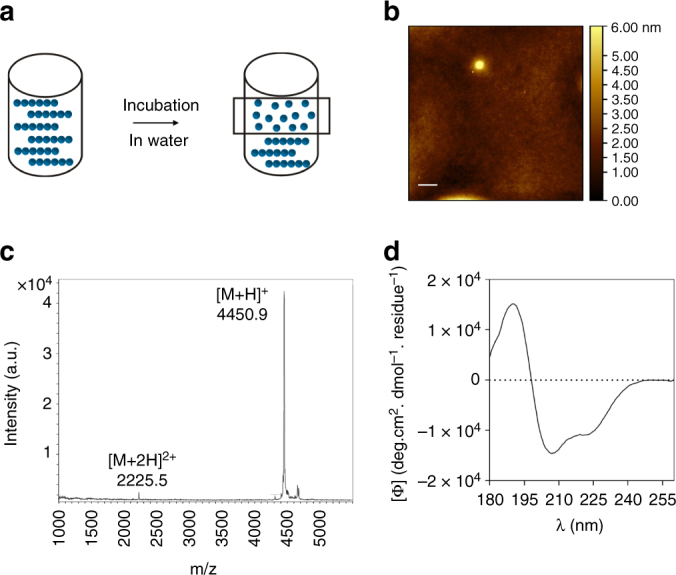
Characterization of released peptide. ad Schematic of the stability study a with examples of a representative AFM image b, mass spectrum c and far-UV CD spectrum d of released Oxm in water. Scale bar, 1 μm
Fig. 4
Fig. 4
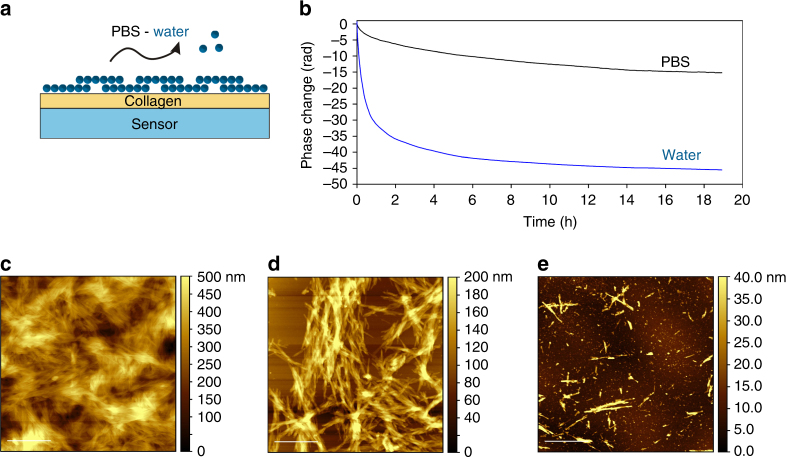
Dissociation profile of Oxm nanofibrils under physiological conditions. a Schematic of the dissociation study using the DPI biosensing technique. b Phase changes as a function of time on top of the DPI sensor coated with collagen and fibrillar Oxm in water (blue) and PBS (black). ce Representative AFM images of Oxm nanofibrils deposited onto a collagen layer before c and after incubation in PBS d and water e. Scale bar, 1 μm
Fig. 5
Fig. 5
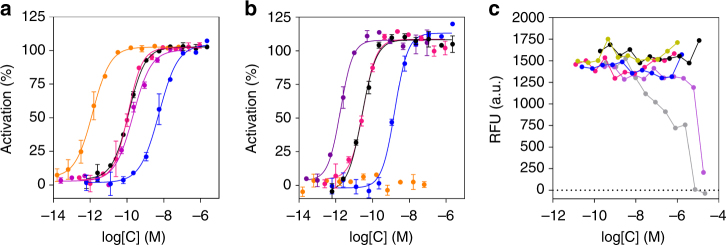
Agonist potency and cytotoxicity profiles of Oxm species. a, b In vitro potencies determined in cAMP accumulation assays in CHO cell lines expressing human GLP-1 a and GCG b receptors of free Oxm (black), released Oxm (magenta), fibrillar Oxm (blue), glucagon (violet), GLP-1 (orange). Data show representative curves of >5 independent experiments. Curve data are the arithmetic mean ± s.d. of duplicate data points. c 48 h cytotoxicity prolife in CHO-GLP-1R cells of vehicle (yellow), free Oxm (black), released Oxm (magenta), fibrillar Oxm (blue), Ro-318220 (violet), Staurosporine (gray). RFU = Relative fluorescence units. Data show representative curves of three independent experiments
Fig. 6
Fig. 6
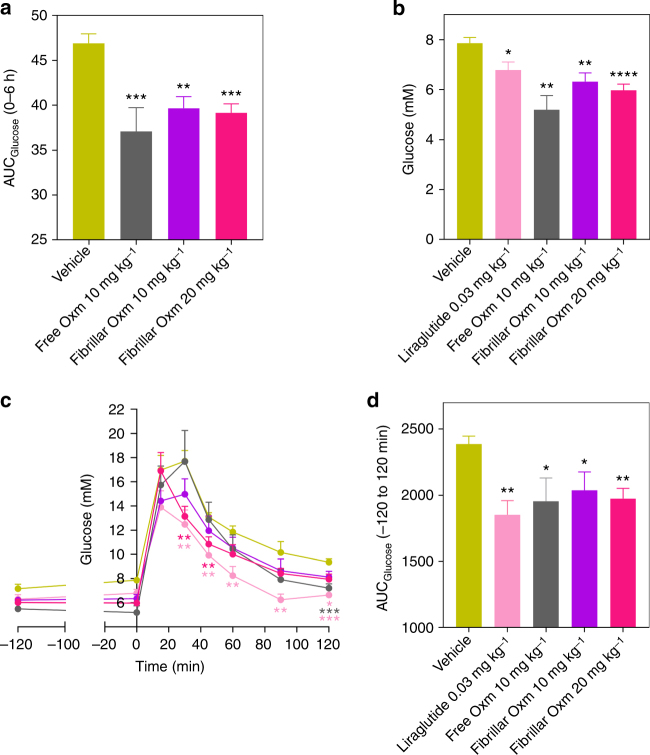
Effect of fibrillar Oxm on blood glucose lowering. Glucose lowering demonstrated after 6 h of administration with either vehicle or free and fibrillar Oxm by either AUC a, or blood glucose concentration at 6 h b. A glucose tolerance test (GTT) was conducted at 6 h post-dose c and efficacy was also expressed by AUC d. Liraglutide was used as positive control and administrated 2 h prior to GTT. Data are mean ± s.e.m. (n = 7–8 animals per group). *P < 0.05, **P < 0.01, ***P < 0.001, ****P < 0.0001, vs. vehicle, two-sided, unpaired t-test
Fig. 7
Fig. 7
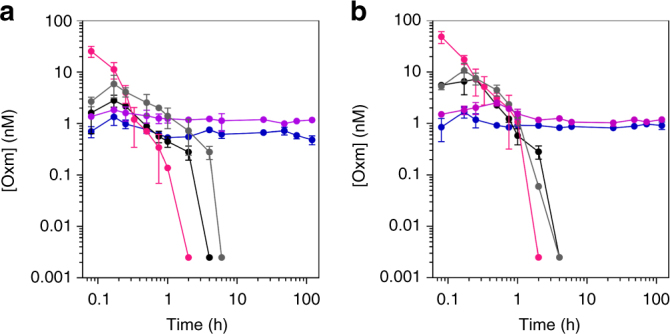
Pharmacokinetic profiles following administration of free and fibrillar Oxm. Oxm bioactivity in rat serum determined using in vitro cell-based cAMP bioassay for determining GLP-1 a and GCG b receptor agonist bioactivity after administration of 5 mg kg−1 of free Oxm i.v. (magenta), s.c. (black), and fibrillar Oxm s.c. (blue) and 10 mg kg−1 of free Oxm s.c. (gray) and fibrillar Oxm s.c. (violet). The data correspond to the average measurements from 3 rats ± s.d
Fig. 8
Fig. 8
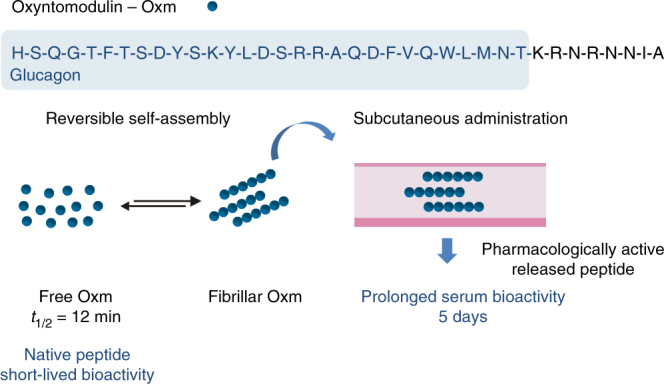
Reversible peptide self-assembly to control and prolong Oxm bioactivity in vivo. The proglucagon-derived peptide hormone Oxm has limited clinical application owing to its short half-life of 12 min in humans. Oxm readily self-assembles into nanofibrils which subsequently dissociate under physiological conditions to release pharmacologically active peptide. The subcutaneous administration of the fibrils in rats prolongs peptide serum bioactivity with Oxm detected for at least 5 days post-nanofibril injection compared to free Oxm (which lost all serum bioactivity after only 4 h)

References

    1. Kaspar AA, Reichert JM. Future directions for peptide therapeutics development. Drug Discov. Today. 2013;18:807–817. doi: 10.1016/j.drudis.2013.05.011. - DOI - PubMed
    1. Fosgerau K, Hoffmann T. Peptide therapeutics: current status and future directions. Drug Discov. Today. 2014;20:122–128. doi: 10.1016/j.drudis.2014.10.003. - DOI - PubMed
    1. Sleep D, Cameron J, Evans LR. Albumin as a versatile platform for drug half-life extension. Biochim. Biophys. Acta. 2013;1830:5526–5534. doi: 10.1016/j.bbagen.2013.04.023. - DOI - PubMed
    1. Kontermann RE. Strategies for extended serum half-life of protein therapeutics. Curr. Opin. Biotechnol. 2011;22:868–876. doi: 10.1016/j.copbio.2011.06.012. - DOI - PubMed
    1. Kovalainen M, et al. Novel delivery systems for improving the clinical use of peptides. Pharmacol. Rev. 2015;67:541–561. doi: 10.1124/pr.113.008367. - DOI - PubMed

Publication types