. 2017 Oct 18;8(1):1033.
doi: 10.1038/s41467-017-01044-y.

Triparental plants provide direct evidence for polyspermy induced polyploidy

Affiliations

Triparental plants provide direct evidence for polyspermy induced polyploidy

Thomas Nakel et al. Nat Commun. .

Erratum in

Abstract

It is considered an inviolable principle that sexually reproducing organisms have no more than two parents and fertilization of an egg by multiple sperm (polyspermy) is lethal in many eukaryotes. In flowering plants polyspermy has remained a hypothetical concept, due to the lack of tools to unambiguously identify and trace this event. We established a high-throughput polyspermy detection assay, which uncovered that supernumerary sperm fusion does occur in planta and can generate viable polyploid offspring. Moreover, polyspermy can give rise to seedlings with one mother and two fathers, challenging the bi-organismal concept of parentage. The polyspermy derived triploids are taller and produce bigger organs than plants resulting from a regular monospermic fertilization. In addition, we demonstrate the hybridization potential of polyspermy by instantly combining three different Arabidopsis accessions in one zygote. Our results provide direct evidence for polyspermy as a route towards polyploidy, which is considered a major plant speciation mechanism.


Conflict of interest statement

The authors declare that they have filed a patent based on this work.

Figures
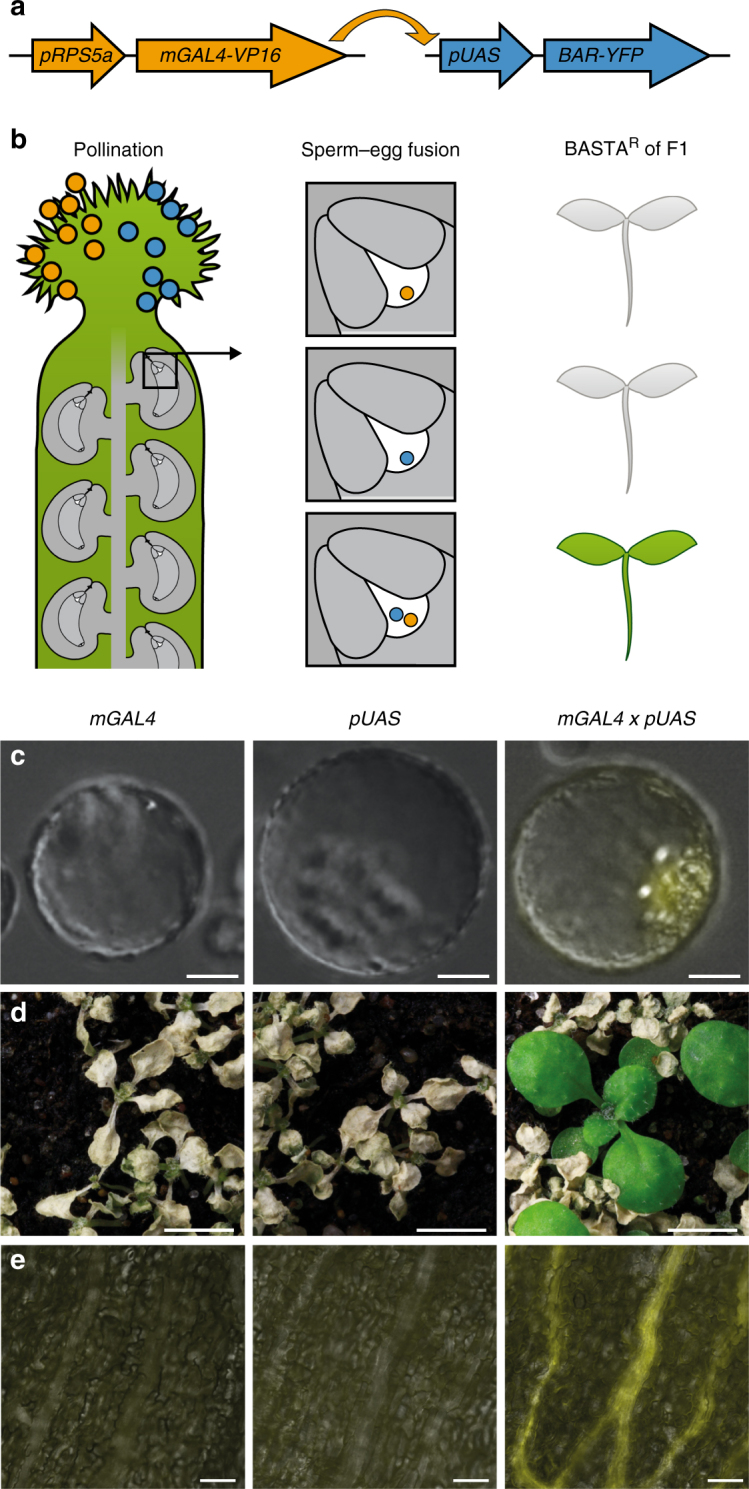
Fig. 1
Fig. 1
Establishment of a high-throughput polyspermy detection assay. a HIPOD comprises the synthetic transcription factor mGAL4 driven by the ubiquitous RPS5a promoter, which transactivates the UAS promoter driving a herbicide resistance-conferring YFP-tagged BAR gene. b Pollen from PD1 (orange) and PD2 (blue) harboring the individual components of the two-component system are applied to the stigma of a gynoecium (green). Fusion of two sperm from two different fathers (orange, blue) to the egg cell (white) but not monospermy enables transactivation resulting in herbicide-resistant F1 plants. c Fluorescence microscopy of protoplasts transformed with pRPS5a::mGAL4-VP16 (left), pUAS::BAR-YFP (middle) or cotransfected with pRPS5a::mGAL4-VP16 and pUAS::BAR-YFP (right). d Herbicide-treated F1 plants resulting from selfing of pRPS5a::mGAL4-VP16/ + (left), selfing of pUAS::BAR-YFP/ + (middle), and a cross between pRPS5a::mGAL4-VP16/- and pUAS::BAR-YFP/- (right). e YFP fluorescence analysis in sepals of F1 plants resulting from selfing of pRPS5a::mGAL4-VP16/ + (left), selfing of pUAS::BAR-YFP/ + (middle), and a cross between pRPS5a::mGAL4-VP16/- and pUAS::BAR-YFP/- (right). Scale bars, 15 µm c, 0.2 cm d, and 50 µm e
Fig. 2
Fig. 2
HIPOD identifies plants with three parents. a Herbicide-treated offspring of diploid wild type (left) and plants recovered from HIPOD (right). b YFP fluorescence analysis of diploid wild type (left) and plants recovered from HIPOD (right). c Multiplex PCR targeting pUAS::BAR-YFP (blue) and pRPS5a::mGAL4-VP16 (orange) in (1) herbicide-resistant plant recovered from HIPOD, (2) pUAS::BAR-YFP/ + , (3) pRPS5a::mGAL4-VP16/ + , (4) pUAS::BAR-YFP/−, pRPS5a::mGAL4-VP16/−, (5) water control, (6) wild-type control. The crossing scheme resulting in the F1 plants analyzed is indicated in the cartoon. d DAPI stained chromosome spreads of a diploid wild-type plant (left) and a plant recovered from HIPOD (right). e Flow cytometric analysis of diploid wild-type plant (upper panel), triploid wild-type plant (middle panel) and a herbicide-resistant plant recovered from HIPOD (lower panel). Scale bars, 0.4 cm a, 100 µm b, and 5 µm d
Fig. 3
Fig. 3
Polyspermy-induced triploid plants are taller and produce bigger organs than plants originating from a regular fertilization mode. a, b Growth height comparison between biparental diploid plants (BP; n = 19), and herbicide-resistant triploid triparental plants (TP; n = 7). c, d Inflorescence and flower of BP and TP plants. e Petal size of BP (n = 68) and TP plants (n = 104). f Sepal size of BP (n = 89) and TP plants (n = 107). g Seed morphology of BP and TP plants. h, i Size of petal epidermis cells in BP (n = 58) and TP plants (n = 93). j, k Silique analysis of 2n BP (n = 19) and 3n TP (n = 39) plants. Siliques are showing dark green seeds, sterile ovules (white arrowhead) and abnormal seeds (white arrow). k Graph shows mean ± s.d. P values (***p < 0.001) report significance by t-test. Box plots show median, quartiles, maximum and minimum. Scale bars, 2 cm a, 2 mm c, 1 mm d, 0.5 mm g, 5 µm h, 0.5 mm j
Fig. 4
Fig. 4
Polyspermy-induced hybridization of three accessions. a Herbicide-resistant plant recovered from three accession HIPOD cross between Col-0, C24 pRPS5a::mGAL4-VP16/ + and Ler pUAS::BAR-YFP/ + (TP3). b YFP fluorescence analysis of a diploid biparental plant (BP) and a triploid triparental plant recovered from a three accession cross (TP3). c Flow cytometry analysis of 2n biparental (2n BP), 3n biparental (3n BP) and 3n triparental plant recovered from a three accession cross(3n TP3). d Analysis of accession-characteristic RFLPs on different chromosomes (Chr.) in TP3 (1), Col-0 (gray) (2), Ler (blue) (3), and C24 (orange) (4). The crossing scheme resulting in the F1 plants analyzed is indicated in the cartoon. Scale bars, 1 cm a, 100 µm b

Comment in

References

    1. Lloyd C, Chan J. Not so divided: the common basis of plant and animal cell division. Nat. Rev. Mol. Cell. Biol. 2006;7:147–152. doi: 10.1038/nrm1831. - DOI - PubMed
    1. Wong JL, Wessel GM. Defending the zygote: search for the ancestral animal block to polyspermy. Curr. Top. Dev. Biol. 2006;72:1–151. - PubMed
    1. Avers CJ. Chromosome Behavior in Fertile Triploid Aster Hybrids. Genetics. 1954;39:117–126. - PMC - PubMed
    1. Stephenson MD, Awartani KA, Robinson WP. Cytogenetic analysis of miscarriages from couples with recurrent miscarriage: a case–control study. Hum. Reprod. 2002;17:446–451. doi: 10.1093/humrep/17.2.446. - DOI - PubMed
    1. Snook RR, Hosken DJ, Karr TL. The biology and evolution of polyspermy: insights from cellular and functional studies of sperm and centrosomal behavior in the fertilized egg. Reproduction. 2011;142:779–792. doi: 10.1530/REP-11-0255. - DOI - PubMed

Publication types
