


SELECT-2: a phase II, double-blind, randomized, placebo-controlled study to assess the efficacy of selumetinib plus docetaxel as a second-line treatment of patients with advanced or metastatic non-small-cell lung cancer
- PMID: 29045535
- PMCID: PMC5834012
- DOI: 10.1093/annonc/mdx628
SELECT-2: a phase II, double-blind, randomized, placebo-controlled study to assess the efficacy of selumetinib plus docetaxel as a second-line treatment of patients with advanced or metastatic non-small-cell lung cancer
Abstract
Background: Combination of selumetinib plus docetaxel provided clinical benefit in a previous phase II trial for patients with KRAS-mutant advanced non-small-cell lung cancer (NSCLC). The phase II SELECT-2 trial investigated safety and efficacy of selumetinib plus docetaxel for patients with advanced or metastatic NSCLC.
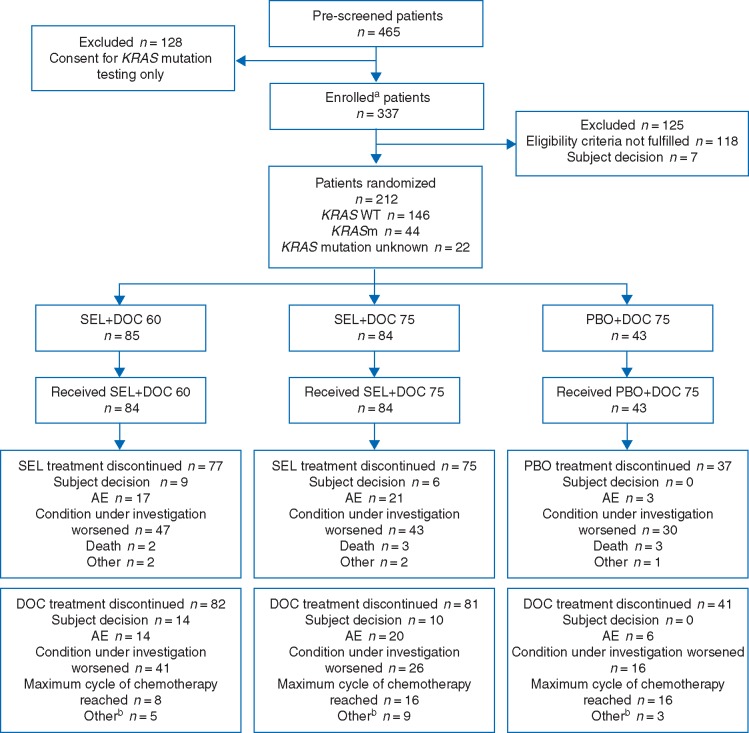
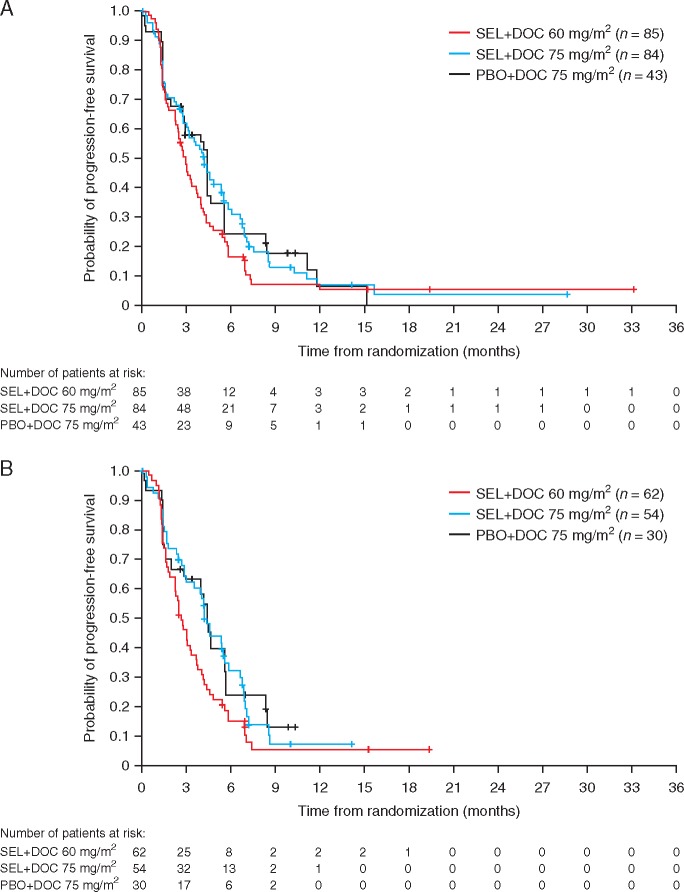
Patients and methods: Patients who had disease progression after first-line anti-cancer therapy were randomized (2 : 2 : 1) to selumetinib 75 mg b.i.d. plus docetaxel 60 or 75 mg/m2 (SEL + DOC 60; SEL + DOC 75), or placebo plus docetaxel 75 mg/m2 (PBO + DOC 75). Patients were initially enrolled independently of KRAS mutation status, but the protocol was amended to include only patients with centrally confirmed KRAS wild-type NSCLC. Primary end point was progression-free survival (PFS; RECIST 1.1); statistical analyses compared each selumetinib group with PBO + DOC 75 for KRAS wild-type and overall (KRAS mutant or wild-type) populations.
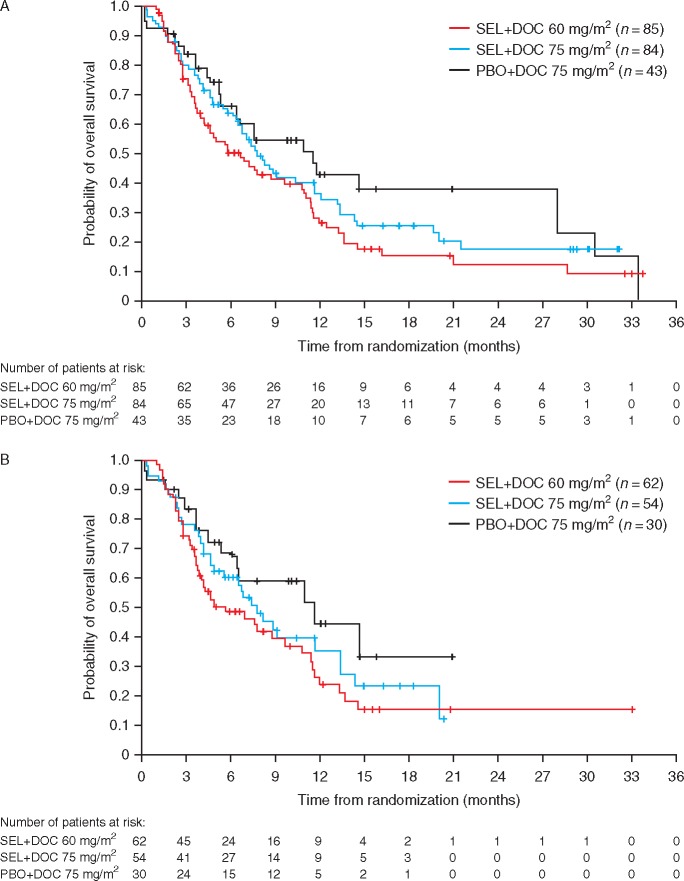
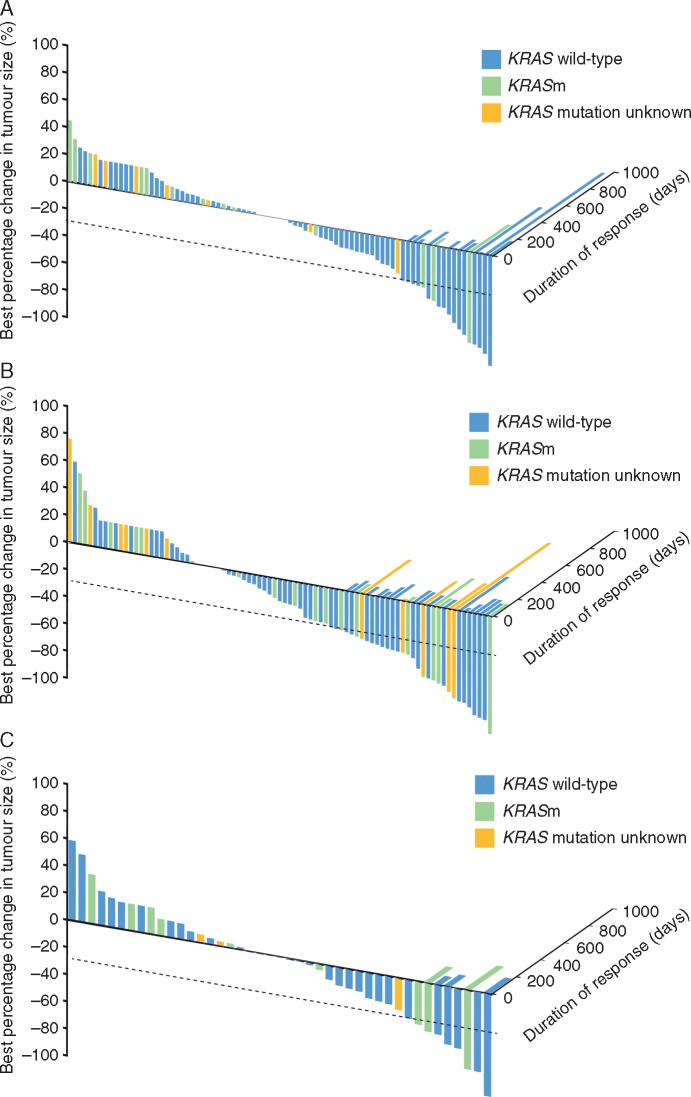
Results: A total of 212 patients were randomized; 69% were KRAS wild-type. There were no statistically significant improvements in PFS or overall survival for overall or KRAS wild-type populations in either selumetinib group compared with PBO + DOC 75. Overall population median PFS for SEL + DOC 60, SEL + DOC 75 compared with PBO + DOC 75 was 3.0, 4.2, and 4.3 months, HRs: 1.12 (90% CI: 0.8, 1.61) and 0.92 (90% CI: 0.65, 1.31), respectively. In the overall population, a higher objective response rate (ORR; investigator assessed) was observed for SEL + DOC 75 (33%) compared with PBO + DOC 75 (14%); odds ratio: 3.26 (90% CI: 1.47, 7.95). Overall the tolerability profile of SEL + DOC was consistent with historical data, without new or unexpected safety concerns identified.
Conclusion: The primary end point (PFS) was not met. The higher ORR with SEL + DOC 75 did not translate into prolonged PFS for the overall or KRAS wild-type patient populations. No clinical benefit was observed with SEL + DOC in KRAS wild-type patients compared with docetaxel alone. No unexpected safety concerns were reported.
Trial identifier: Clinicaltrials.gov NCT01750281.
Keywords: KRAS; MEK1/2; advanced non-small-cell lung cancer (NSCLC); docetaxel; metastatic disease; selumetinib.
© The Author 2017. Published by Oxford University Press on behalf of the European Society for Medical Oncology.
Figures
References
-
- Yeh TC, Marsh V, Bernat BA. et al. Biological characterization of ARRY-142886 (AZD6244), a potent, highly selective mitogen-activated protein kinase kinase 1/2 inhibitor. Clin Cancer Res 2007; 13(5): 1576–1583. - PubMed
-
- Banerji U, Camidge DR, Verheul HM. et al. The first-in-human study of the hydrogen sulfate (Hyd-sulfate) capsule of the MEK1/2 inhibitor AZD6244 (ARRY-142886): a phase I open-label multicenter trial in patients with advanced cancer. Clin Cancer Res 2010; 16(5): 1613–1623. - PubMed
-
- Roberts PJ, Stinchcombe TE.. KRAS mutation: should we test for it, and does it matter? J Clin Oncol 2013; 31(8): 1112–1121. - PubMed
-
- Davies BR, Logie A, McKay JS. et al. AZD6244 (ARRY-142886), a potent inhibitor of mitogen-activated protein kinase/extracellular signal-regulated kinase kinase 1/2 kinases: mechanism of action in vivo, pharmacokinetic/pharmacodynamic relationship, and potential for combination in preclinical models. Mol Cancer Ther 2007; 6(8): 2209–2219. - PubMed
Publication types
MeSH terms
Substances
Associated data
LinkOut - more resources
Full Text Sources
Other Literature Sources
Medical
Miscellaneous
