


Structural Variability Across the Primate Brain: A Cross-Species Comparison
- PMID: 29045561
- PMCID: PMC6887925
- DOI: 10.1093/cercor/bhx244
Structural Variability Across the Primate Brain: A Cross-Species Comparison
Abstract
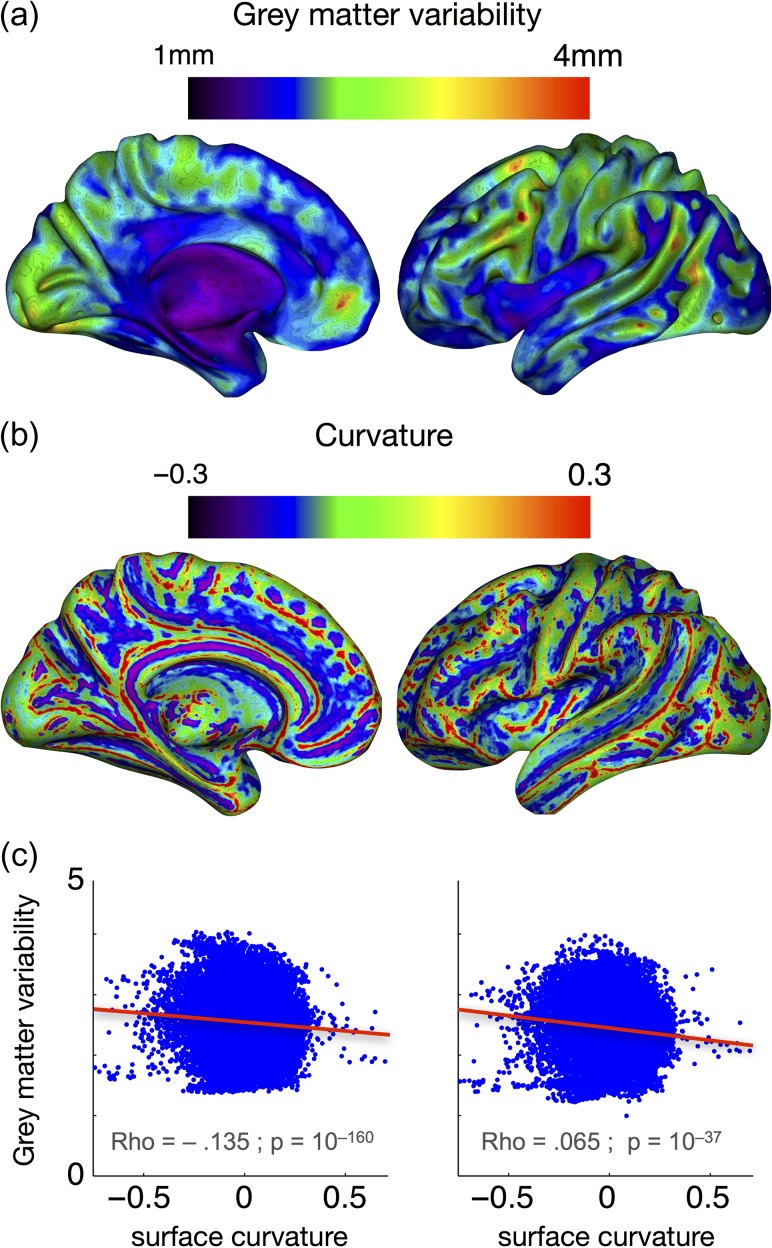
A large amount of variability exists across human brains; revealed initially on a small scale by postmortem studies and, more recently, on a larger scale with the advent of neuroimaging. Here we compared structural variability between human and macaque monkey brains using grey and white matter magnetic resonance imaging measures. The monkey brain was overall structurally as variable as the human brain, but variability had a distinct distribution pattern, with some key areas showing high variability. We also report the first evidence of a relationship between anatomical variability and evolutionary expansion in the primate brain. This suggests a relationship between variability and stability, where areas of low variability may have evolved less recently and have more stability, while areas of high variability may have evolved more recently and be less similar across individuals. We showed specific differences between the species in key areas, including the amount of hemispheric asymmetry in variability, which was left-lateralized in the human brain across several phylogenetically recent regions. This suggests that cerebral variability may be another useful measure for comparison between species and may add another dimension to our understanding of evolutionary mechanisms.
Figures




Comment in
-
How Primate Brains Vary and Evolve.Trends Cogn Sci. 2018 Mar;22(3):195-197. doi: 10.1016/j.tics.2018.01.002. Epub 2018 Jan 18. Trends Cogn Sci. 2018. PMID: 29361383
References
-
- Amunts K, Malikovic A, Mohlberg H, Schormann T, Zilles K. 2000. Brodmann’s areas 17 and 18 brought into stereotaxic space—where and how variable? NeuroImage. 11:66–84. - PubMed
-
- Amunts K, Schleicher A, Bürgel U, Mohlberg H, Uylings HB, Zilles K. 1999. Broca’s region revisited: cytoarchitecture and intersubject variability. J Comp Neurol. 412:319–341. - PubMed
-
- Amunts K, Schleicher A, Zilles K. 2007. Cytoarchitecture of the cerebral cortex—more than localization. NeuroImage. 37:1061–1065. discussion 1066-1068. - PubMed
-
- Andersson JL, Skare S, Ashburner J. 2003. How to correct susceptibility distortions in spin-echo echo-planar images: application to diffusion tensor imaging. Neuroimage. 20:870–888. - PubMed
-
- Andersson JLR, Xu J, Yacoub E, Auerbach E, Moeller S, Ugurbil K. 2012. A Comprehensive Gaussian Process Framework for Correcting Distortions and Movements in Diffusion Images. Melbourne, Australia: ISMRM.
Publication types
MeSH terms
Grants and funding
LinkOut - more resources
Full Text Sources
Other Literature Sources
