. 2017 Oct 17;21(3):732-744.
doi: 10.1016/j.celrep.2017.09.046.

Clonal Heterogeneity Influences the Fate of New Adaptive Mutations

Affiliations

Clonal Heterogeneity Influences the Fate of New Adaptive Mutations

Ignacio Vázquez-García et al. Cell Rep. .

Abstract

The joint contribution of pre-existing and de novo genetic variation to clonal adaptation is poorly understood but essential to designing successful antimicrobial or cancer therapies. To address this, we evolve genetically diverse populations of budding yeast, S. cerevisiae, consisting of diploid cells with unique haplotype combinations. We study the asexual evolution of these populations under selective inhibition with chemotherapeutic drugs by time-resolved whole-genome sequencing and phenotyping. All populations undergo clonal expansions driven by de novo mutations but remain genetically and phenotypically diverse. The clones exhibit widespread genomic instability, rendering recessive de novo mutations homozygous and refining pre-existing variation. Finally, we decompose the fitness contributions of pre-existing and de novo mutations by creating a large recombinant library of adaptive mutations in an ensemble of genetic backgrounds. Both pre-existing and de novo mutations substantially contribute to fitness, and the relative fitness of pre-existing variants sets a selective threshold for new adaptive mutations.

Keywords: adaptation; clonal heterogeneity; drug resistance; genetic variation; genome evolution; mutation; population dynamics; quantitative traits.


Figures

None
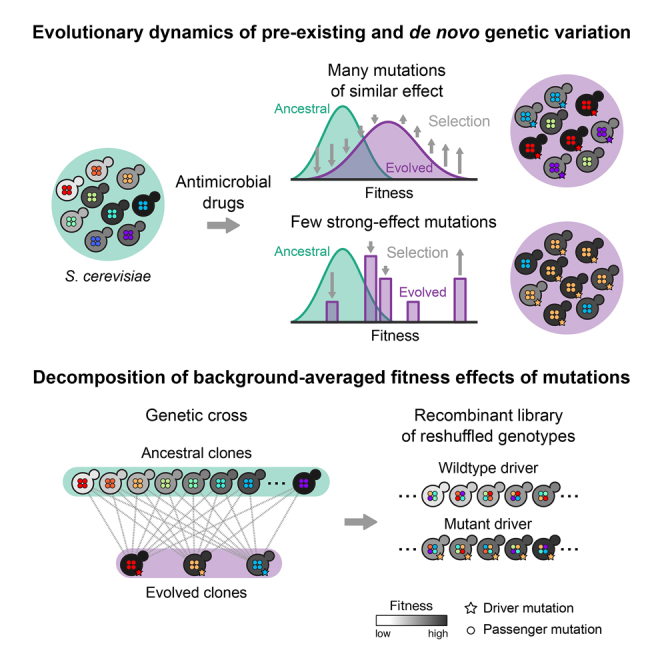
Graphical abstract
Figure 1
Figure 1
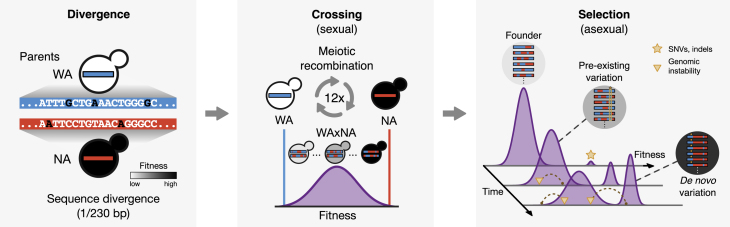
Study Overview Schematic of the divergence, crossing, and selection phases of the experiment. Two diverged S. cerevisiae lineages (WA and NA) were crossed for twelve rounds, generating a large ancestral population of unique haplotypes. These diploid cells were asexually evolved for 32 days in stress and control environments, and their adaptation was studied by whole-population and isolate sequencing and phenotyping. Populations evolved resistant macroscopic subclones driven by individual cells with beneficial genetic backgrounds (i.e., parental allele configurations) and by beneficial de novo mutations that provided a resistance phenotype.
Figure 2
Figure 2
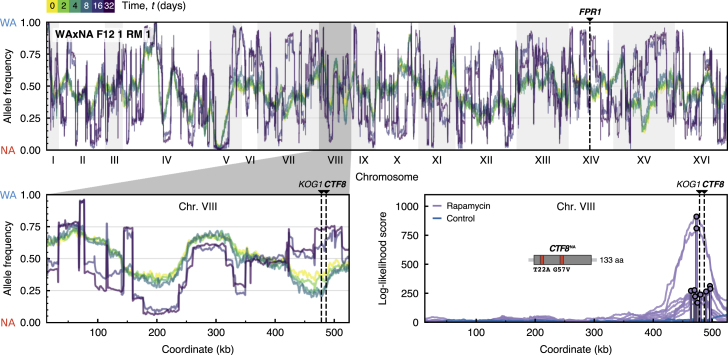
Genome-wide Allele Frequency Changes Genome-wide allele frequency of pre-existing parental variants after t=(0,2,4,8,16,32) days, measured by whole-population sequencing for a representative population in rapamycin. Pre-existing and de novo driver mutations are highlighted by dashed lines. Top: chromosomes are shown on the x axis; the frequency of the WA allele at locus i, xiWA, is shown on the y axis. The reciprocal frequency of the NA allele is equivalent because xiNA=1xiWA. Bottom left: enlarged inset of the shaded region showing allele frequency changes in chromosome VIII during selection in rapamycin. Early time points 2, 4, and 8 show localized allele frequency changes at 460–490 kb because of a beneficial NA allele sweeping with hitchhiking passengers. Late time points 16 and 32 show abrupt jumps between successive loci that reflect the parental haplotype of emerging subclone(s). These long-range correlations can alter the frequency of parental alleles independently of their fitness value. In case of a fully clonal population, allele frequencies at 0, 0.5, and 1.0 would correspond to the background genotypes NA/NA, WA/NA, and WA/WA of a diploid clone that reached fixation. Bottom right: we tested a model in which each allele is proposed to be a driver under selection, with linked passenger alleles also changing in frequency by genetic hitchhiking. Top log likelihood scores are shown for all populations in this region of interest (Supplemental Experimental Procedures). We validated the CTF8NA allele to be strongly beneficial for rapamycin resistance (Figure S8). See also Figures S1 and S2.
Figure 3
Figure 3
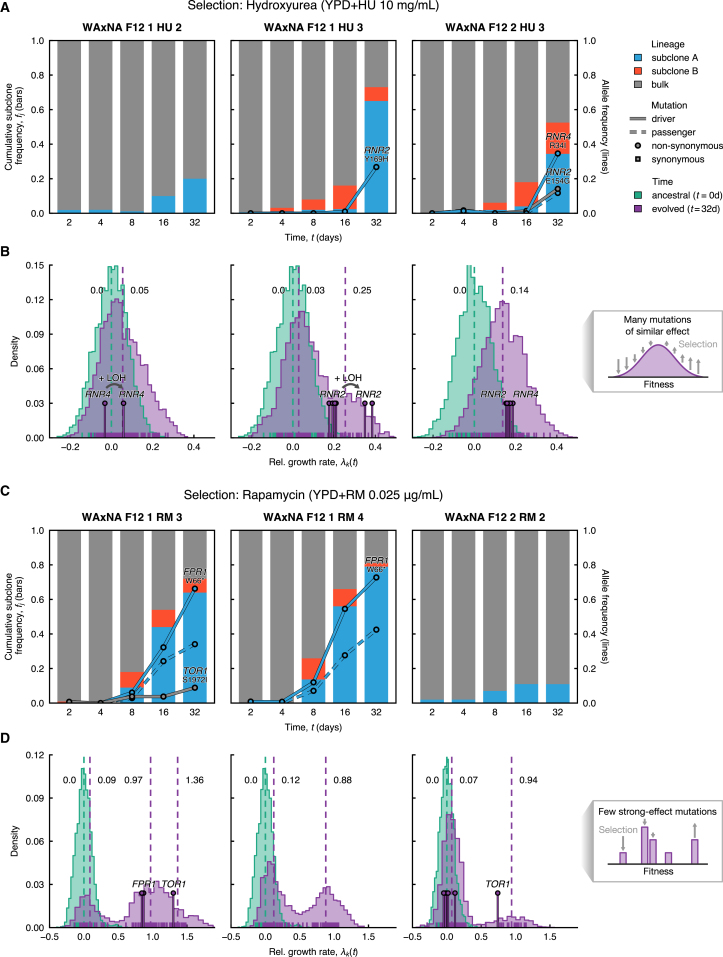
Reconstruction of Subclonal Dynamics Competing subclones evolved in hydroxyurea and rapamycin experienced a variety of fates. (A and C) Time is shown on the x axis, starting after crossing, when the population has no macroscopic subclones and during selection with (A) hydroxyurea and (C) rapamycin between t=0 and t=32 days. Cumulative haplotype frequency of subclones (bars) and allele frequency of de novo mutants (lines) are shown on the y axis. Most commonly, selective sweeps were observed where a spontaneous mutation arose and increased in frequency. Driver mutations are shown as solid lines and passenger mutations as dashed lines, colored by subclone assignment; circles and squares denote non-synonymous and synonymous mutations, respectively. For driver mutations, the mutated gene and codon are indicated above each line. (B and D) Variability in intra-population growth rate, estimated by random sampling of 96 individuals at initial (t=0 days, green) and final time points (t=32 days, purple), before and after selection with (B) hydroxyurea and (D) rapamycin. Relative growth rates λk(t) by individual k are shown at the foot of the histogram, calculated by averaging over nr=32 technical replicates per individual. Relative growth rates are normalized with respect to the mean population growth rate λkt=0 at t=0 days. The posterior means of the distribution modes fitted by a Gaussian mixture model are indicated as dashed lines. The fitter individuals (pins) carry driver mutations, detected by targeted sampling and sequencing. The insets on the right depict a schematic of the fitness distribution in two limit cases: when there are many mutations of similar effect, the fitness wave will be smooth and unimodal; when only few mutations of large effect exist, the fitness distribution will become multimodal. See also Figures S3, S4, and S10.
Figure 4
Figure 4
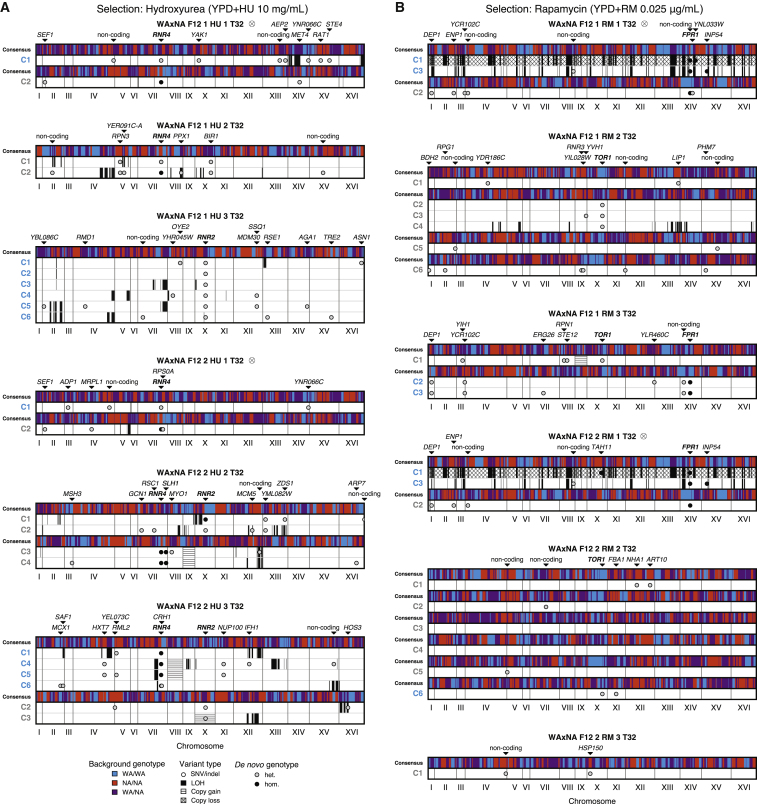
Pervasive Selection for Adaptive Mutations and Genomic Instability Whole-genome sequences of clones sampled from WAxNA F12 populations. SNVs, indels, and chromosome-level aberrations were detected by whole-genome sequencing in single-cell diploid clones derived from evolved populations after t=32 days in (A) hydroxyurea or (B) rapamycin (Table S1). Chromosomes are shown on the x axis; clone isolates are listed on the left, colored by lineage (Figure S3). The consensus shows the majority genotype across population isolates with a sequence identity greater than 80%. WA/WA (blue) and NA/NA (red) represent homozygous diploid genotypes, and WA/NA (purple) represents a heterozygous genotype. Individual cells with a shared background genotype carry de novo SNVs and indels (circles), de novo mis-segregations with loss of heterozygosity (solid segments), and de novo gains or losses in copy number (hatched segments). Driver and passenger mutations are listed along the top (drivers are shown in boldface). Populations marked by ⊗ indicate cross-contamination during the selection phase, but any derived events are independent. All ancestral sequenced isolates can be found in Figure S5. See also Figures 3A and 3C, Table 1, and Table S1.
Figure 5
Figure 5
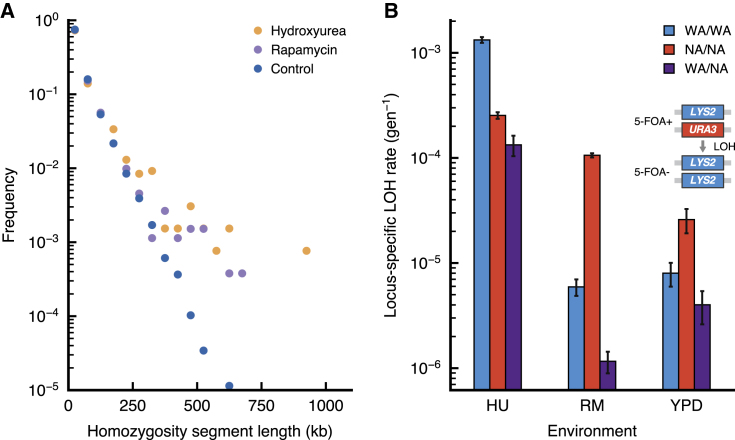
Elevated Rates of Loss of Heterozygosity (A) The length distribution of homozygous segments, in bins corresponding to 50-kb increments, shows an excess of long homozygosity tracts above 300 kb in hydroxyurea and rapamycin (Kolmogorov-Smirnov test, p < 0.01). Ancestral haploid isolates are used to compare a set of in silico diploid genomes to evolved diploid isolates. Only unrelated isolate backgrounds were included. (B) Background- and environment-dependent rates of loss of heterozygosity were measured in a fluctuation assay by loss of the URA3 marker. Resistant colonies growing in 5-fluororotic acid (5-FOA+) indicate loss of the marker. Based on the number of 5-FOA+ colony-forming units (CFUs), the mean number of LOH events are estimated using the empirical probability-generating function of the Luria-Delbrück distribution (Supplemental Experimental Procedures). The locus-specific LOH rates are shown, given by the mean number of LOH events divided by the total number of cells in YPD. Error bars denote the upper and lower 95% confidence intervals. LOH rates were elevated in hydroxyurea compared with the control environment and manifested background-dependent effects between the parents and their hybrid. See also Figure 4.
Figure 6
Figure 6
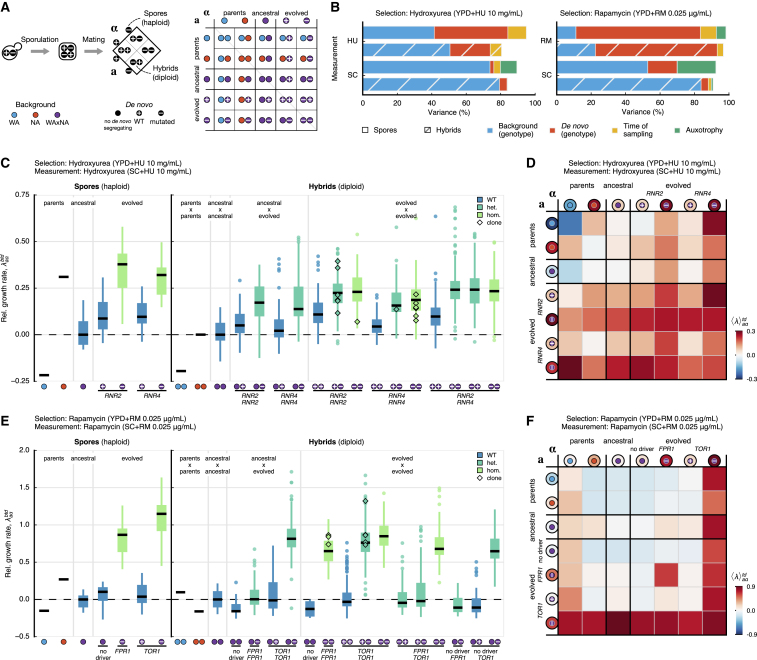
Ensemble-Averaged Fitness Effects of Genetic Background and De Novo Mutations (A) To quantify the fitness effects of background variation and de novo mutations in hydroxyurea (RNR2 and RNR4) and rapamycin (FPR1 and TOR1), we isolated individuals from ancestral and evolved populations. From these diploid cells, we sporulated and selected haploid segregants of each mating type. Spores with mutations in RNR2, RNR4, and TOR1 were genotyped to test whether they carry the wild-type or mutated allele. We crossed the MATa and MATα versions to create hybrids (48 × 48 in hydroxyurea and 56 × 56 in rapamycin). Independent segregants were used to measure the biological variability of ancestral and evolved backgrounds. (B) Variance decomposition of the growth rate of spores (solid) and hybrids (hatched) that can be attributed to different components using a linear mixed model. The model components are the background genotype, b; de novo genotype, d; time of sampling during the selection phase, t; and auxotrophy, x. Estimates of variance components are obtained by restricted maximum likelihood (Figure S12 and Table S6). (C and E) Relative growth rate of spores, λ{a,α}btd, and hybrids, λbtd, measured for multiple combinations of background and de novo genotypes and averaged over measurement replicates. Relative growth rates are normalized with respect to the mean growth rate of the ancestral WAxNA cross. Measurements of cells selected in (C) hydroxyurea and (E) rapamycin were taken in the respective stress environments. Medians and 25%/75% percentiles across groups are shown, with medians shown as horizontal black lines and colored by de novo genotype (wild-type, blue; heterozygote, cyan; homozygote, green). Outliers (circles) and isolated, selected clones with matching genotypes (diamonds) are highlighted. (D and F) Ensemble average of the relative growth rate of spores, λ{a,α}td, and hybrids, λtd, measured in (D) hydroxyurea and (F) rapamycin. The color scale for all matrices is shown at the right and indicates the difference in the ensemble average with respect to the ancestral WAxNA crosses. The symbols in (C)–(F) follow the legend in (A) and indicate combinations of the type of genetic background (WA parent, formula image; NA parent, formula image; WAxNA segregant, formula image) and the genotype of de novo mutations (no de novo mutation, formula image; wild-type, formula image; mutated, formula image). An extended version of the figure with all combinations and controls can be found in Figures S10 and S11, respectively.

References

    1. Balaban N.Q., Merrin J., Chait R., Kowalik L., Leibler S. Bacterial persistence as a phenotypic switch. Science. 2004;305:1622–1625. - PubMed
    1. Barbera M.A., Petes T.D. Selection and analysis of spontaneous reciprocal mitotic cross-overs in Saccharomyces cerevisiae. Proc. Natl. Acad. Sci. USA. 2006;103:12819–12824. - PMC - PubMed
    1. Barrick J.E., Lenski R.E. Genome dynamics during experimental evolution. Nat. Rev. Genet. 2013;14:827–839. - PMC - PubMed
    1. Boyer S., Biswas D., Kumar Soshee A., Scaramozzino N., Nizak C., Rivoire O. Hierarchy and extremes in selections from pools of randomized proteins. Proc. Natl. Acad. Sci. USA. 2016;113:3482–3487. - PMC - PubMed
    1. Burke M.K., Dunham J.P., Shahrestani P., Thornton K.R., Rose M.R., Long A.D. Genome-wide analysis of a long-term evolution experiment with Drosophila. Nature. 2010;467:587–590. - PubMed

LinkOut - more resources