Review
. 2017 Nov;58(6):1083-1091.
doi: 10.3349/ymj.2017.58.6.1083.

Alterations in Gut Microbiota and Immunity by Dietary Fat

Affiliations
Review

Alterations in Gut Microbiota and Immunity by Dietary Fat

Bo Gie Yang et al. Yonsei Med J. 2017 Nov.

Abstract

Gut microbiota play critical physiological roles in energy extraction from the intestine and in the control of systemic immunity, as well as local intestinal immunity. Disturbance of gut microbiota leads to the development of several diseases, such as colitis, inflammatory bowel diseases, metabolic disorders, cancer, etc. From a metabolic point of view, the gut is a large metabolic organ and one of the first to come into contact with dietary fats. Interestingly, excessive dietary fat has been incriminated as a primary culprit of metabolic syndrome and obesity. After intake of high-fat diet or Western diet, extensive changes in gut microbiota have been observed, which may be an underlying cause of alterations in whole body metabolism and nutrient homeostasis. Here, we summarize recent data on changes in the gut microbiota and immunity associated with dietary fat, as well as their relationships with the pathogenesis of metabolic syndrome. These findings may provide insight into the understanding of the complex pathophysiology related to the development of metabolic diseases and offer an opportunity to develop novel candidates for therapeutic agents.

Keywords: Gut microbiota; diabetes; gut immunity; obesity.


Conflict of interest statement

The authors have no financial conflicts of interest.

Figures
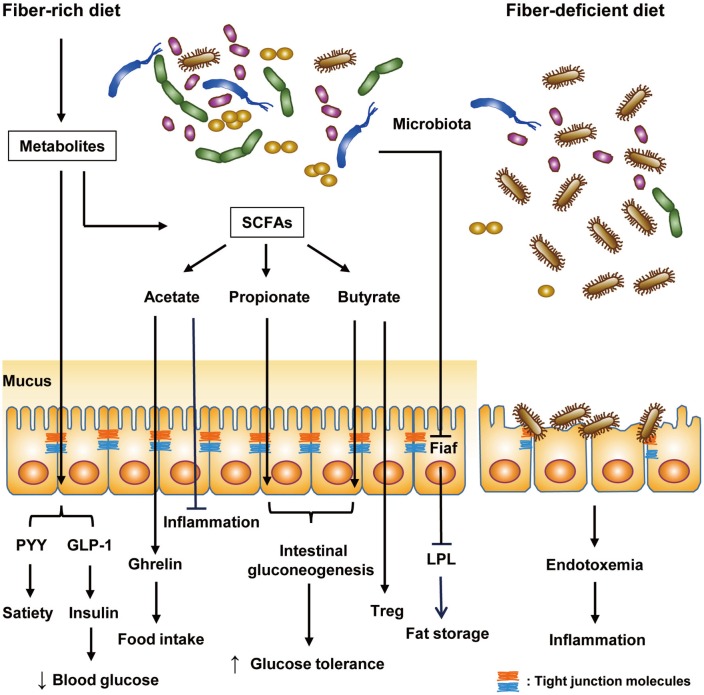
Fig. 1
Fig. 1. Regulation of host metabolism and immunity by gut microbiota. Under a fiber-rich diet, gut microbiota metabolize undigested dietary fiber into SCFAs (acetate, propionate, and butyrate), affecting host metabolism and immunity. Microbial metabolites from this process improve host metabolism. In particular, the secretion of peptide hormones, such as PYY and GLP-1, is promoted by microbial metabolites: PYY decreases appetite and GLP-1 lowers blood glucose level via promotion of insulin secretion. Among SCFAs, butyrate and propionate activate intestinal gluconeogenesis and improve systemic glucose profiles. Meanwhile, acetate promotes secretion of ghrelin, a hunger hormone, and increases food intake, consequently causing hyperphagia and obesity. Nevertheless, acetate has anti-inflammatory function like butyrate. Butyrate enhances gut barrier function of intestinal epithelial cells and increases regulatory T (Treg) cells. In addition, gut microbiota suppress expression of fasting-induced adipose factor (Fiaf), an inhibitor of LPL, promoting fat storage in adipocytes. Under fiber-deficient diet, mucus-degrading bacteria expand and impair the integrity of the mucus layer. Thereby, endotoxemia-induced metabolic inflammation ensues. SCFAs, short-chain fatty acids; PYY, peptide YY; GLP-1, glucagon-like peptide-1; LPL, lipoprotein lipase.
Fig. 2
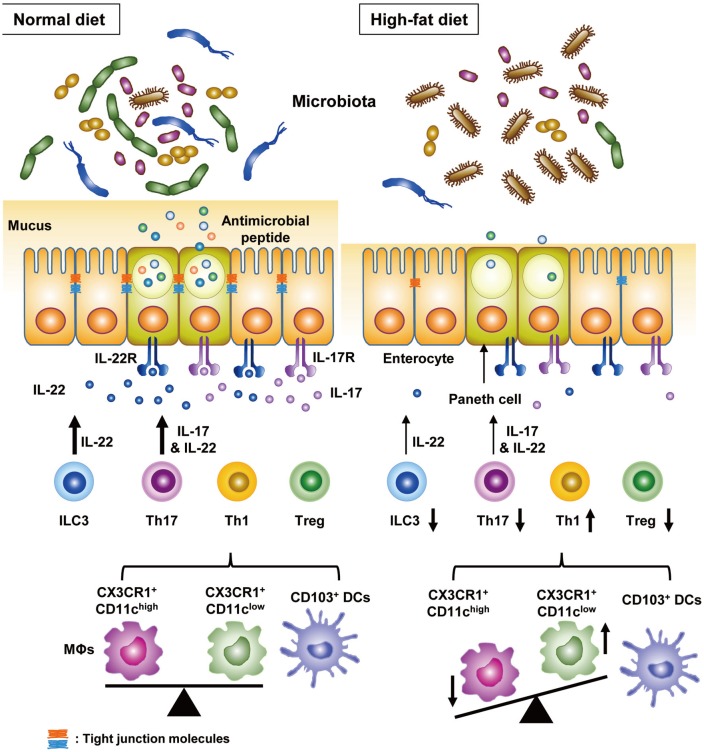
Fig. 2. Changes in the intestinal immunity by HFD. HFD changes intestinal immunity, as well as gut microbiota composition. HFD, in particular, increases the frequency of Th1 cells among the CD4 T cells and decreases those of Th17 and Treg cells. HFD increases the frequency of a CX3CR1+CD11chigh macrophage (MΦ) subset, preferentially inducing Th1 cells, and decreases that of a CX3CR1+CD11clow MΦ subset, preferentially inducing Th17 cells without affecting that of CD103+ DCs. Changes in the proportions of two MΦ subsets lead to the changes in Th1 and Th17 cells after HFD feeding. Intriguingly, intestinal Th17 cells play an important role in improving metabolic diseases through IL-17 and IL-22. IL-22 is produced also by ILC3 and functions to improve metabolic profiles. Proportions of ILC3 are decreased by HFD. IL-17, mainly produced by Th17 cells, reverses decreased granules and antimicrobial peptide production of Paneth cells, leading to expansion of microbiota associated with lean phenotype. In addition, IL-17 enhances barrier function of intestinal epithelial cell by increasing expression of tight junction molecules. HFD, high-fat diet; DCs, dendritic cells; IL, interleukin, ILC3, group 3 innate lymphoid cells.

References

    1. Beltrán-Sánchez H, Harhay MO, Harhay MM, McElligott S. Prevalence and trends of metabolic syndrome in the adult U.S. population, 1999-2010. J Am Coll Cardiol. 2013;62:697–703. - PMC - PubMed
    1. Hotamisligil GS. Inflammation and metabolic disorders. Nature. 2006;444:860–867. - PubMed
    1. Cani PD, Amar J, Iglesias MA, Poggi M, Knauf C, Bastelica D, et al. Metabolic endotoxemia initiates obesity and insulin resistance. Diabetes. 2007;56:1761–1772. - PubMed
    1. Hill DA, Artis D. Intestinal bacteria and the regulation of immune cell homeostasis. Intestinal bacteria and the regulation of immune cell homeostasis. Annu Rev Immunol. 2010;28:623–667. - PMC - PubMed
    1. Qin J, Li R, Raes J, Arumugam M, Burgdorf KS, Manichanh C, Nielsen T, et al. A human gut microbial gene catalogue established by metagenomic sequencing. Nature. 2010;464:59–65. - PMC - PubMed