. 2018 Feb 1;35(2):312-334.
doi: 10.1093/molbev/msx271.

The Rate of Evolution of Postmating-Prezygotic Reproductive Isolation in Drosophila

Affiliations

The Rate of Evolution of Postmating-Prezygotic Reproductive Isolation in Drosophila

David A Turissini et al. Mol Biol Evol. .

Abstract

Reproductive isolation is an intrinsic aspect of species formation. For that reason, the identification of the precise isolating traits, and the rates at which they evolve, is crucial to understanding how species originate and persist. Previous work has measured the rates of evolution of prezygotic and postzygotic barriers to gene flow, yet no systematic analysis has studied the rates of evolution of postmating-prezygotic (PMPZ) barriers. We measured the magnitude of two barriers to gene flow that act after mating occurs but before fertilization. We also measured the magnitude of a premating barrier (female mating rate in nonchoice experiments) and two postzygotic barriers (hybrid inviability and hybrid sterility) for all pairwise crosses of all nine known extant species within the melanogaster subgroup. Our results indicate that PMPZ isolation evolves faster than hybrid inviability but slower than premating isolation. Next, we partition postzygotic isolation into different components and find that, as expected, hybrid sterility evolves faster than hybrid inviability. These results lend support for the hypothesis that, in Drosophila, reproductive isolation mechanisms (RIMs) that act early in reproduction (or in development) tend to evolve faster than those that act later in the reproductive cycle. Finally, we tested whether there was evidence for reinforcing selection at any RIM. We found no evidence for generalized evolution of reproductive isolation via reinforcement which indicates that there is no pervasive evidence of this evolutionary process. Our results indicate that PMPZ RIMs might have important evolutionary consequences in initiating speciation and in the persistence of new species.

Keywords: Drosophila; conspecific sperm precedence; genomic alignment; hybrids; postmating-prezygotic isolation; postzygotic isolation; premating isolation.


Figures

<sc>Fig</sc>. 1.
Fig. 1.
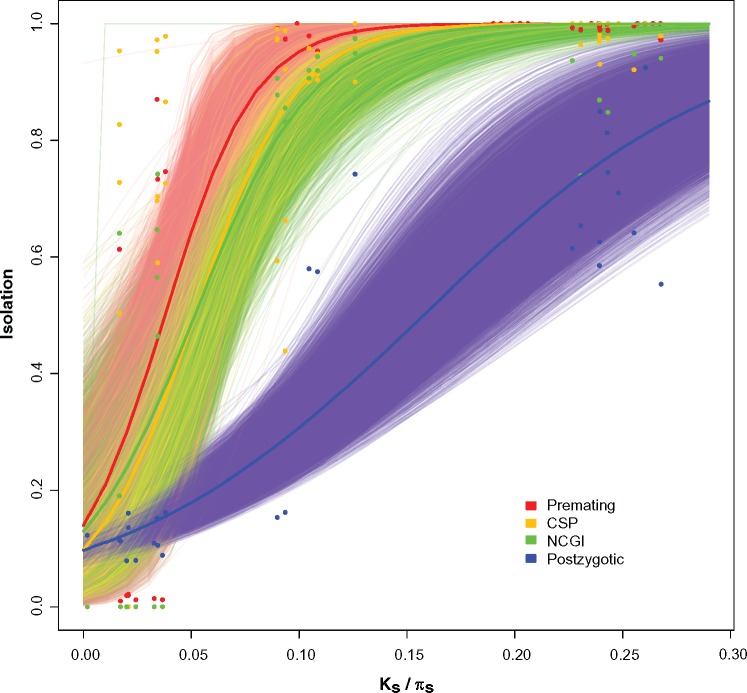
Premating, conspecific sperm precedence, noncompetitive gametic isolation, and postzygotic isolation increase with pairwise genetic distance between species. Proxies of premating isolation (red), conspecific sperm precedence (CSP, yellow), noncompetitive gametic isolation (NCGI, green), and postzygotic isolation (blue) were regressed against phylogenetic distance (Ks between species and πs within species). The four types of isolation increase with genetic distance, and premating isolation evolves faster than hybrid inviability. The thick red, yellow, green, and blue lines represent fitted logistic regressions for the premating, and postzygotic data, respectively. The thinner lines of each of the four colors are the regressions for each of 10,000 bootstrap resamplings of the data.
<sc>Fig</sc>. 2.
Fig. 2.
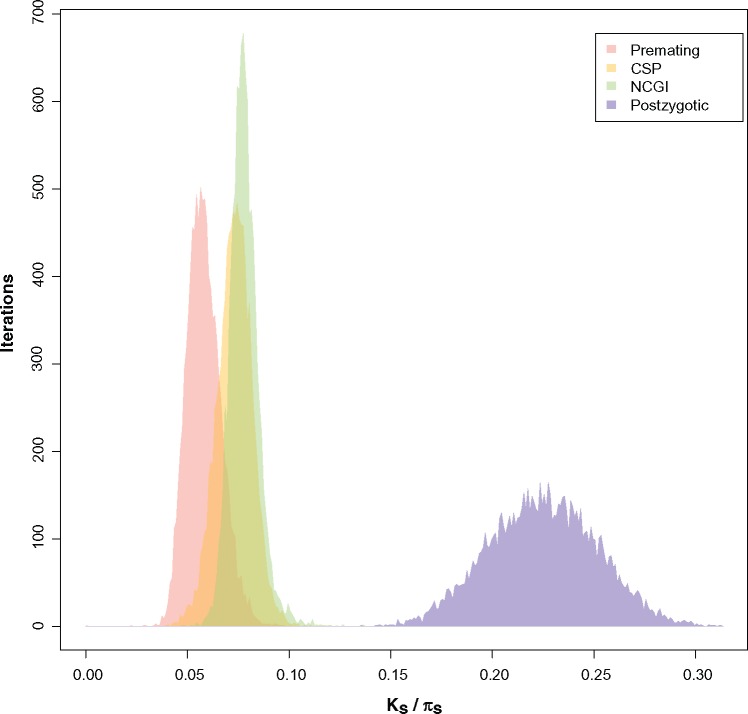
Premating, NCGI, CSP, and postzygotic isolation evolve at different rates in the melanogaster species subgroup. Threshold_Ks illustrates the Ks value for which a given RI barrier achieves a value of 0.95. Premating isolation values are red, conspecific sperm precedence (CSP) are yellow, noncompetitive gametic isolation (NCGI) are green, and postzygotic values are blue. Regression coefficients (supplementary table S9, Supplementary Material online) show that the rates at which each RIM increases differ from each other.
<sc>Fig</sc>. 3.
Fig. 3.
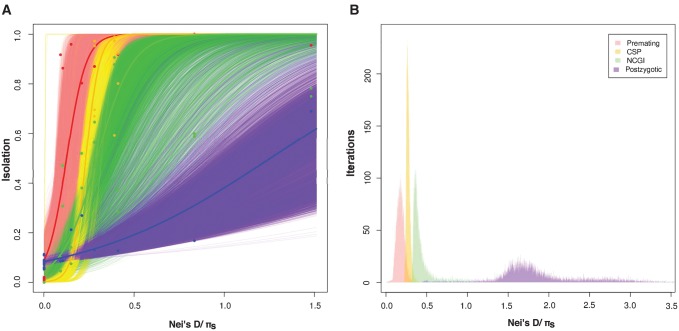
Premating, CSP, NCGI, and postzygotic isolation increase with pairwise genetic distance between species across the Sophophora subgenus. To account for the possibility of phylogenetic nonindependence in the melanogaster species subgroup, we subsampled phylogenetically independent crosses and added a pair of species from other four Drosophila clades (all within the Sophophora genus). Proxies of RI are similar to the ones shown in figure 1. Premating isolation (red), conspecific sperm precedence (CSP, yellow), noncompetitive gametic isolation (NCGI, green), and postzygotic isolation (blue) were regressed against phylogenetic distance (Nei’s distance between species and πs within species). (A) As observed in the melanogaster species subgroup, the four types of isolation increase with genetic distance, and premating isolation evolves faster than hybrid inviability. The thick red, yellow, green, and blue lines represent fitted logistic regressions for the premating and postzygotic data, respectively. The thinner lines of each of the four colors are the regressions for each of 10,000 bootstrap resamplings of the data. (B) Premating, NCGI, CSP, and postzygotic isolation (hybrid inviability) evolve at different rates in the Drosophila genus in a set of phylogenetically independent species pairs (supplementary table S10, Supplementary Material online). Bootstrapped distributions of Threshold_Ks show the Ks value for which a given RI barrier achieves a value of 0.95 and illustrate that all RIMs evolve at a different rate.
<sc>Fig</sc>. 4.
Fig. 4.
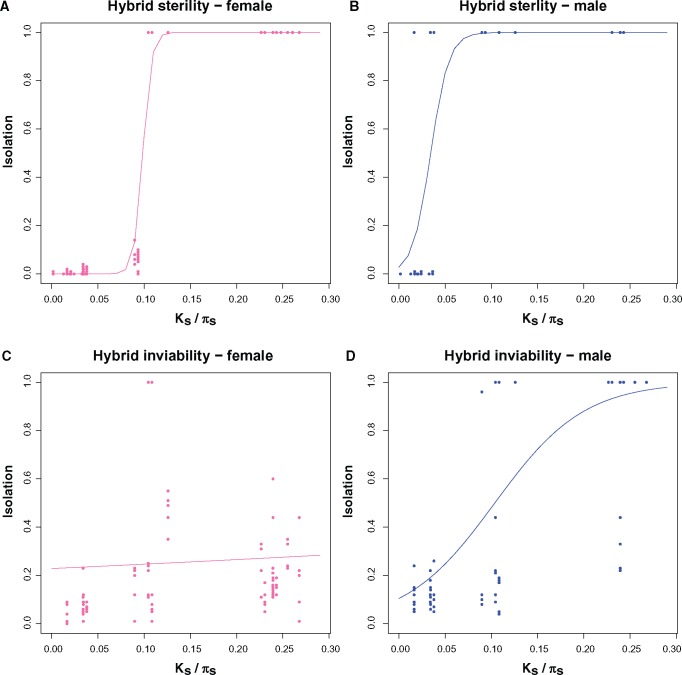
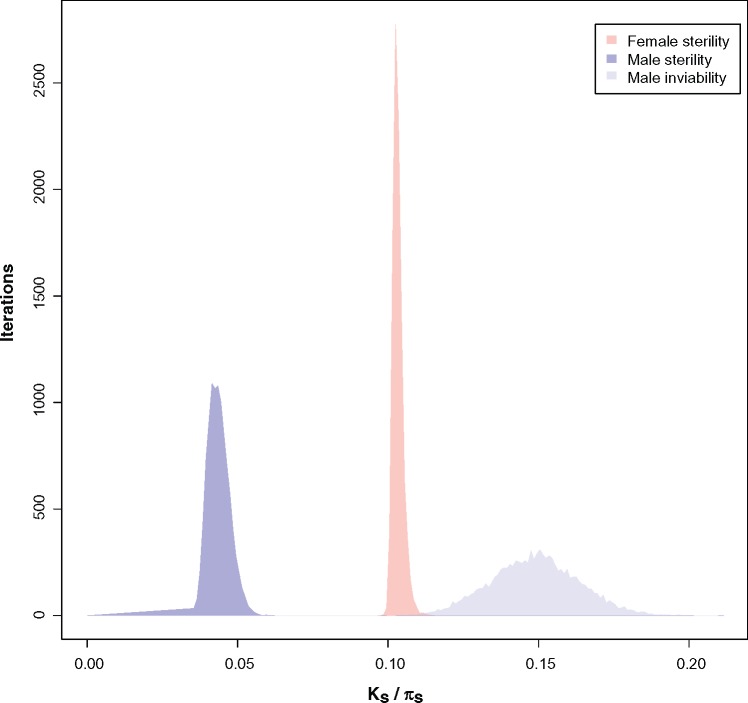
Hybrid sterility evolves faster than hybrid inviability. Values of female and male inviability and female and male sterility were regressed against phylogenetic distance (Ks between species and πs within species). The four types of isolation increase with genetic distance. In both sexes, fertility evolves faster than hybrid inviability. Given the perfect separation of values along the x-axis (Kss), hybrid sterility was not directly compared with other RIMs.
<sc>Fig</sc>. 5.
Fig. 5.
Female sterility, male sterility, and female sterility evolve at different rates in the melanogaster species subgroup. Threshold_Ks indicates the Ks value for which a given RI barrier achieves a value of 0.95 (similar to the distributions shown in fig. 2). Even though these distributions of bootstrapped values are not a statistical test, Threshold_Ks illustrates how quickly isolation approaches 1. Female sterility values are red, male sterility are purple, and male inviability are blue. Female viability did not reach (or approached) an asymptote in our study and for that reason there is no distribution of bootstrapped values for this RIM.
<sc>Fig</sc>. 6.
Fig. 6.
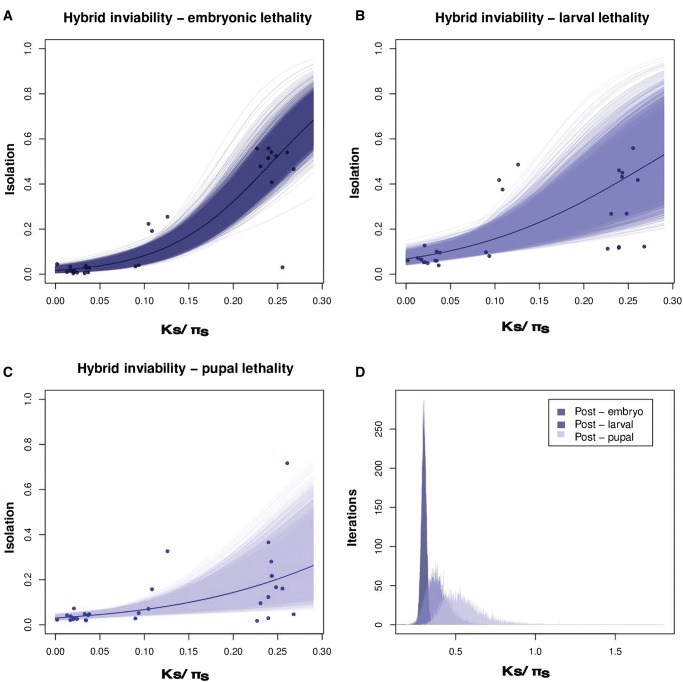
Rates at which inviability increases with genetic distance for three developmental stages. Measures of inviability at each developmental stage were regressed against phylogenetic distance (Ks between species and πs within species). The three types of postzygotic isolation (i.e., death at a particular developmental stage) increase with genetic distance. (A) Embryonic lethality. (B) Larval lethality. (C) Pupal lethality. The thick lines represent fitted logistic regressions for each developmental stage. The thinner lines are the regressions for each of 10,000 bootstrap resamplings of the data. (D) Distributions of bootstrapped values of Threshold_Ks, a parameter that determines how quickly isolation approaches 1, are largely nonoverlapping. Regression coefficients (supplementary table S15, Supplementary Material online) show that early inviability (hybrid embryonic lethality) evolves faster than later inviability (hybrid pupal lethality).

References

    1. Abbott R, Albach D, Ansell S, Arntzen JW, Baird SJE, Bierne N, Boughman J, Brelsford A, Buerkle CA, Buggs R, et al. 2013. Hybridization and speciation. J Evol Biol. 262: 229–246. - PubMed
    1. Ahmed-Braimah YH. 2016. Multiple genes cause postmating prezygotic reproductive isolation in the Drosophila virilis group. G3 6:4067–4076. - PMC - PubMed
    1. Ahmed-Braimah YH, McAllister BF.. 2012. Rapid evolution of assortative fertilization between recently allopatric species of Drosophila. Int J Evol Biol. 2012:285468.. - PMC - PubMed
    1. Ala‐Honkola O, Ritchie MG, Veltsos P.. 2016. Postmating–prezygotic isolation between two allopatric populations of Drosophila montana: fertilisation success differs under sperm competition. Ecol Evol. 66: 1679–1691. - PMC - PubMed
    1. Andolfatto P. 2007. Hitchhiking effects of recurrent beneficial amino acid substitutions in the Drosophila melanogaster genome. Genome Res. 1712: 1755–1762.http://dx.doi.org/10.1101/gr.6691007 - DOI - PMC - PubMed

Publication types