


Analysis of the interests of Google users on toothache information
- PMID: 29049315
- PMCID: PMC5648146
- DOI: 10.1371/journal.pone.0186059
Analysis of the interests of Google users on toothache information
Abstract
Background: The knowledge on health interests of a given population of Internet users might contribute to the increase of evidence on community's dental needs, and consequently, to the improvement of public health planning. The frequency of searches for specific issues on Google can be analyzed by the application of Google Trends.
Aim: In this study, we aimed to characterize the interests on toothache information of Google users from the United States, United Kingdom, Australia and Brazil.
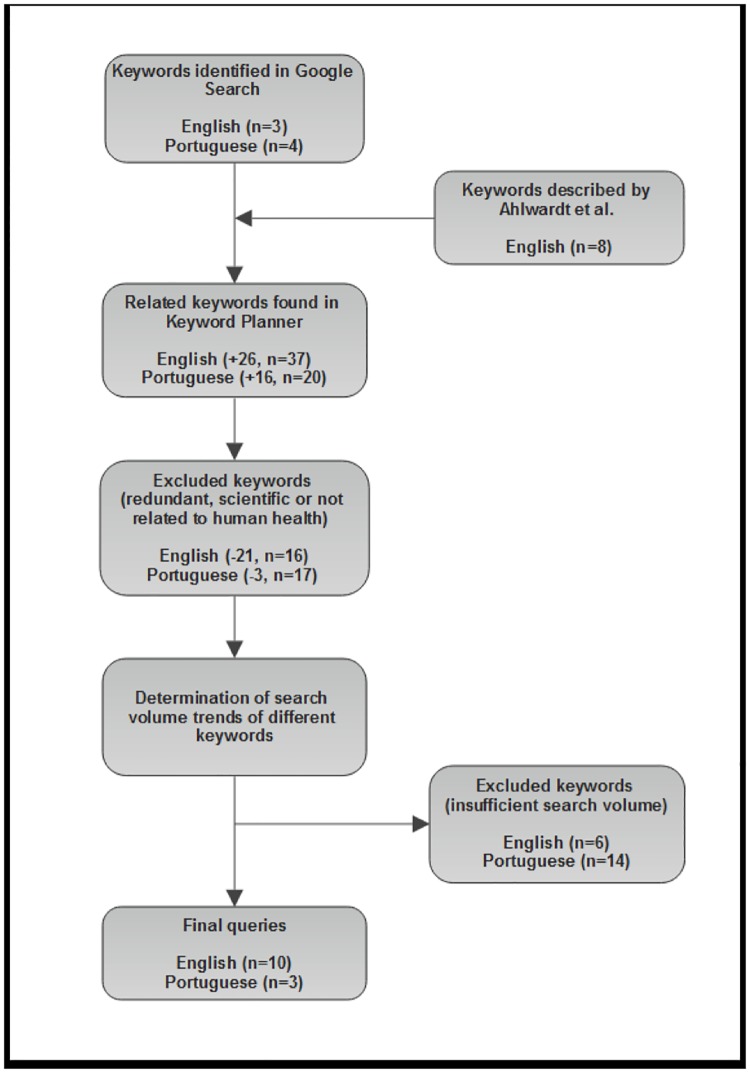
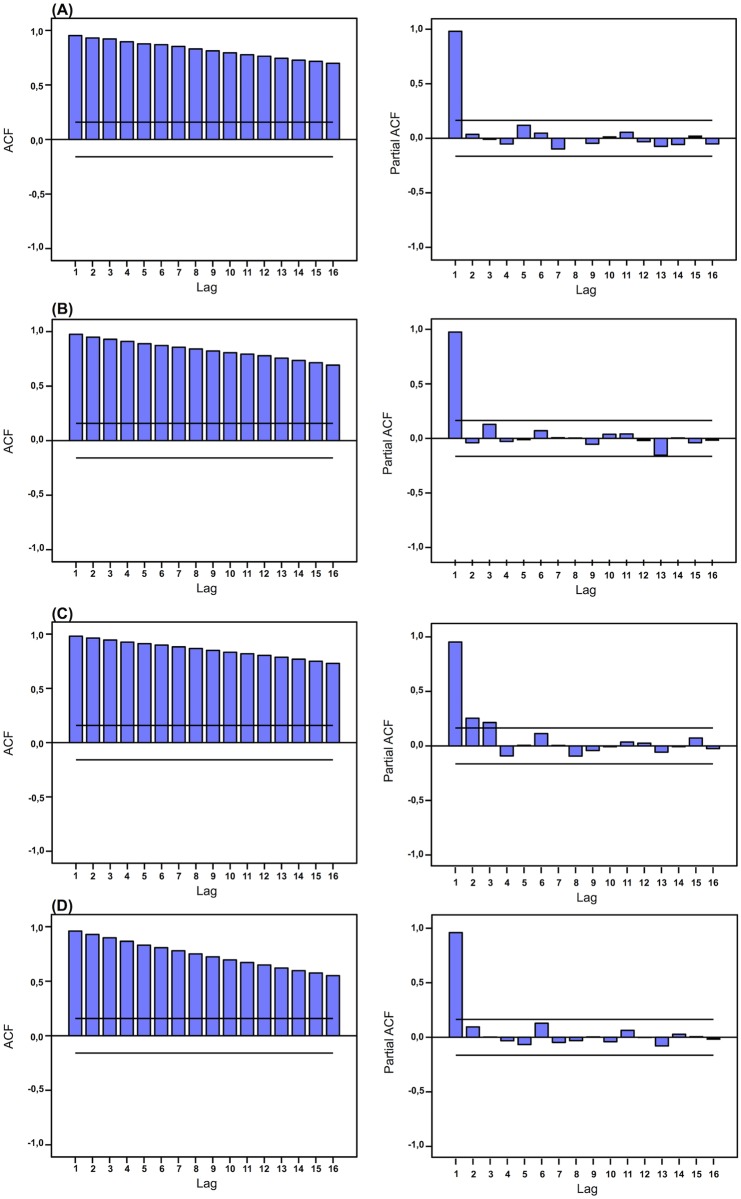
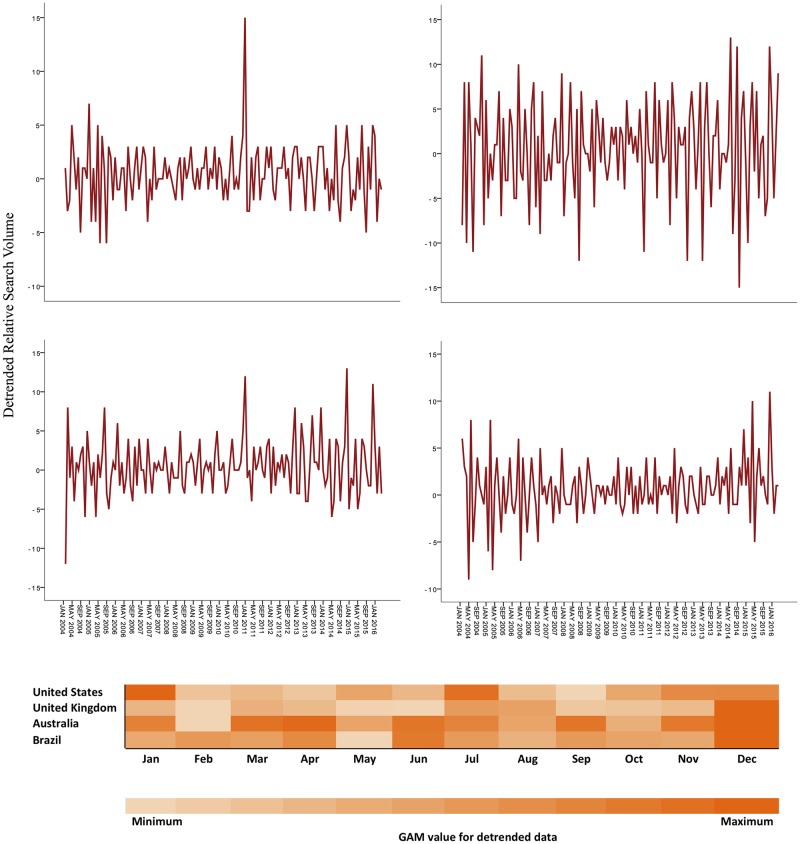
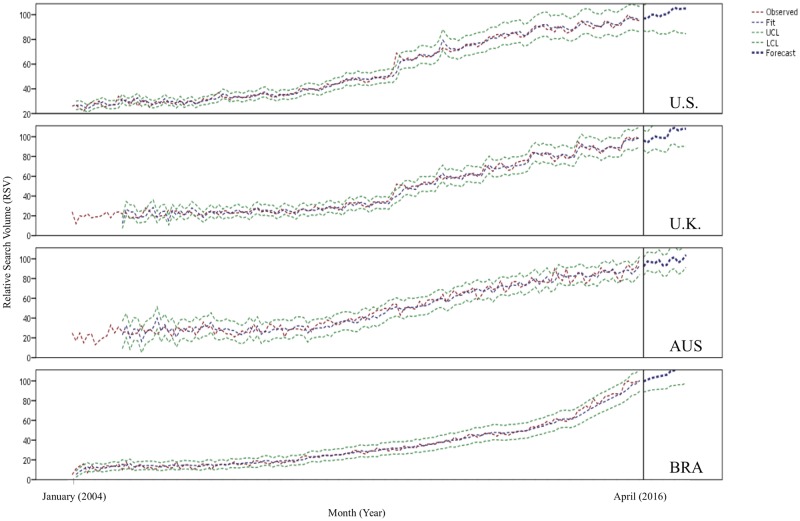
Methods: The monthly variation of relative search volume (RSV) and the lists of main toothache-related queries were determined from January 2004 through April 2016 using Google Trends. Autoregressive Integrated Moving Average (ARIMA) forecasting models were developed to determine predictive RSV values for toothache for additional 12 months. Autocorrelation plots and general additive model (GAM) were applied to determine trends and seasonality in RSV curves. Through linear regression models, we assessed the association between the variation of annual means of RSV values and national statistics for toothache in the U.S. and U.K. Subsequently, the distribution of main queries according to the identification of endodontic pain, type of searching information, and the interest in self-management of toothache was evaluated for the four countries.
Results: The autocorrelation plots showed patterns of non-stationary time series. The monthly variation influenced the data of the U.S. and U.K., with the higher RSV values found respectively in January/July and December. Also, the interest on toothache in the U.K. increases in the second semester and in the fourth quarter, especially in December. Additionally, an annual variation affected significantly all time series, with the increment of RSV means over the years, varying from 265% in the U.S. to 745% in Brazil. In parallel, the increments in RSV values were also observed in all predictive curves. The annual variation of observed and fitted RSV values was directly associated with the increase of toothache visits in the U.S. and urgent dental treatments in the U.K. Moreover, the queries typed on Google were markedly linked to searches on endodontic pain information, especially in Brazil, where the residents usually searched for relief and/or self-management of pain.
Conclusions: Therefore, these findings indicate an increasing interest of Google users on toothache-related topics, regardless of country and season. The Internet activity can be used by policy makers as a complementary source of data for the development and implementation of strategies to control and prevent toothache complications.
Conflict of interest statement
Figures
Similar articles
-
Digital behavior surveillance: Monitoring dental caries and toothache interests of Google users from developing countries.Oral Dis. 2019 Jan;25(1):339-347. doi: 10.1111/odi.12986. Epub 2018 Oct 17. Oral Dis. 2019. PMID: 30270556
-
Toothpaste-related interests of Google users from different countries.Braz Oral Res. 2023 Dec 15;37:e124. doi: 10.1590/1807-3107bor-2023.vol37.0124. eCollection 2023. Braz Oral Res. 2023. PMID: 38126468
-
Digital surveillance: The interest in mouthwash-related information.Int J Dent Hyg. 2024 May;22(2):414-422. doi: 10.1111/idh.12755. Epub 2023 Sep 18. Int J Dent Hyg. 2024. PMID: 37721314
-
Assessing the Methods, Tools, and Statistical Approaches in Google Trends Research: Systematic Review.J Med Internet Res. 2018 Nov 6;20(11):e270. doi: 10.2196/jmir.9366. J Med Internet Res. 2018. PMID: 30401664 Free PMC article.
-
[Web search data as health data? : Geographic differences, temporal trends, and topics of interest from internet search engine analyses in Germany].Hautarzt. 2022 Jan;73(1):53-60. doi: 10.1007/s00105-021-04918-x. Epub 2021 Nov 23. Hautarzt. 2022. PMID: 34812913 Free PMC article. Review. German.
Cited by
-
Influence of Mass Media on Italian Web Users During the COVID-19 Pandemic: Infodemiological Analysis.JMIRx Med. 2021 Oct 18;2(4):e32233. doi: 10.2196/32233. eCollection 2021 Oct-Dec. JMIRx Med. 2021. PMID: 34842858 Free PMC article.
-
A study of Facebook comments regarding amber teething necklaces: insights into public perception.Eur Arch Paediatr Dent. 2025 Feb;26(1):71-82. doi: 10.1007/s40368-024-00956-w. Epub 2024 Nov 6. Eur Arch Paediatr Dent. 2025. PMID: 39503825
-
"Dr. Google, I am in Pain"-Global Internet Searches Associated with Pain: A Retrospective Analysis of Google Trends Data.Int J Environ Res Public Health. 2020 Feb 4;17(3):954. doi: 10.3390/ijerph17030954. Int J Environ Res Public Health. 2020. PMID: 32033087 Free PMC article.
-
Levels of toothache-related interests of Google and YouTube users from developed and developing countries over time.PeerJ. 2019 Oct 10;7:e7706. doi: 10.7717/peerj.7706. eCollection 2019. PeerJ. 2019. PMID: 31616582 Free PMC article.
-
Chronic lifestyle diseases display seasonal sensitive comorbid trend in human population evidence from Google Trends.PLoS One. 2018 Dec 12;13(12):e0207359. doi: 10.1371/journal.pone.0207359. eCollection 2018. PLoS One. 2018. PMID: 30540756 Free PMC article.
References
-
- Hobdell M, Petersen PE, Clarkson J, Johnson N. Global goals for oral health 2020. Int Dent J. 2003; 53:285–288. - PubMed
-
- Cohen LA, Bonito AJ, Akin DR, Manski RJ, Macek MD, Edwards RR, et al. Toothache pain: behavioral impact and self-care strategies. Spec Care Dentist. 2009; 29:85–95. doi: 10.1111/j.1754-4505.2008.00068.x - DOI - PubMed
-
- Santiago BM, Valença AM, Vettore MV. Social capital and dental pain in Brazilian northeast: a multilevel cross-sectional study. BMC Oral Health. 2013; 13:2 doi: 10.1186/1472-6831-13-2 - DOI - PMC - PubMed
-
- Mejia G, Armfield JM, Jamieson LM. Self-rated oral health and oral health-related factors: the role of social inequality. Aust Dent J. 2014; 59:226–233. doi: 10.1111/adj.12173 - DOI - PubMed
-
- Locker D, Grushka M. The impact of dental and facial pain. J Dent Res. 1987; 66:1414–1417. doi: 10.1177/00220345870660090101 - DOI - PubMed
MeSH terms
LinkOut - more resources
Full Text Sources
Other Literature Sources
Miscellaneous
