


HIV dynamics linked to memory CD4+ T cell homeostasis
- PMID: 29049331
- PMCID: PMC5648138
- DOI: 10.1371/journal.pone.0186101
HIV dynamics linked to memory CD4+ T cell homeostasis
Abstract
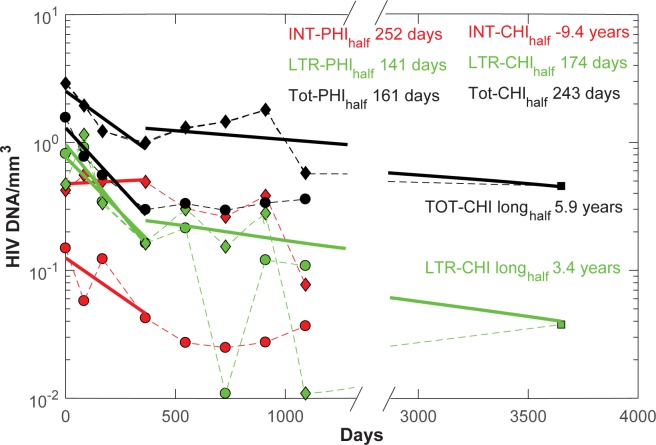
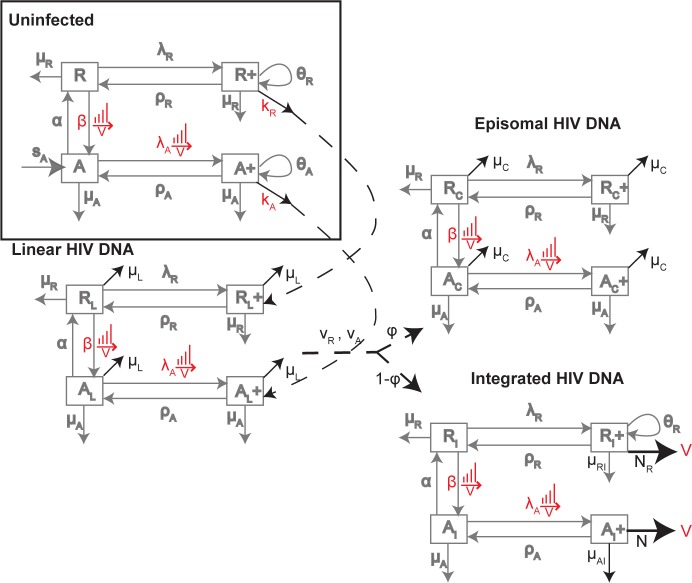
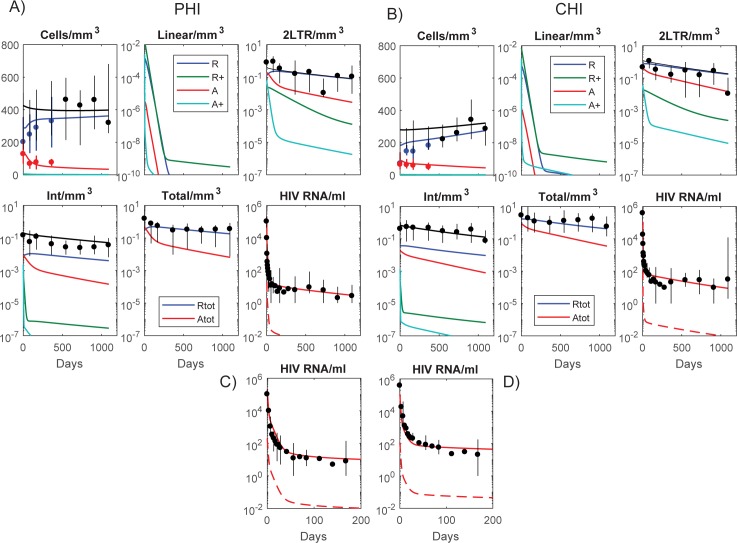
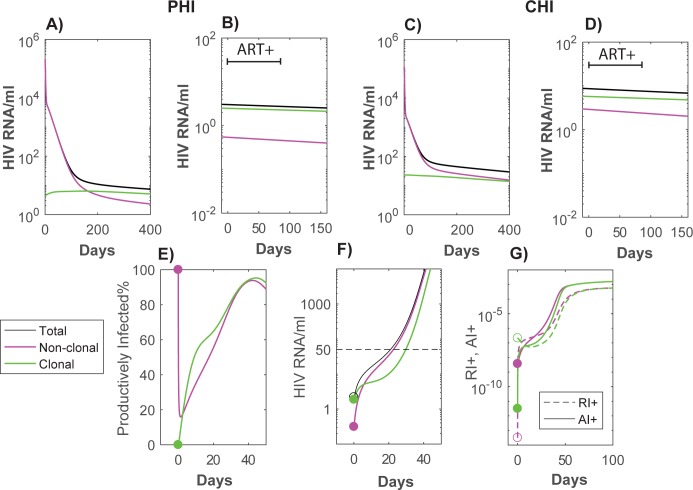
The dynamics of latent HIV is linked to infection and clearance of resting memory CD4+ T cells. Infection also resides within activated, non-dividing memory cells and can be impacted by antigen-driven and homeostatic proliferation despite suppressive antiretroviral therapy (ART). We investigated whether plasma viral level (pVL) and HIV DNA dynamics could be explained by HIV's impact on memory CD4+ T cell homeostasis. Median total, 2-LTR and integrated HIV DNA levels per μL of peripheral blood, for 8 primary (PHI) and 8 chronic HIV infected (CHI) individuals enrolled on a raltegravir (RAL) based regimen, exhibited greatest changes over the 1st year of ART. Dynamics slowed over the following 2 years so that total HIV DNA levels were equivalent to reported values for individuals after 10 years of ART. The mathematical model reproduced the multiphasic dynamics of pVL, and levels of total, 2-LTR and integrated HIV DNA in both PHI and CHI over 3 years of ART. Under these simulations, residual viremia originated from reactivated latently infected cells where most of these cells arose from clonal expansion within the resting phenotype. Since virion production from clonally expanded cells will not be affected by antiretroviral drugs, simulations of ART intensification had little impact on pVL. HIV DNA decay over the first year of ART followed the loss of activated memory cells (120 day half-life) while the 5.9 year half-life of total HIV DNA after this point mirrored the slower decay of resting memory cells. Simulations had difficulty reproducing the fast early HIV DNA dynamics, including 2-LTR levels peaking at week 12, and the later slow loss of total and 2-LTR HIV DNA, suggesting some ongoing infection. In summary, our modelling indicates that much of the dynamical behavior of HIV can be explained by its impact on memory CD4+ T cell homeostasis.
Conflict of interest statement
Figures
References
-
- Chun TW, Justement JS, Moir S, Hallahan CW, Maenza J, Mullins JI, et al. Decay of the HIV reservoir in patients receiving antiretroviral therapy for extended periods: implications for eradication of virus. J Infect Dis. 2007;195(12):1762–4. Epub 2007/05/12. doi: JID37645 [pii] doi: 10.1086/518250 . - DOI - PubMed
-
- Chun TW, Nickle DC, Justement JS, Meyers JH, Roby G, Hallahan CW, et al. Persistence of HIV in gut-associated lymphoid tissue despite long-term antiretroviral therapy. J Infect Dis. 2008;197(5):714–20. Epub 2008/02/12. doi: 10.1086/527324 . - DOI - PubMed
-
- Palmer S, Maldarelli F, Wiegand A, Bernstein B, Hanna GJ, Brun SC, et al. Low-level viremia persists for at least 7 years in patients on suppressive antiretroviral therapy. Proc Natl Acad Sci U S A. 2008;105(10):3879–84. Epub 2008/03/12. doi: 10.1073/pnas.0800050105 . - DOI - PMC - PubMed
-
- Crooks AM, Bateson R, Cope AB, Dahl NP, Griggs MK, Kuruc JD, et al. Precise Quantitation of the Latent HIV-1 Reservoir: Implications for Eradication Strategies. J Infect Dis. 2015;212(9):1361–5. doi: 10.1093/infdis/jiv218 - DOI - PMC - PubMed
MeSH terms
Substances
LinkOut - more resources
Full Text Sources
Other Literature Sources
Medical
Research Materials
