Age-Related Changes in Objective and Subjective Speech Perception in Complex Listening Environments
- PMID: 29049601
- PMCID: PMC5945070
- DOI: 10.1044/2017_JSLHR-H-17-0030
Age-Related Changes in Objective and Subjective Speech Perception in Complex Listening Environments
Abstract
Purpose: A frequent complaint by older adults is difficulty communicating in challenging acoustic environments. The purpose of this work was to review and summarize information about how speech perception in complex listening situations changes across the adult age range.
Method: This article provides a review of age-related changes in speech understanding in complex listening environments and summarizes results from several studies conducted in our laboratory.
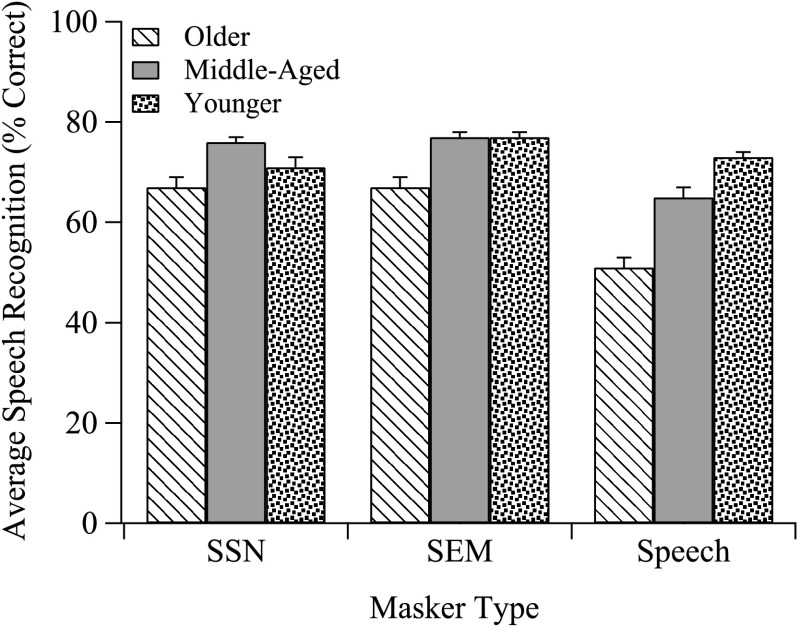
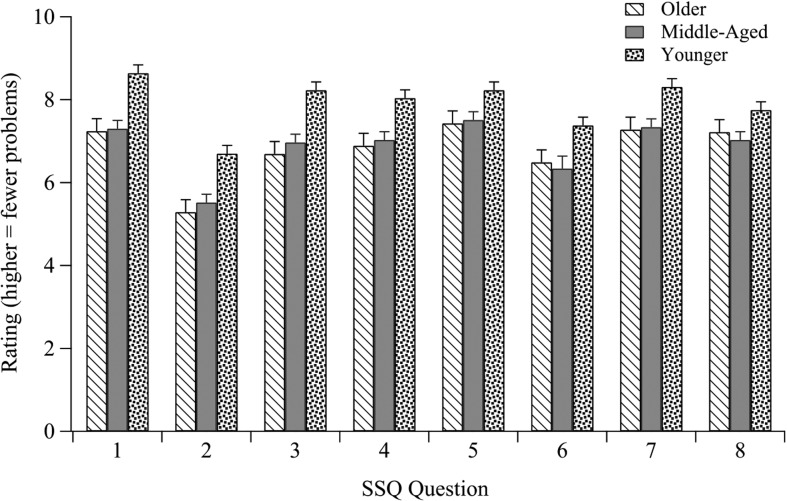
Results: Both degree of high frequency hearing loss and cognitive test performance limit individuals' ability to understand speech in difficult listening situations as they age. The performance of middle-aged adults is similar to that of younger adults in the presence of noise maskers, but they experience substantially more difficulty when the masker is 1 or 2 competing speech messages. For the most part, middle-aged participants in studies conducted in our laboratory reported as much self-perceived hearing problems as did older adult participants.
Conclusions: Research supports the multifactorial nature of listening in real-world environments. Current audiologic assessment practices are often insufficient to identify the true speech understanding struggles that individuals experience in these situations. This points to the importance of giving weight to patients' self-reported difficulties.
Presentation video: http://cred.pubs.asha.org/article.aspx?articleid=2601619.
Figures
References
-
- Akeroyd M. A. (2008). Are individual differences in speech reception related to individual differences in cognitive ability? A survey of twenty experimental studies with normal and hearing-impaired adults. International Journal of Audiology, 47(Suppl. 2), S53–S71. https://doi.org/10.1080/14992020802301142 - PubMed
-
- Alain C., Arnott S. R., Hevenor S., Graham S., & Grady C. L. (2001). “What” and “where” in the human auditory system. Proceedings of the National Academy of Sciences of the United States of America, 98(21), 12301–12306. https://doi.org/10.1073/pnas.211209098 - PMC - PubMed
-
- Anderson S., White-Schwoch T., Parbery-Clark A., & Kraus N. (2013). A dynamic auditory-cognitive system supports speech-in-noise perception in older adults. Hearing Research, 300, 18–32. https://doi.org/10.1016/j.heares.2013.03.006 - PMC - PubMed
-
- Arbogast T. L., Mason C. R., & Kidd G. (2005). The effect of spatial separation on informational masking of speech in normal-hearing and hearing-impaired listeners. The Journal of the Acoustical Society of America, 117(4), 2169–2180. https://doi.org/10.112/1.1861598 - PubMed
-
- Arehart K. H., Souza P., Baca R., & Kates J. M. (2013). Working memory, age, and hearing loss: Susceptibility to hearing aid distortion. Ear and Hearing, 34(3), 251–260. https://doi.org/10.1097/AUD.0b013e318271aa5e - PMC - PubMed
Publication types
MeSH terms
Grants and funding
LinkOut - more resources
Full Text Sources
Other Literature Sources
Medical