. 2017 Oct 20;8(1):1056.
doi: 10.1038/s41467-017-01220-0.

Genome-wide association study identifies the SERPINB gene cluster as a susceptibility locus for food allergy

Affiliations

Genome-wide association study identifies the SERPINB gene cluster as a susceptibility locus for food allergy

Ingo Marenholz et al. Nat Commun. .

Abstract

Genetic factors and mechanisms underlying food allergy are largely unknown. Due to heterogeneity of symptoms a reliable diagnosis is often difficult to make. Here, we report a genome-wide association study on food allergy diagnosed by oral food challenge in 497 cases and 2387 controls. We identify five loci at genome-wide significance, the clade B serpin (SERPINB) gene cluster at 18q21.3, the cytokine gene cluster at 5q31.1, the filaggrin gene, the C11orf30/LRRC32 locus, and the human leukocyte antigen (HLA) region. Stratifying the results for the causative food demonstrates that association of the HLA locus is peanut allergy-specific whereas the other four loci increase the risk for any food allergy. Variants in the SERPINB gene cluster are associated with SERPINB10 expression in leukocytes. Moreover, SERPINB genes are highly expressed in the esophagus. All identified loci are involved in immunological regulation or epithelial barrier function, emphasizing the role of both mechanisms in food allergy.


Conflict of interest statement

The authors declare no competing financial interests.

Figures
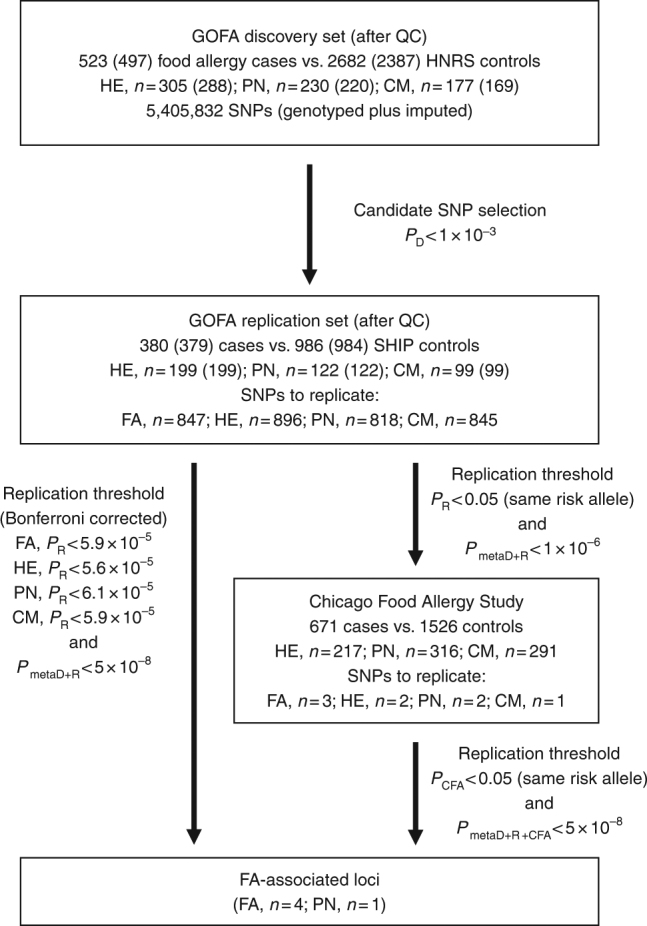
Fig. 1
Fig. 1
Study design of the GWAS on food allergy. Workflow of the GWAS on food allergy is shown including the number of cases and controls, and the P value thresholds used for each study set and phenotype. GOFA German Genetics of Food Allergy Study, HNR Heinz Nixdorf Recall Study, SHIP Study of Health in Pomerania, CFA Chicago Food Allergy Study, QC quality control, FA any food allergy, HE hen’s egg allergy, PN peanut allergy, CM cow’s milk allergy, P D, P R, and P metaD+R, P value in the GOFA discovery set, in the GOFA replication set, and in the meta-analysis of both sets, respectively
Fig. 2
Fig. 2
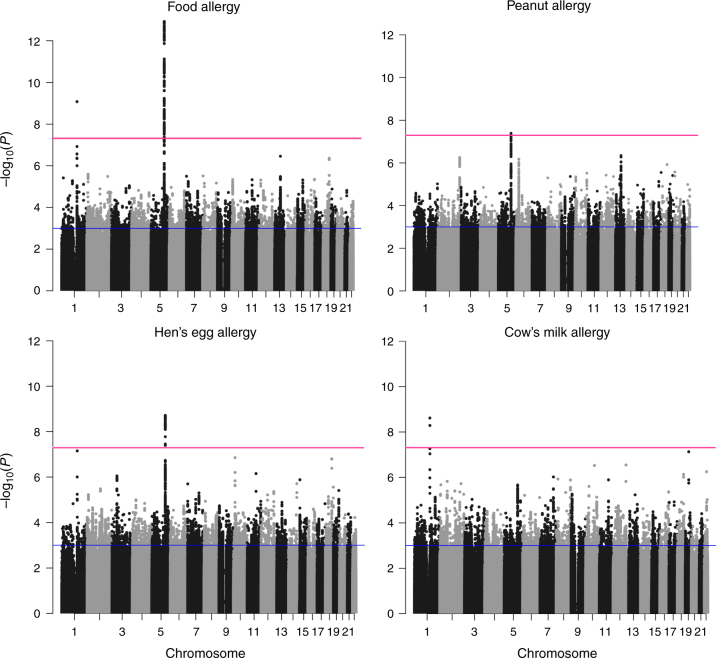
Association results of the GWAS on food allergy. The results of the GWAS on any food allergy (497 cases vs. 2387 controls) and on food-specific allergies against hen’s egg (288 cases), peanut (220 cases), and cow’s milk (169 cases) are presented. The Manhattan plots show the chromosomal positions (x-axis) and association P values (y-axis) for all SNPs of the discovery set. Red and blue lines indicate the thresholds for genome-wide significance (P < 5 × 10−8) and for entering the replication phase (P < 1 × 10−3) respectively

References

    1. Osborne NJ, et al. Prevalence of challenge-proven IgE-mediated food allergy using population-based sampling and predetermined challenge criteria in infants. J. Allergy Clin. Immunol. 2011;127:668–676. doi: 10.1016/j.jaci.2011.01.039. - DOI - PubMed
    1. Tang ML, Mullins RJ. Food allergy: is prevalence increasing? Intern. Med. J. 2017;47:256–261. doi: 10.1111/imj.13362. - DOI - PubMed
    1. Muraro A, et al. EAACI food allergy and anaphylaxis guidelines: diagnosis and management of food allergy. Allergy. 2014;69:1008–1025. doi: 10.1111/all.12429. - DOI - PubMed
    1. Nwaru BI, et al. Prevalence of common food allergies in Europe: a systematic review and meta-analysis. Allergy. 2014;69:992–1007. doi: 10.1111/all.12423. - DOI - PubMed
    1. Grabenhenrich LB, et al. Anaphylaxis in children and adolescents: The European Anaphylaxis Registry. J. Allergy Clin. Immunol. 2016;137:1128–1137. doi: 10.1016/j.jaci.2015.11.015. - DOI - PubMed

Publication types