


Intensive follow-up for women with breast cancer: review of clinical, economic and patient's preference domains through evidence to decision framework
- PMID: 29052503
- PMCID: PMC5649085
- DOI: 10.1186/s12955-017-0779-5
Intensive follow-up for women with breast cancer: review of clinical, economic and patient's preference domains through evidence to decision framework
Abstract
Background: Women treated for breast cancer are followed-up for monitoring of treatment effectiveness and for detecting recurrences at an early stage. The type of follow-up received may affect women's reassurance and impact on their quality of life. Anxiety and depression among women with breast cancer has been described, but little is known about how the intensity of the follow-up can affect women's psychological status. This study was undertaken to evaluate the effects of intensive vs. less-intensive follow-up on different health outcomes, to determine what are women's preferences and values regarding the follow-up received, and also assess the costs of these different types of follow-up.
Methods: A systematic review following standard Cochrane Collaboration methods was carried out to assess the efficacy of intensive follow-up versus non-intensive follow-up in breast cancer patients. Two additional reviews on women's preferences and economic evidence were also carried out. The search was performed up to January 2016 in: MEDLINE, EMBASE, PDQ, McMaster Health Systems Evidence, CENTRAL, and NHS EED (through The Cochrane Library). The quality of evidence was assessed by GRADE (for quantitative studies) and CerQUAL (for qualitative studies). Several outcomes including mortality, breast cancer recurrences, quality of life, and patient satisfaction were evaluated.
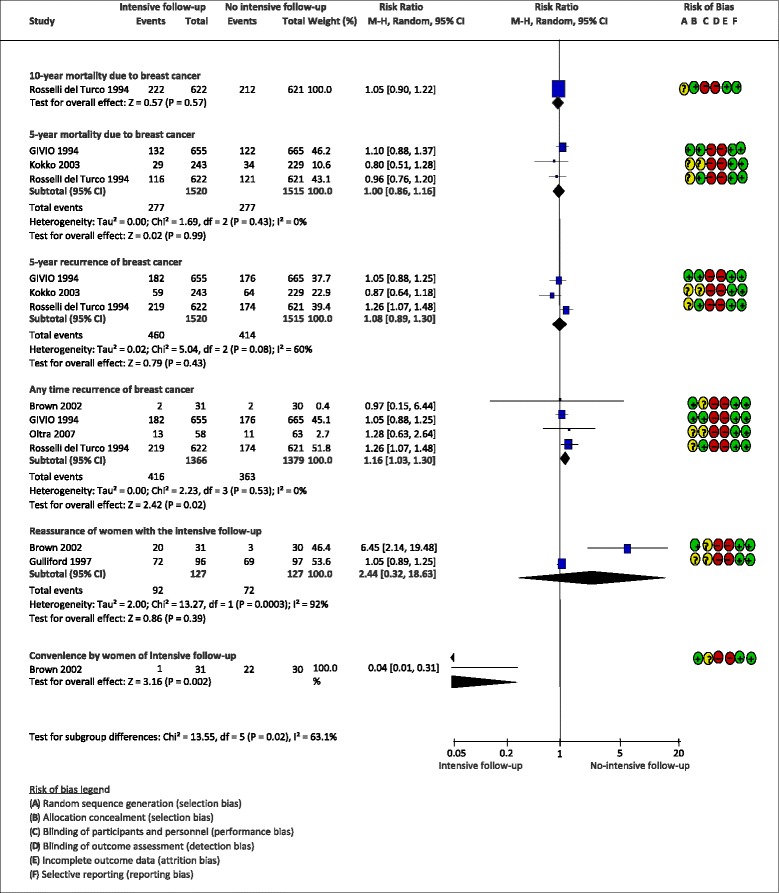
Results: Six randomised trials (corresponding to 3534 women) were included for the evaluation of health outcomes; three studies were included for women's values and preferences and four for an economic assessment. There is moderate certainty of evidence showing that intensive follow-up, including more frequent diagnostic tests or visits, does not have effects on 5- or 10-year overall mortality and recurrences in women with breast cancer, compared with less intensive follow-up. Regarding women's preferences and values, there was important variability among studies and within studies (low confidence due to risk of bias and inconsistency). Furthermore, intensive follow-up, as opposed to less intensive follow-up, is not likely to be cost-effective.
Conclusions: Less intensive follow-up appears to be justified and can be recommended over intensive follow-up. Resources could thus be mobilised to other aspects of breast cancer care, or other areas of healthcare.
Keywords: Breast cancer; EtD framework; Follow-up; Recommendation.
Conflict of interest statement
Ethics approval and consent to participate
Not applicable.
Consent for publication
Not applicable.
Competing interests
The authors declare that they have no competing interests.
Publisher’s Note
Springer Nature remains neutral with regard to jurisdictional claims in published maps and institutional affiliations.
Figures

References
-
- Boyle P, Levin B. World cancer report. Lyon: IARC Press; 2008.
Publication types
MeSH terms
LinkOut - more resources
Full Text Sources
Other Literature Sources
Medical
