Susceptibility-weighted Imaging in Thrombolytic Therapy of Acute Ischemic Stroke
- PMID: 29052571
- PMCID: PMC5684633
- DOI: 10.4103/0366-6999.216401
Susceptibility-weighted Imaging in Thrombolytic Therapy of Acute Ischemic Stroke
Abstract
Objective: To provide a comprehensive and latest overview of susceptibility-weighted imaging (SWI) in the application of thrombolysis in acute ischemic stroke, and to update the decision-making effect and clinical value of SWI on identifying stroke patients suitable for thrombolytic therapy and possible benefits and risks followed.
Data sources: Literatures referred to this review were collected from PubMed, Medline, and EMBASE published till May 2017, using the search terms including susceptibility-weighted imaging, gradient-echo, T2*, thrombolysis, recombinant tissue plasminogen activator (rt-PA), thrombolytic therapy, and stroke.
Study selection: Papers in English or with available English abstracts were considered, with no limitation of study design. References were also identified from the bibliographies of identified articles and the authors' files.
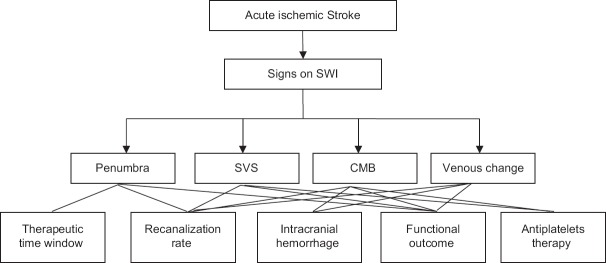
Results: SWI is of guiding significance for thrombolytic therapy in stroke patients, it can predict the location and length of thrombus and ischemic penumbra. It is worthy of noting that susceptibility vessel sign (SVS) on SWI can be used to predict recanalization after thrombolytic therapy and whether it is better to implement endovascular thrombolectomy in combination or alone. SWI is sensitive in detecting cerebral microbleed (CMB), and CMB might not be a contraindication for thrombolytic therapy, yet CMBs in multiple foci could possibly be related to intracranial hemorrhage (ICH) after thrombolysis. SVS and CMB on SWI sequence are of instructive value in performing antiplatelet therapy after thrombolytic therapy. Cerebral venous change on SWI is related to lower recanalization rate and poor outcome after thrombolysis.
Conclusions: It seems that SWI can be applied to guide individualized thrombolytic therapies and assist clinicians in making better decisions by weighing benefits and risks. However, there still exist controversies about the relationship between signs on SWI and thrombolytic therapy.
Conflict of interest statement
There are no conflicts of interest.
Figures
References
-
- Feigin VL, Lawes CM, Bennett DA, Anderson CS. Stroke epidemiology: A review of population-based studies of incidence, prevalence, and case-fatality in the late 20th century. Lancet Neurol. 2003;2:43–53. doi: 10.1016/S1474-4422(03)00266-7. - PubMed
-
- Lyden P. Tissue plasminogen activator for acute ischemic stroke. N Engl J Med. 1995;334:1405–6. - PubMed
-
- National Institute of Neurological Disorders and Stroke rt-PA Stroke Study Group. Tissue plasminogen activator for acute ischemic stroke. N Engl J Med. 1995;333:1581–7. - PubMed
-
- Furlan A, Higashida R, Wechsler L, Gent M, Rowley H, Kase C, et al. Intra-arterial prourokinase for acute ischemic stroke. The PROACT II study: A randomized controlled trial. Prolyse in Acute Cerebral Thromboembolism. JAMA. 1999;282:2003–11. - PubMed
-
- Strbian D, Sairanen T, Meretoja A, Pitkäniemi J, Putaala J, Salonen O, et al. Patient outcomes from symptomatic intracerebral hemorrhage after stroke thrombolysis. Neurology. 2011;26(77):341–8. doi: 10.1212/WNL.0b013e3182267b8c. - PubMed
Publication types
MeSH terms
Substances
LinkOut - more resources
Full Text Sources
Other Literature Sources
Medical