


Bacterial Keratitis: Isolated Organisms and Antibiotic Resistance Patterns in San Francisco
- PMID: 29053557
- PMCID: PMC5716884
- DOI: 10.1097/ICO.0000000000001417
Bacterial Keratitis: Isolated Organisms and Antibiotic Resistance Patterns in San Francisco
Abstract
Purpose: Understanding the spectrum of pathogens in a given geographic region is important when deciding on empiric antibiotic therapy. In this study, we evaluate the spectrum of bacterial organisms cultured from corneal samples and their antibiotic sensitivities to guide initial treatment of keratitis.
Methods: We performed a retrospective case review of cultures from suspected infectious keratitis cases at the Francis I. Proctor Foundation, University of California, San Francisco, from 1996 through 2015. Logistic regression models were used to assess the risk of culturing methicillin-resistant Staphylococcus aureus (MRSA) from ulcers over time and the association between the year cultured and moxifloxacin resistance.
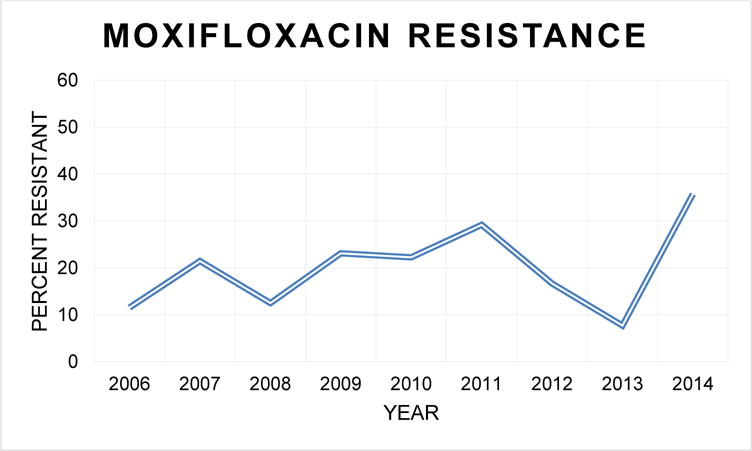
Results: A total of 522 of 2203 (23.7%) cultures grew bacterial organisms believed to be the etiology of infection, with available antibiotic sensitivity data. Of these, 338 (65.3%) grew gram-positive organisms with the most common being methicillin-sensitive Staphylococcus aureus (20.1%, N = 105). One hundred eighty (34.7%) grew gram-negative species with Pseudomonas aeruginosa as the most prevalent organism (10.9%, N = 57). There was 1.13 increased odds of culturing MRSA for each 1-year increase in the culture date (P = 0.01) and 1.26 increased odds of culturing an organism resistant to moxifloxacin with each 1-year increase in the culture date after controlling for the infectious organism (P < 0.001).
Conclusions: Gram-positive organisms are the most commonly identified etiology of microbial keratitis in this series. Approximately 35% of cultured organisms had variable susceptibility to moxifloxacin, and resistance seems to be increasing over time. The risk of culturing MRSA increased over time.
Conflict of interest statement
No conflicting relationship exists for any author.
Figures
References
-
- Mah-Sadorra JH, Yavuz SG, Najjar DM, Laibson PR, Rapuano CJ, Cohen EJ. Trends in contact lens-related corneal ulcers. Cornea. 2005;24:51–58. - PubMed
-
- Green M, Apel A, Stapleton F. Risk factors and causative organisms in microbial keratitis. Cornea. 2008;27:22–27. - PubMed
-
- Alexandrakis G, Alfonso EC, Miller D. Shifting trends in bacterial keratitis in south Florida and emerging resistance to fluoroquinolones. Ophthalmology. 2000;107:1497–1502. - PubMed
-
- Ibrahim YW, Boase DL, Cree IA. Epidemiological characteristics, predisposing factors and microbiological profiles of infectious corneal ulcers: the Portsmouth corneal ulcer study. Br J Ophthal. 2009;93:1319–1324. - PubMed
-
- Cruciani F, Cuozzo G, Di Pillo S, Cavallaro M. Predisposing factors, clinical and microbiological aspects of bacterial keratitis: a clinical study. La Clinica terapeutica. 2009;160:207–210. - PubMed
MeSH terms
Substances
Grants and funding
LinkOut - more resources
Full Text Sources
Other Literature Sources
Medical
