


Companion Plants for Aphid Pest Management
- PMID: 29053585
- PMCID: PMC5746795
- DOI: 10.3390/insects8040112
Companion Plants for Aphid Pest Management
Abstract
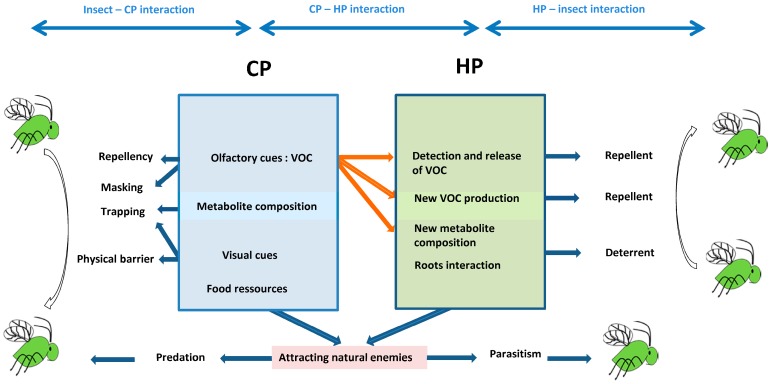
A potential strategy for controlling pests is through the use of "companion plants" within a crop system. This strategy has been used in several trials to fight against a major crop insect pest: the aphid. We reviewed the literature to highlight the major mechanisms by which a companion plant may act. Trials carried out under laboratory or field conditions revealed that companion plants operate through several mechanisms. A companion plant may be associated with a target crop for various reasons. Firstly, it can attract aphids and draw them away from their host plants. Secondly, it can alter the recognition of the host plant. This effect is mostly attributed to companion plant volatiles since they disturb the aphid host plant location, and additionally they may react chemically and physiologically with the host plant, making it an unsuitable host for aphids. Thirdly, it can attract natural enemies by providing shelter and food resources. In this review, the feasibility of using companion plants is discussed. We conclude that many factors need to be taken into account for a successful companion plant strategy. For the best long-term results, companion plant strategies have to be combined with other alternative approaches against aphids.
Keywords: aphid; companion plant; intercropping; natural enemies; repellent; trap plant; volatiles.
Conflict of interest statement
The authors declare no conflict of interest
Figures
References
-
- Dixon A. Aphid ecology: Life cycles, polymorphism, and population regulation. Annu. Rev. Ecol. Syst. 1977;8:329–353. doi: 10.1146/annurev.es.08.110177.001553. - DOI
-
- Dong M., Zhang D., Du X. The relationship between aphids and their natural enemies and the ecological management. Acta Phytophylacica Sin. 2011;38:327–332.
-
- Blackman R., Eastop V. Aphids on the World’s Crops an Identification and Information Guide. John Wiley & Sons; Oxford, UK: 2000.
-
- Blackman R.L., Eastop V.F. Taxonomic issues. In: Van Emden H.F., Harrington R., editors. Aphids as Crop Pests. CABI; Wallingford, UK: 2007. pp. 1–30.
Publication types
LinkOut - more resources
Full Text Sources
Other Literature Sources
