


Friedreich's ataxia: clinical features, pathogenesis and management
- PMID: 29053830
- PMCID: PMC5862303
- DOI: 10.1093/bmb/ldx034
Friedreich's ataxia: clinical features, pathogenesis and management
Abstract
Introduction: Friedreich's ataxia is the most common inherited ataxia.
Sources of data: Literature search using PubMed with keywords Friedreich's ataxia together with published papers known to the authors.
Areas of agreement: The last decade has seen important advances in our understanding of the pathogenesis of disease. In particular, the genetic and epigenetic mechanisms underlying the disease now offer promising novel therapeutic targets.
Areas of controversy: The search for effective disease-modifying agents continues. It remains to be determined whether the most effective approach to treatment lies with increasing frataxin protein levels or addressing the metabolic consequences of the disease, for example with antioxidants.
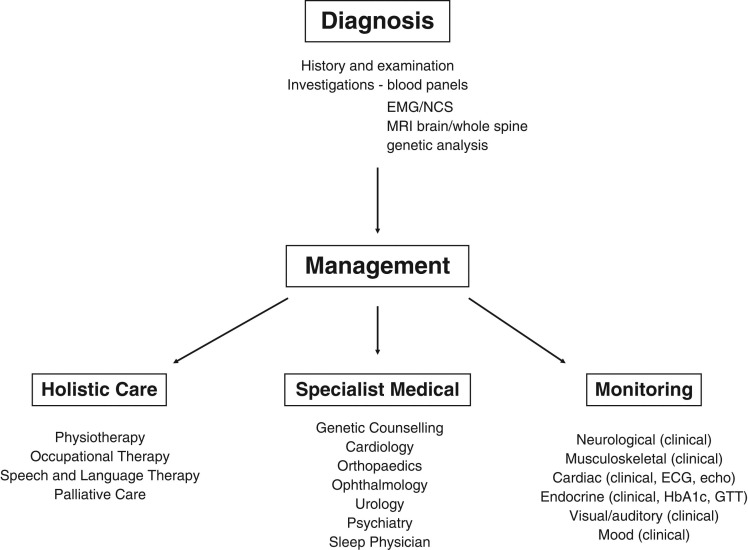
Areas timely for developing research: Management of Freidreich's ataxia is currently focussed on symptomatic management, delivered by the multidisciplinary team. Phase II clinical trials in agents that address the abberrant silencing of the frataxin gene need to be translated into large placebo-controlled Phase III trials to help establish their therapeutic potential.
Keywords: Friedreich’s ataxia; antioxidants; epigenetics.
© The Author 2017. Published by Oxford University Press. All rights reserved. For permissions, please e-mail: journals.permissions@oup.com
Figures
Comment in
-
Expanding the genetic basis of ataxia.Nat Genet. 2019 Apr;51(4):580-581. doi: 10.1038/s41588-019-0387-x. Nat Genet. 2019. PMID: 30926965 No abstract available.
References
-
- Vankan P. Prevalence gradients of Friedreich’s Ataxia and R1b haplotype in Europe co-localize, suggesting a common Palaeolithic origin in the Franco-Cantabrian ice age refuge. J Neurochem 2013;126:11–20. - PubMed
-
- Reetz K, Dogan I, Costa AS, et al. Biological and clinical characteristics of the European Friedreich’s Ataxia Consortium for Translational Studies (EFACTS) cohort: a cross-sectional analysis of baseline data. Lancet Neurol 2015;14:174–82. - PubMed
-
- Friedreich N. Ueber Degenerative Atrophie der Spinalen Hinterstränge. Arch Pathol Anat Phys Klin Med 1863;26:391–419.
-
- Harding AE. Friedreich’s ataxia: a clinical and genetic study of 90 families with an analysis of early diagnostic criteria and intrafamilial clustering of clinical features. Brain 1981;104:589–620. - PubMed
-
- Campuzano V, Montermini L, Moltò MD, et al. Friedreich’s ataxia: autosomal recessive disease caused by an intronic GAA triplet repeat expansion. Science 1996;271:1423–7. - PubMed
Publication types
MeSH terms
Substances
LinkOut - more resources
Full Text Sources
Other Literature Sources
Medical
