


Selenoproteins in Tumorigenesis and Cancer Progression
- PMID: 29054422
- PMCID: PMC5819884
- DOI: 10.1016/bs.acr.2017.08.002
Selenoproteins in Tumorigenesis and Cancer Progression
Abstract
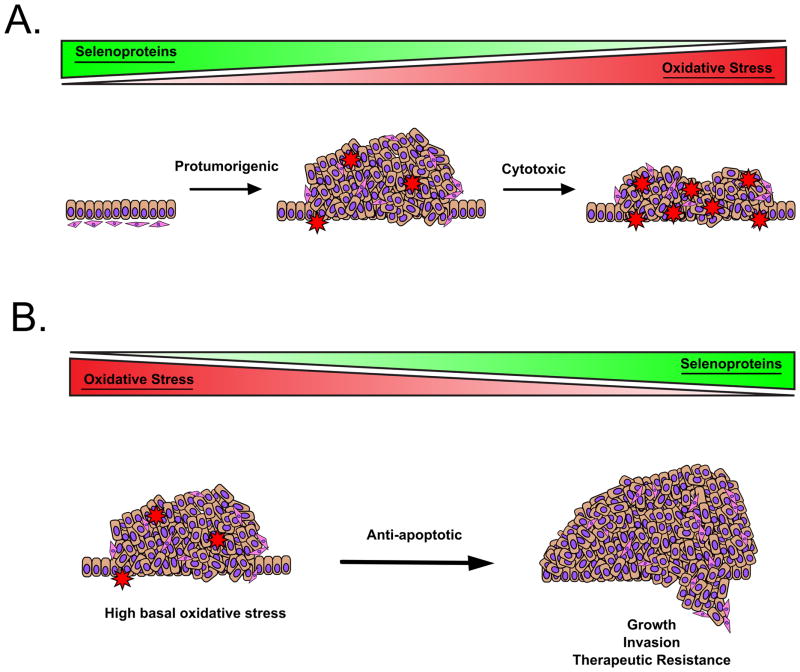
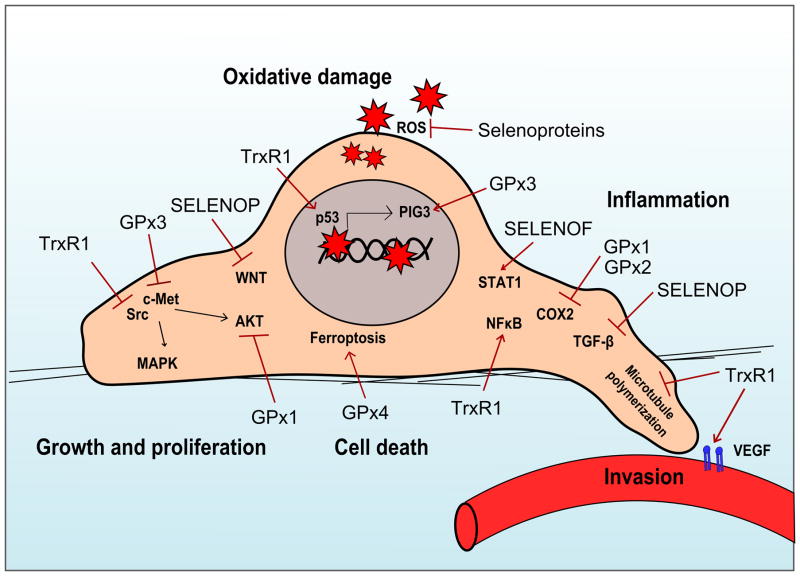
Selenium is a micronutrient essential to human health and has long been associated with cancer prevention. Functionally, these effects are thought to be mediated by a class of selenium-containing proteins known as selenoproteins. Indeed, many selenoproteins have antioxidant activity which can attenuate cancer development by minimizing oxidative insult and resultant DNA damage. However, oxidative stress is increasingly being recognized for its "double-edged sword" effect in tumorigenesis, whereby it can mediate both negative and positive effects on tumor growth depending on the cellular context. In addition to their roles in redox homeostasis, recent work has also implicated selenoproteins in key oncogenic and tumor-suppressive pathways. Together, these data suggest that the overall contribution of selenoproteins to tumorigenesis is complicated and may be affected by a variety of factors. In this review, we discuss what is currently known about selenoproteins in tumorigenesis with a focus on their contextual roles in cancer development, growth, and progression.
Keywords: Glutathione peroxidase; Selenium; Selenoprotein F; Selenoprotein P; Selenoproteins; Thioredoxin reductase.
© 2017 Elsevier Inc. All rights reserved.
References
-
- Al-Taie OH, Seufert J, Mork H, Treis H, Mentrup B, Thalheimer A, Starostik P, Abel J, Scheurlen M, Kohrle J, Jakob F. Eur J Hum Genet. 2002;10:499–504. - PubMed
-
- Al-Taie OH, Uceyler N, Eubner U, Jakob F, Mork H, Scheurlen M, Brigelius-Flohe R, Schottker K, Abel J, Thalheimer A, Katzenberger T, Illert B, Melcher R, Kohrle J. Nutr Cancer. 2004;48:6–14. - PubMed
-
- Andersen RK, Hammer K, Hager H, Christensen JN, Ludvigsen M, Honore B, Thomsen MB, Madsen M. Pigment Cell Melanoma Res. 2015;28:267–80. - PubMed
-
- Apostolou S, Klein JO, Mitsuuchi Y, Shetler JN, Poulikakos PI, Jhanwar SC, Kruger WD, Testa JR. Oncogene. 2004;23:5032–40. - PubMed
Publication types
MeSH terms
Substances
Grants and funding
LinkOut - more resources
Full Text Sources
Other Literature Sources
Medical
