


Approaches for calculating solvation free energies and enthalpies demonstrated with an update of the FreeSolv database
- PMID: 29056756
- PMCID: PMC5648357
- DOI: 10.1021/acs.jced.7b00104
Approaches for calculating solvation free energies and enthalpies demonstrated with an update of the FreeSolv database
Abstract
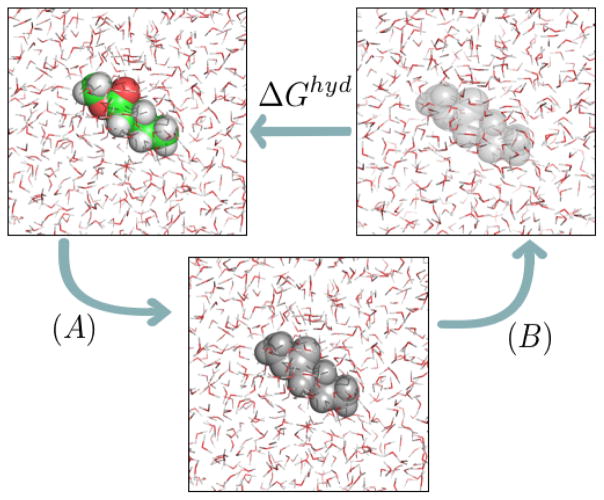
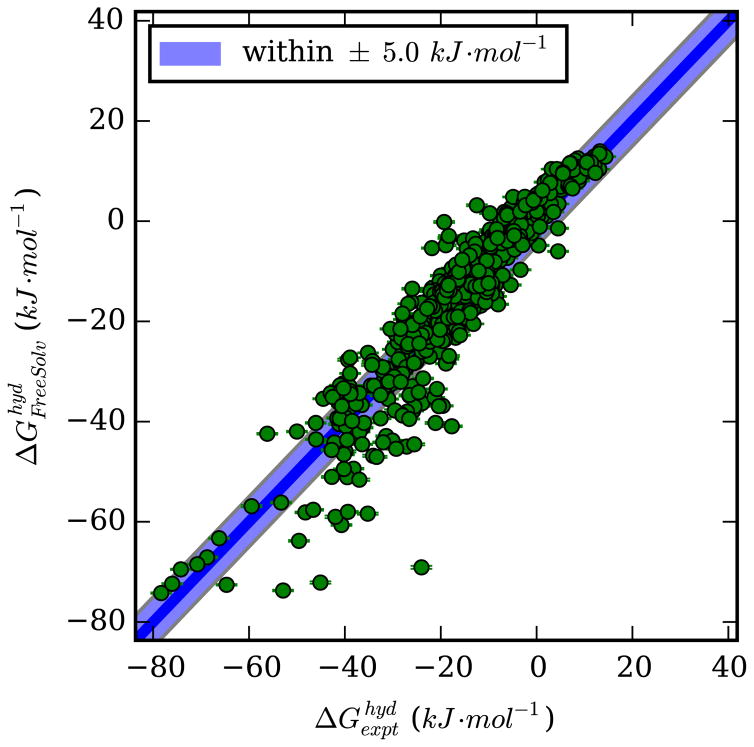
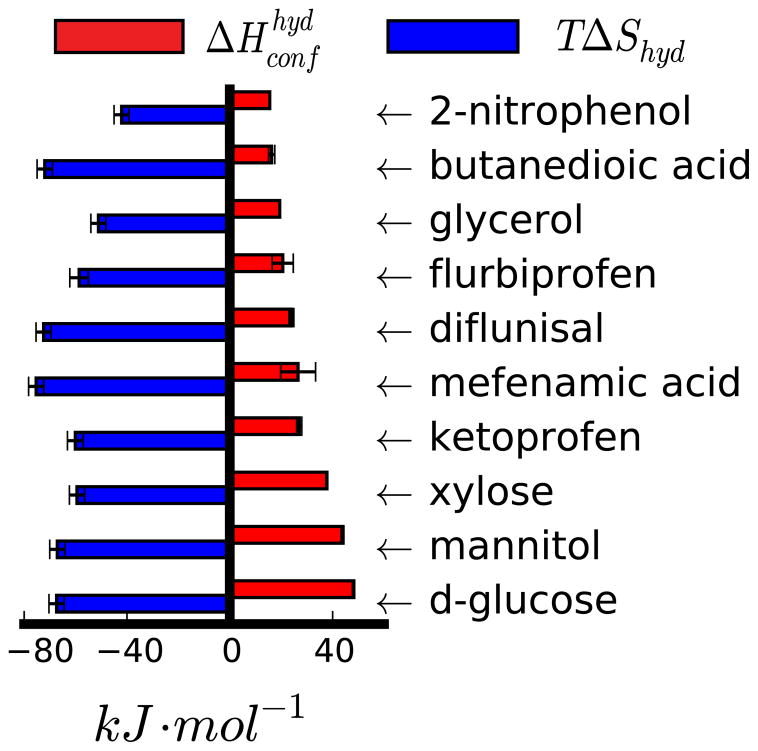
Solvation free energies can now be calculated precisely from molecular simulations, providing a valuable test of the energy functions underlying these simulations. Here, we briefly review "alchemical" approaches for calculating the solvation free energies of small, neutral organic molecules from molecular simulations, and illustrate by applying them to calculate aqueous solvation free energies (hydration free energies). These approaches use a non-physical pathway to compute free energy differences from a simulation or set of simulations and appear to be a particularly robust and general-purpose approach for this task. We also present an update (version 0.5) to our FreeSolv database of experimental and calculated hydration free energies of neutral compounds and provide input files in formats for several simulation packages. This revision to FreeSolv provides calculated values generated with a single protocol and software version, rather than the heterogeneous protocols used in the prior version of the database. We also further update the database to provide calculated enthalpies and entropies of hydration and some experimental enthalpies and entropies, as well as electrostatic and nonpolar components of solvation free energies.
Figures
References
-
- Guthrie JP. A Blind Challenge for Computational Solvation free Energies: Introduction and Overview. J Phys Chem B. 2009;113:4501–4507. - PubMed
-
- Klimovich PV, Mobley DL. Predicting Hydration free Energies Using All-atom Molecular Dynamics Simulations and Multiple Starting Conformations. J Comput-Aided Mol Des. 2010;24:307–316. - PubMed
-
- Chorny I, Dill KA, Jacobson MP. Surfaces Affect ion Pairing. J Phys Chem B. 2005;109:24056–24060. - PubMed
Grants and funding
LinkOut - more resources
Full Text Sources
Other Literature Sources