. 2017:2:7.
doi: 10.1038/s41536-017-0011-6. Epub 2017 Mar 27.

A short discourse on vascular tissue engineering

Affiliations

A short discourse on vascular tissue engineering

William G Chang et al. NPJ Regen Med. 2017.

Abstract

Vascular tissue engineering has significant potential to make a major impact on a wide array of clinical problems. Continued progress in understanding basic vascular biology will be invaluable in making further advancements. Past and current achievements in tissue engineering of microvasculature to perfuse organ specific constructs, small vessels for dialysis grafts, and modified synthetic and pediatric large caliber-vessel grafts will be discussed. An emphasis will be placed on clinical trial results with small and large-caliber vessel grafts. Challenges to achieving engineered constructs that satisfy the physiologic, immunologic, and manufacturing demands of engineered vasculature will be explored.


Conflict of interest statement

COMPETING INTERESTS WGC declares no competing interests.

Figures
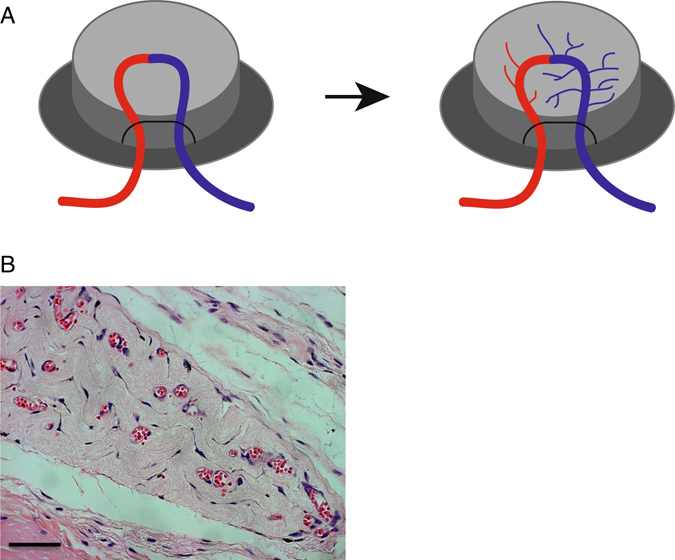
Fig. 1
Fig. 1
Approaches to in vivo microvasculature engineering. a Schematic of angiogenic arteriovenous loop. In vivo anastomosis between artery and vein is formed within a protected chamber that is fill with extracellular matrix. Angiogenic response is stimulated over time in vivo. b H&E of a section of collagen gel implant containing self-assembled, perfused microvessels after two weeks of subcutaneous implantation within an immunodeficient mouse. HUVEC and placental perictyes were freely suspended within the gels as decribed in [29] prior to implantations. Scale bar is 50 μm. Figure reproduced with permission from Oxford University Press
Fig. 2
Fig. 2
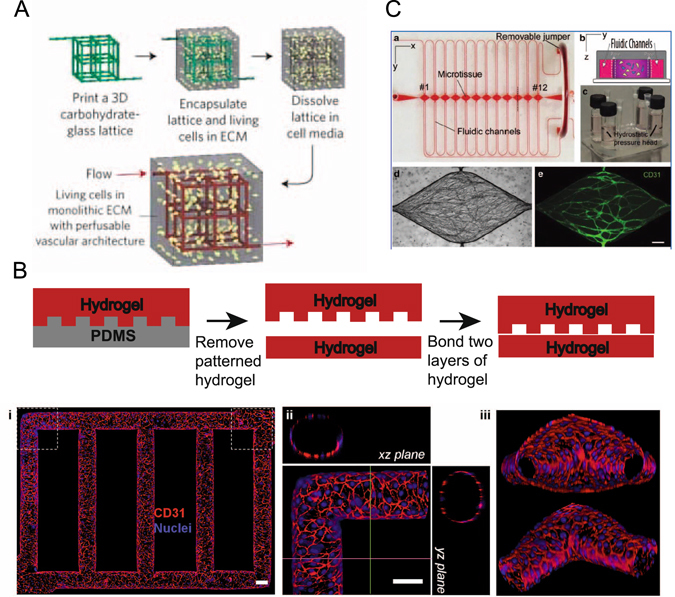
Microfluidic approaches to in vitro microvascular engineering. a Schematic of self-supporting 3D printed carbohydrate-glass lattice that is encapsulated. Once the lattice is dissolved, a perfusable network results. Living cells can be placed within the ectracellular matrix and within the perfusable channels. b (Left) Schematic protocol of microfluidic device construction by bonding micropatterned hydrogel and thin layer to form microvascular channel network. (Right) Top and cross-sectional views of confocal Z-stacks showing endothelial-lined microvascular channels. Red is CD31 and blue are nuclei. Scale bar is 100 μm. c (Top) Microfluidic platform made from PDMS that consists of a daisy chain of microtissue chambers connected by pores and loaded with extracellular matrix, endothelial cells, and fibroblasts. (Bottom) Brightfield and CD31 immunofluroescent staining demonstrating microvascular networks formed by endothelial self-assembly. Scale bar is 200 μm. Figures reproduced and modified from [46, 47, 48] with permissions from Nature publishing, PNAS, Tissue engineering part c. Scale bar is 50 μm
Fig. 3
Fig. 3
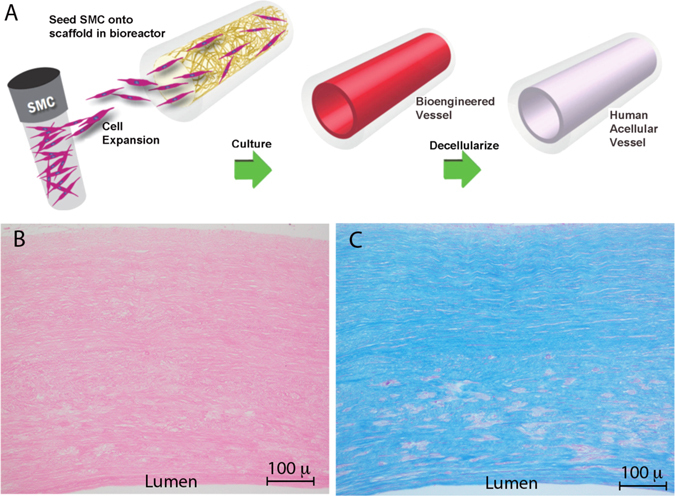
Engineered acelluar small-vessel grafts. a Schematic demonstrating steps in the construction of acellular vascular grafts. Cadaver-derived SMCs are seeded onto tubular PGA scaffold, which are then cultured in bioreactors. PGA degrades leaving, collagenous tissues which is then decellularized for “off the shelf” vascular graft. b Hematoxylin and eosin and c Masson’s trichrome collagen staining of decellularized graft. Scale bars are 100 μm

References

    1. Pober JS, Tellides G. Participation of blood vessel cells in human adaptive immune responses. Trends. Immunol. 2012;33:49–57. doi: 10.1016/j.it.2011.09.006. - DOI - PMC - PubMed
    1. Jain RK, Au P, Tam J, Duda DG, Fukumura D. Engineering vascularized tissue. Nat. Biotechnol. 2005;23:821–823. doi: 10.1038/nbt0705-821. - DOI - PubMed
    1. Organ Procurement and Transplantation Network. US Department of Health & Human Services. October 2015.
    1. Chu H, Wang Y. Therapeutic angiogenesis: controlled delivery of angiogenic factors. Ther. Deliv. 2012;3:693–714. doi: 10.4155/tde.12.50. - DOI - PMC - PubMed
    1. Hedman M, Hartikainen J, Ylä-Herttuala S. Progress and prospects: hurdles to cardiovascular gene therapy clinical trials. Gene. Ther. 2011;18:743–749. doi: 10.1038/gt.2011.43. - DOI - PubMed