Review
. 2017 Oct;13(4):317-324.
doi: 10.3988/jcn.2017.13.4.317.

Apraxia: Review and Update

Affiliations
Review

Apraxia: Review and Update

Jung E Park. J Clin Neurol. 2017 Oct.

Abstract

Praxis, the ability to perform skilled or learned movements is essential for daily living. Inability to perform such praxis movements is defined as apraxia. Apraxia can be further classified into subtypes such as ideomotor, ideational and limb-kinetic apraxia. Relevant brain regions have been found to include the motor, premotor, temporal and parietal cortices. Apraxia is found in a variety of highly prevalent neurological disorders including dementia, stroke and Parkinsonism. Furthermore, apraxia has been shown to negatively affect quality of life. Therefore, recognition and treatment of this disorder is critical. This article provides an overview of apraxia and highlights studies dealing with the neurophysiology of this disorder, opening up novel perspectives for the use of motor training and noninvasive brain stimulation as treatment.

Keywords: Parkinsonism; apraxia; dementia; ideational; ideomotor; limb-kinetic; neurophysiology; stroke.


Conflict of interest statement

The author has no financial conflicts of interest.

Figures
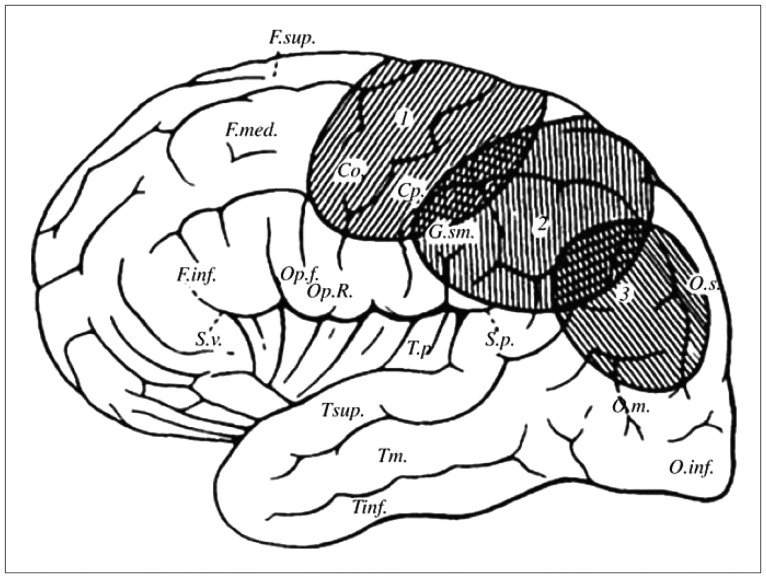
Fig. 1
Fig. 1. Reproduction of Liepmann's schema of the motor engram. Adapted from Roby-Brami et al. Philos Trans R Soc Lond B Biol Sci 2012;367:144-160, with permission of Royal Society Publishing. 1: limb-kinetic apraxia, 2: ideomotor apraxia, 3: ideational apraxia, Co.: precentral gyrus, Cp: postcentral gyrus, F. inf.: frontal lobe, inferior, F. med.: frontal lobe, middle, F. sup.: frontal lobe, superior, G.sm.: supramarginal gyrus, O.m.: occipital lobe, medial, O.s.: occipital lobe, superior.
Fig. 2
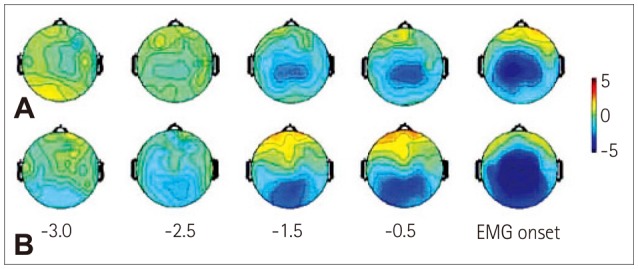
Fig. 2. Spatial plots for simple movement (A) and tool use movement (B). The beginning of the Bereitschaftspotentials (BPs), or movement-related cortical potentials, are seen to occur in bilateral sensorimotor areas in simple movement, while it is seen to begin in the left parietal area in tool pantomime. Adapted from Wheaton et al. Clinical Neurophysiology 2005;116:1382-1390, with permission of Springer.
Fig. 3
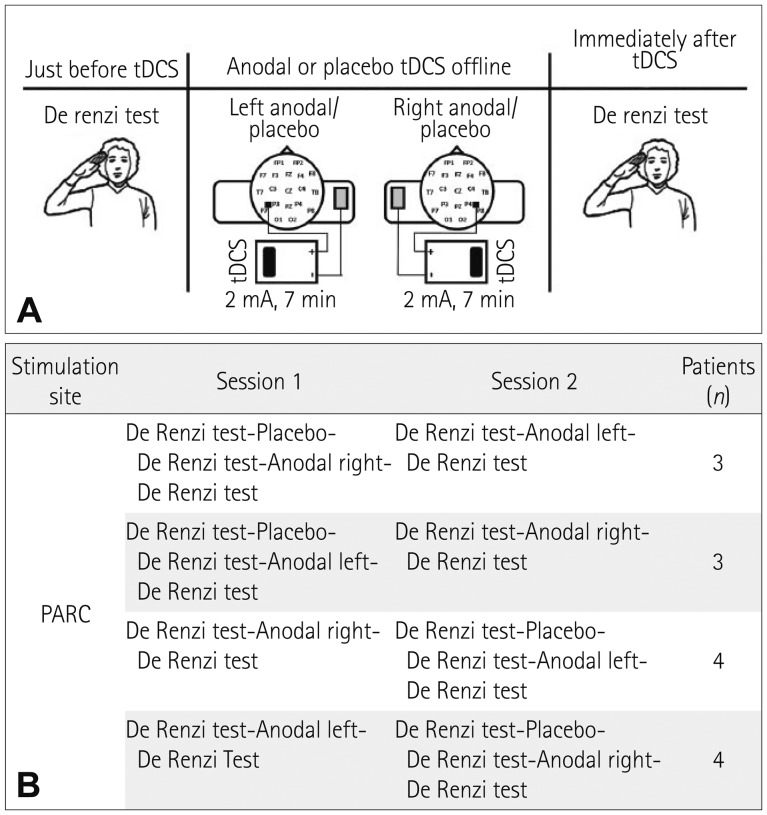
Fig. 3. Study design of tDCS in patients with corticobasal syndrome. The study was conducted in a randomized, double-blind fashion. All patients were randomly subjected to three types of stimulation over two sessions. A: tDCS of the left parietal cortex, right parietal cortex and placebo tDCS. B: The De Renzi ideomotor apraxia test was conducted to assess limb apraxia prior to and following each stimulation session. Adapted from Bianchi et al. European Journal of Neurology 2015;22: 1317-1322, with permission of Wiley. tDCS: transcranial direct current stimulation, PARC: parietal cortex.

References

    1. Gross RG, Grossman M. Update on apraxia. Curr Neurol Neurosci Rep. 2008;8:490–496. - PMC - PubMed
    1. Roby-Brami A, Hermsdörfer J, Roy AC, Jacobs S. A neuropsychological perspective on the link between language and praxis in modern humans. Philos Trans R Soc Lond B Biol Sci. 2012;367:144–160. - PMC - PubMed
    1. Geschwind N. Disconnexion syndromes in animals and man. II. Brain. 1965;88:585–644. - PubMed
    1. Geschwind N. Disconnexion syndromes in animals and man. I. Brain. 1965;88:237–294. - PubMed
    1. Heilman KM, Rothi LJ, Valenstein E. Two forms of ideomotor apraxia. Neurology. 1982;32:342–346. - PubMed

LinkOut - more resources