


Randomized, Evaluator-Blinded Study Comparing Safety and Effect of Two Hyaluronic Acid Gels for Lips Enhancement
- PMID: 29059146
- PMCID: PMC5821480
- DOI: 10.1097/DSS.0000000000001282
Randomized, Evaluator-Blinded Study Comparing Safety and Effect of Two Hyaluronic Acid Gels for Lips Enhancement
Abstract
Background: Hyaluronic acid (HA) fillers may differ in terms of gel characteristics and ease of use and it is of interest whether this might affect safety and duration of effect.
Objective: To compare the long-term safety and effect of 2 HA fillers produced by 2 different technologies for lip enhancement.
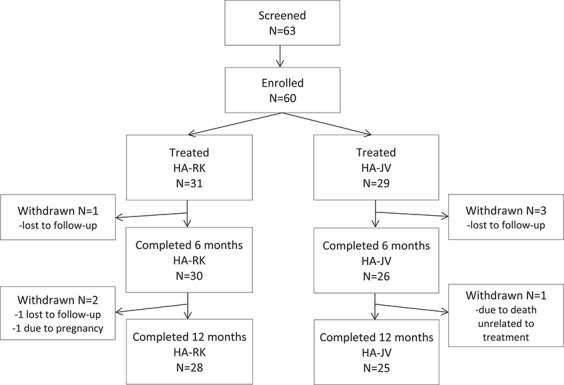
Materials and methods: Subjects with very thin to moderately thick lips were randomized and treated with HA-RK (N = 31) or HA-JV (N = 29) to improve lip fullness by ≥ 1 grade on a 5-point scale, using a maximum of 3 mL of product.
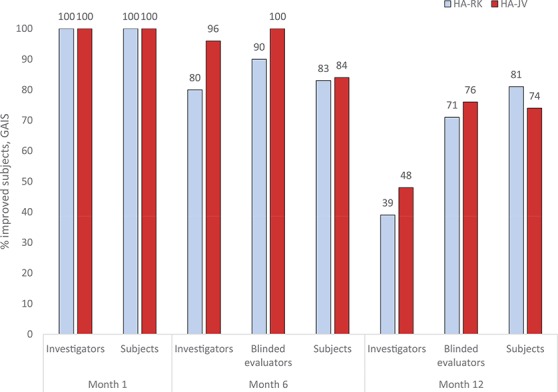
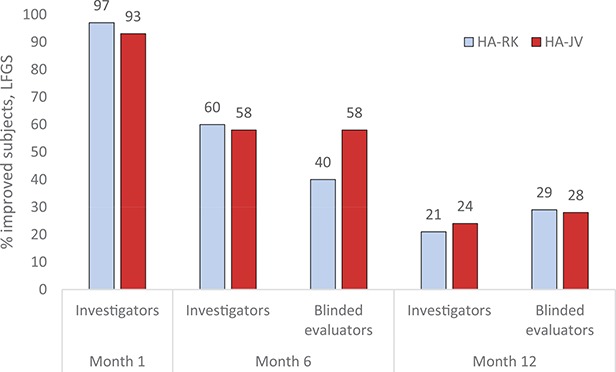
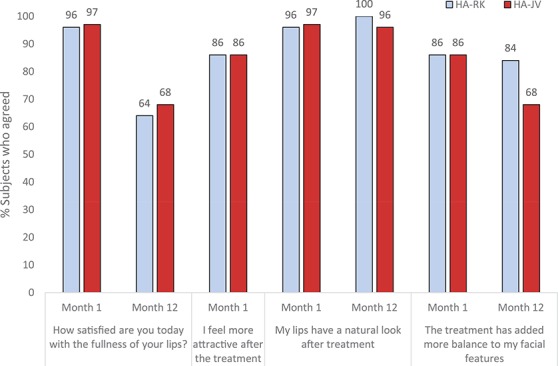
Results: A smaller volume of HA-RK compared with HA-JV was required to improve lip fullness by ≥ 1 grade (mean: 1.54 mL vs 1.94 mL, p < .001). Despite the smaller volume, lip fullness and global aesthetic improvement were comparably sustained in both groups. At 6 months, 60.0% versus 57.7% of subjects (HA-RK vs HA-JV) had improved lip fullness. At 12 months, 71.4% versus 76.0% had aesthetic improvement (blinded evaluations) and 85.7% versus 86.2% felt more attractive. Both products were well tolerated.
Conclusion: Both products achieved durable improvement in lip fullness and aesthetic appearance. A significantly smaller amount of HA-RK was required compared with HA-JV to achieve optimal treatment effect.
Conflict of interest statement
Supported by Galderma. S. Hilton is a consultant for Allergan, Galderma, Q-Med, S&V Technologies, Cosmetique, L'Oreal, Sanofi-Aventis, and HAL. G. Sattler has lectured for and serves on the advisory board for Allergan, Galderma, and Merz. U. Samuelson has lectured for Allergan, Galderma, and Novus Scientific and serves on the advisory board for Eternogen. C. Wong is an employee for Galderma. Medical Writing Assistance was provided by PCG Clinical Services. The remaining author has indicated no significant interest with commercial supporters.
Figures
References
-
- Penna V, Stark GB, Eisenhardt SU, Bannasch H, et al. The aging lip: a comparative histological analysis of age-related changes in the upper lip complex. Plast Reconstr Surg 2009;124:624–8. - PubMed
-
- Monheit GD, Coleman KM. Hyaluronic acid fillers. Dermatol 2006;19:141–50. - PubMed
-
- Carruthers A, Carruthers J, Hardas B, Kaur M, et al. A validated lip fullness grading scale. Dermatol Surg 2008;34(Suppl 2):S161–6. - PubMed
-
- Dayan S, Bruce S, Kilmer S, Dover JS, et al. Safety and effectiveness of the hyaluronic acid filler, HYC-24L, for lip and perioral augmentation. Dermatol Surg 2015;41(Suppl 1):S293–301. - PubMed
Publication types
MeSH terms
Substances
LinkOut - more resources
Full Text Sources
Other Literature Sources
Medical
