Magnetoreception-A sense without a receptor
- PMID: 29059181
- PMCID: PMC5695626
- DOI: 10.1371/journal.pbio.2003234
Magnetoreception-A sense without a receptor
Abstract
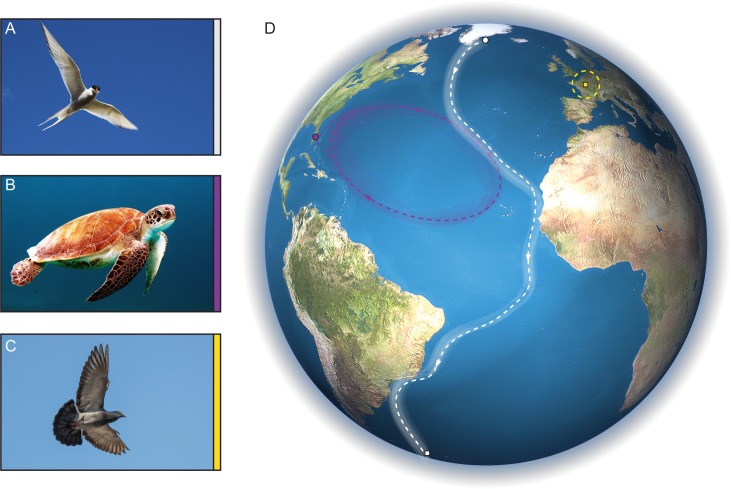
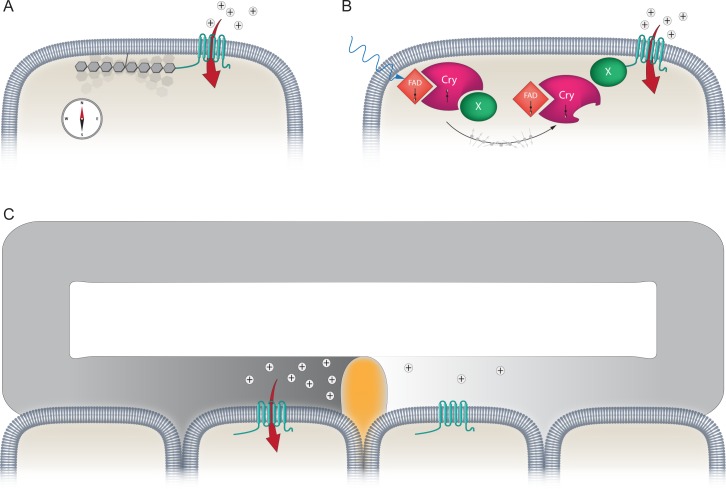
Evolution has equipped life on our planet with an array of extraordinary senses, but perhaps the least understood is magnetoreception. Despite compelling behavioral evidence that this sense exists, the cells, molecules, and mechanisms that mediate sensory transduction remain unknown. So how could animals detect magnetic fields? We introduce and discuss 3 concepts that attempt to address this question: (1) a mechanically sensitive magnetite-based magnetoreceptor, (2) a light-sensitive chemical-based mechanism, and (3) electromagnetic induction within accessory structures. In discussing the merits and issues with each of these ideas, we draw on existing precepts in sensory biology. We argue that solving this scientific mystery will require the development of new genetic tools in magnetosensitive species, coupled with an interdisciplinary approach that bridges physics, behavior, anatomy, physiology, molecular biology, and genetics.
Conflict of interest statement
The authors have declared that no competing interests exist.
Figures
References
-
- Needham J (1962) Science and Civilization in China: Cambridge University Press.
-
- Merrill RT, McElhinny M. W. (1983) The Earth's magnetic field: Its history, origin and planetary perspective. International geophysics series 32.
-
- Egevang C, Stenhouse IJ, Phillips RA, Petersen A, Fox JW, et al. (2010) Tracking of Arctic terns Sterna paradisaea reveals longest animal migration. Proc Natl Acad Sci U S A 107: 2078–2081. doi: 10.1073/pnas.0909493107 - DOI - PMC - PubMed
-
- Merkel FWW W. (1965) Magnetismus und richtungsfinden zugunruhiger rotkehlchen (Erithacus rubecula). Vogelwarte 23: 71–77.
-
- Blakemore R (1975) Magnetotactic bacteria. Science 190: 377–379. - PubMed
MeSH terms
Substances
LinkOut - more resources
Full Text Sources
Other Literature Sources