


Trajectories of Responses to Pictorial Cigarette Pack Warnings
- PMID: 29059340
- PMCID: PMC5991219
- DOI: 10.1093/ntr/ntx182
Trajectories of Responses to Pictorial Cigarette Pack Warnings
Abstract
Background: Pictorial warnings on cigarette packs are a cost-effective policy-level intervention for smoking cessation; however, little research has examined changes in the impact of warnings over time, especially shortly following the first exposure to pictorial warnings. We sought to characterize the trajectories of responses to pictorial cigarette pack warnings soon after first exposure.
Methods: Participants were 2149 adult smokers in North Carolina and California, United States. In 2014-2015, we randomized smokers to have pictorial (intervention) or text-only (control) warnings on their cigarette packs for 4 weeks. Weekly surveys assessed psychosocial and behavioral outcomes.
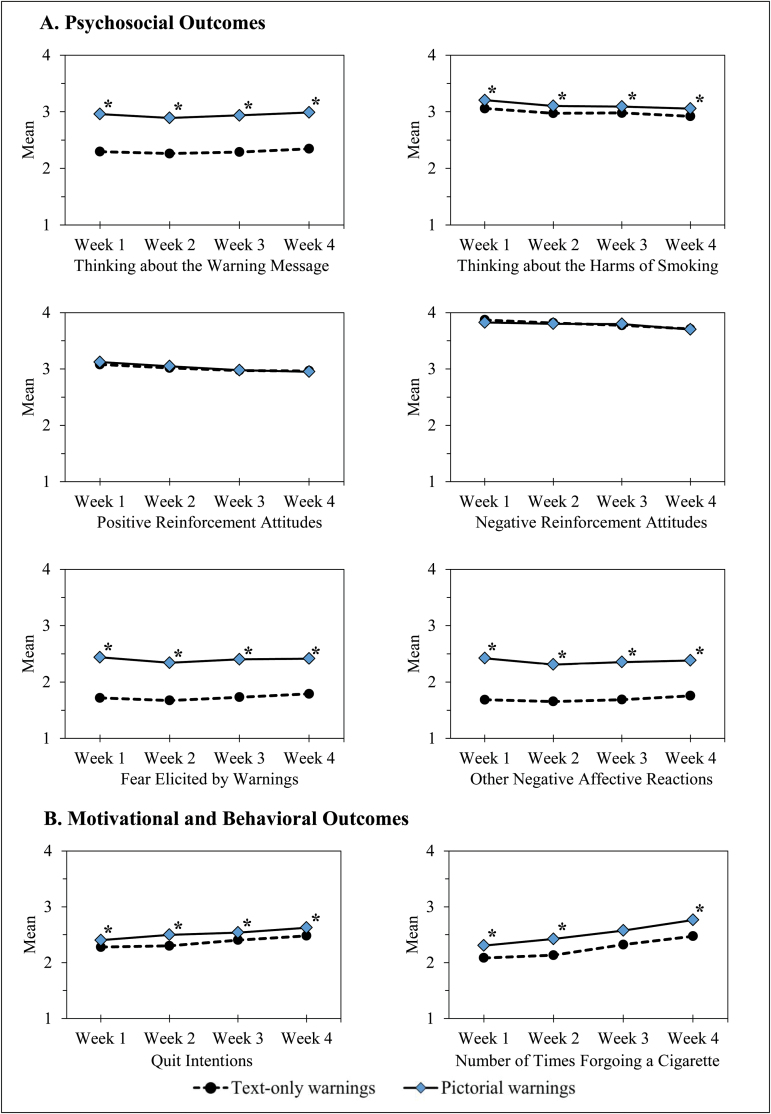
Results: After 1 week, smokers in the intervention arm reported higher levels of most outcomes, compared with the control arm. Over subsequent weeks, smokers in both trial arms had decreases in thinking about the harms of smoking (β = -0.046), positive (β = -0.036), and negative (β = -0.042) smoking reinforcement attitudes, and increases in quit intentions (β = 0.070) and cigarette forgoing (β = 0.137) (all p < .05). Only negative affective reactions decreased more in the intervention versus control condition (pinteraction < .01).
Conclusions: The impact of pictorial cigarette pack warnings on emotions and cognitions may wane over time. In contrast, quit intentions and cigarette forgoing may continue to increase, at least during the initial period after introduction. Rotation of pictorial warnings may help prevent warning wear-out.
Implications: Cigarette smoking is the leading cause of preventable morbidity and mortality and warnings on cigarette packs are a cost-effective policy-level intervention. Prior studies reporting on cigarette pack warning "wear out" have been limited by being short-term single-session experimental studies. Ours are the first study to experimentally examine the trajectories of several outcomes after first exposure and report that the impact of pictorial cigarette pack warnings on emotions and cognitions may wane over time while quit intentions and cigarette forgoing may continue to increase.
Trials registration: ClinicalTrials.gov identifier: NCT02247908; https://clinicaltrials.gov/ct2/show/NCT02247908.
Figures
References
-
- Jamal A, King BA, Neff LJ, Whitmill J, Babb SD, Graffunder CM. Current cigarette smoking among adults — United States, 2005–2015. MMWR Morb Mortal Wkly Rep. 2016;65:1205–1211. https://www.cdc.gov/mmwr/volumes/65/wr/mm6544a2.htm?s_cid=mm6544a2_w. Accessed April 12, 2017. - PubMed
-
- US Department of Health and Human Services. The Health Consequences of smoking—50 Years of Progress: A Report of the Surgeon General.Atlanta, GA: US Department of Health and Human Services, Centers for Disease Control and Prevention, National Center for Chronic Disease Prevention and Health Promotion, Office on Smoking and Health; 2014.
-
- Borland R. Tobacco health warnings and smoking-related cognitions and behaviours. Addiction. 1997;92(11):1427–1435. http://www.ncbi.nlm.nih.gov/pubmed/9519486. Accessed April 11, 2017. - PubMed
Publication types
MeSH terms
Associated data
Grants and funding
LinkOut - more resources
Full Text Sources
Other Literature Sources
Medical
