


Dapagliflozin acutely improves endothelial dysfunction, reduces aortic stiffness and renal resistive index in type 2 diabetic patients: a pilot study
- PMID: 29061124
- PMCID: PMC5654086
- DOI: 10.1186/s12933-017-0621-8
Dapagliflozin acutely improves endothelial dysfunction, reduces aortic stiffness and renal resistive index in type 2 diabetic patients: a pilot study
Abstract
Background: Sodium-glucose cotransporter-2 inhibitors reduce blood pressure (BP) and renal and cardiovascular events in patients with type 2 diabetes through not fully elucidated mechanisms. Aim of this study was to investigate whether dapagliflozin is able to acutely modify systemic and renal vascular function, as well as putative mechanisms.
Methods: Neuro-hormonal and vascular variables, together with 24 h diuresis, urinary sodium, glucose, isoprostanes and free-water clearance were assessed before and after a 2-day treatment with dapagliflozin 10 mg QD in sixteen type 2 diabetic patients; data were compared with those obtained in ten patients treated with hydrochlorothiazide 12.5 mg QD. Brachial artery endothelium-dependent and independent vasodilation (by flow-mediated dilation) and pulse wave velocity were assessed. Renal resistive index was obtained at rest and after glyceryl trinitrate administration. Differences were analysed by repeated measures ANOVA, considering treatment as between factor and time as within factor; Bonferroni post hoc comparison test was also used.
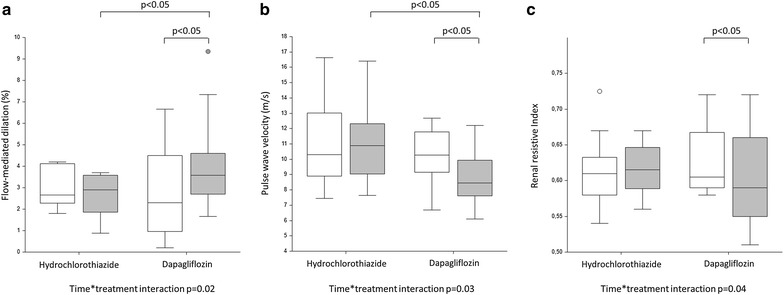
Results: Dapagliflozin decreased systolic BP and induced an increase in 24 h diuresis to a similar extent of hydrochlorothiazide; 24 h urinary glucose and serum magnesium were also increased. 24 h urinary sodium and fasting blood glucose were unchanged. Oxidative stress was reduced, as by a decline in urinary isoprostanes. Flow-mediated dilation was significantly increased (2.8 ± 2.2 to 4.0 ± 2.1%, p < 0.05), and pulse-wave-velocity was reduced (10.1 ± 1.6 to 8.9 ± 1.6 m/s, p < 0.05), even after correction for mean BP. Renal resistive index was reduced (0.62 ± 0.04 to 0.59 ± 0.05, p < 0.05). These vascular modifications were not observed in hydrochlorothiazide-treated individuals.
Conclusions: An acute treatment with dapagliflozin significantly improves systemic endothelial function, arterial stiffness and renal resistive index; this effect is independent of changes in BP and occurs in the presence of stable natriuresis, suggesting a fast, direct beneficial effect on the vasculature, possibly mediated by oxidative stress reduction.
Keywords: Dapagliflozin; Endothelium; Flow-mediated dilation; Pulse wave velocity; Resistive index; SGLT2-inhibitors; Thiazide diuretics; Type 2 diabetes.
Figures
References
-
- Cai Z, Xin J, Pollock DM, Pollock JS. Shear stress-mediated NO production in inner medullary collecting duct cells. Am J Physiol Renal Physiol. 2000;279:F270–F274. - PubMed
MeSH terms
Substances
LinkOut - more resources
Full Text Sources
Other Literature Sources
Medical
