


Integrated community case management by drug sellers influences appropriate treatment of paediatric febrile illness in South Western Uganda: a quasi-experimental study
- PMID: 29061148
- PMCID: PMC5654057
- DOI: 10.1186/s12936-017-2072-9
Integrated community case management by drug sellers influences appropriate treatment of paediatric febrile illness in South Western Uganda: a quasi-experimental study
Abstract
Background: Fever case management is a major challenge for improved child health globally, despite existence of cheap and effective child survival health technologies. The integrated Community Case Management (iCCM) intervention of paediatric febrile illnesses though adopted by Uganda's Ministry of Health to be implemented by community health workers, has not addressed the inaccess to life-saving medicines and diagnostics. Therefore, the iCCM intervention was implemented in private drug shops and evaluated for its effect on appropriate treatment of paediatric fever in a low malaria transmission setting in South Western Uganda.
Methods: From June 2013 to September 2015, the effect of the iCCM intervention on drug seller paediatric fever management and adherence to iCCM guidelines was assessed in a quasi-experimental study in South Western Uganda. A total of 212 care-seeker exit interviews were done before and 285 after in the intervention arm as compared to 216 before and 268 care-seeker interviews at the end of the study period in the comparison arm. The intervention effect was assessed by difference-in-difference analysis of drug seller treatment practices against national treatment recommendations between the intervention and comparison arms. Observed proportions among care-seeker interviews were compared with corresponding proportions from 5795 child visits recorded in patient registries and 49 direct observations of drug seller-care-seeker encounters in intervention drug shops.
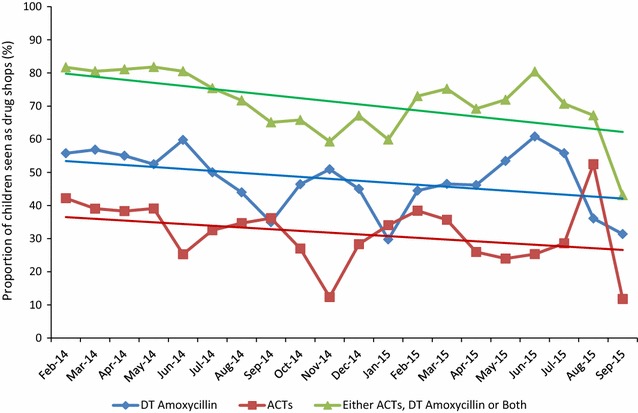
Results: The iCCM intervention increased the appropriate treatment of uncomplicated malaria, pneumonia symptoms and non-bloody diarrhoea by 80.2% (95% CI 53.2-107.2), 65.5% (95% CI 51.6-79.4) and 31.4% (95% CI 1.6-61.2), respectively. Within the intervention arm, drug seller scores on appropriate treatment for pneumonia symptoms and diagnostic test use were the same among care-seeker exit interviews and direct observation. A linear trend (negative slope, - 0.009 p value < 0.001) was observed for proportions of child cases prescribed any antimicrobial medicine in the intervention arm drug shops.
Conclusions: The iCCM intervention improved appropriate treatment for uncomplicated malaria, pneumonia symptoms and diarrhoea. Drug seller adherence to iCCM guidelines was high, without causing excessive prescription of antimicrobial medicines in this study. Further research should assess whether this effect is sustained over time and under routine supervision models.
Keywords: Appropriate treatment; Diagnostics; Drug sellers; Febrile illness; Integrated case management; Malaria; Pneumonia; Private sector; Uganda.
Figures

References
-
- UNICEF. Levels and trends in child mortality. Report 2015. Estimates developed by the UN Interagency Group for child mortality estimation. New York, USA2015c.
-
- Global Health Observatory (GHO) Data. under-five mortality http://www.who.int/gho/child_health/mortality/mortality_under_five_text/en/. Accessed 21 Apr 2017.
-
- Child Survival. Under-five mortality—current status and progress. https://data.unicef.org/topic/child-survival/under-five-mortality/.
-
- Uganda Ministry of Health. Annual health sector performance report—financial year 2015–2016. Kampala: Uganda Ministry of Health; 2016.
-
- Young M, Wolfheim C, Marsh DR, Hammamy D. World Health Organization/United Nations Children’s Fund joint statement on integrated community case management: an equity-focused strategy to improve access to essential treatment services for children. Am J Trop Med Hyg. 2012;87:6–10. doi: 10.4269/ajtmh.2012.12-0221. - DOI - PMC - PubMed
Publication types
MeSH terms
Substances
LinkOut - more resources
Full Text Sources
Other Literature Sources
Medical
