


Electrophysiology of prosodic and lexical-semantic processing during sentence comprehension in aphasia
- PMID: 29061490
- PMCID: PMC6530485
- DOI: 10.1016/j.neuropsychologia.2017.10.023
Electrophysiology of prosodic and lexical-semantic processing during sentence comprehension in aphasia
Abstract
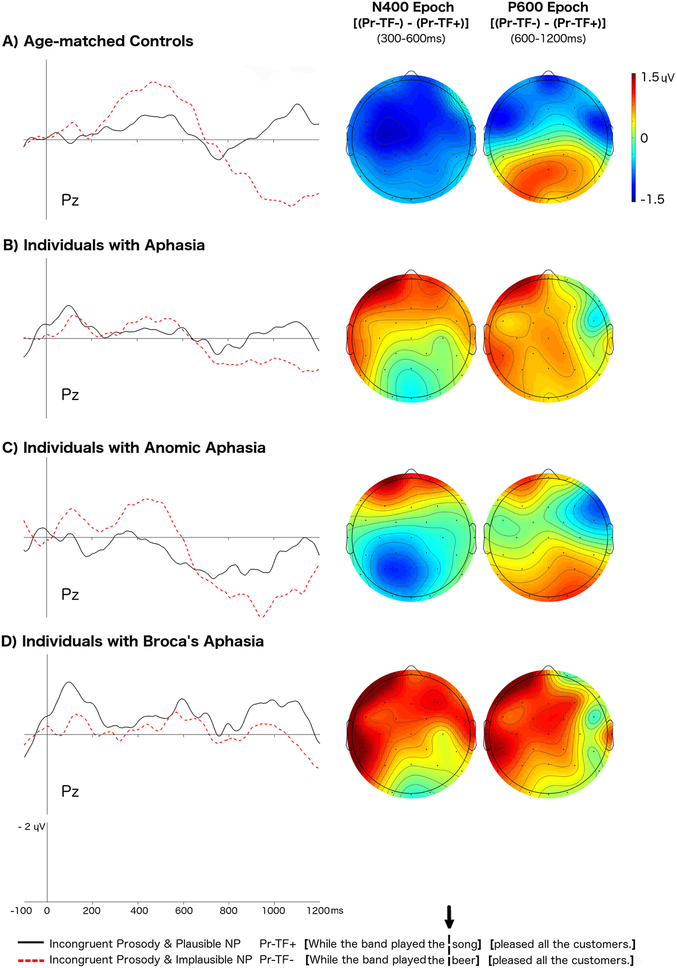
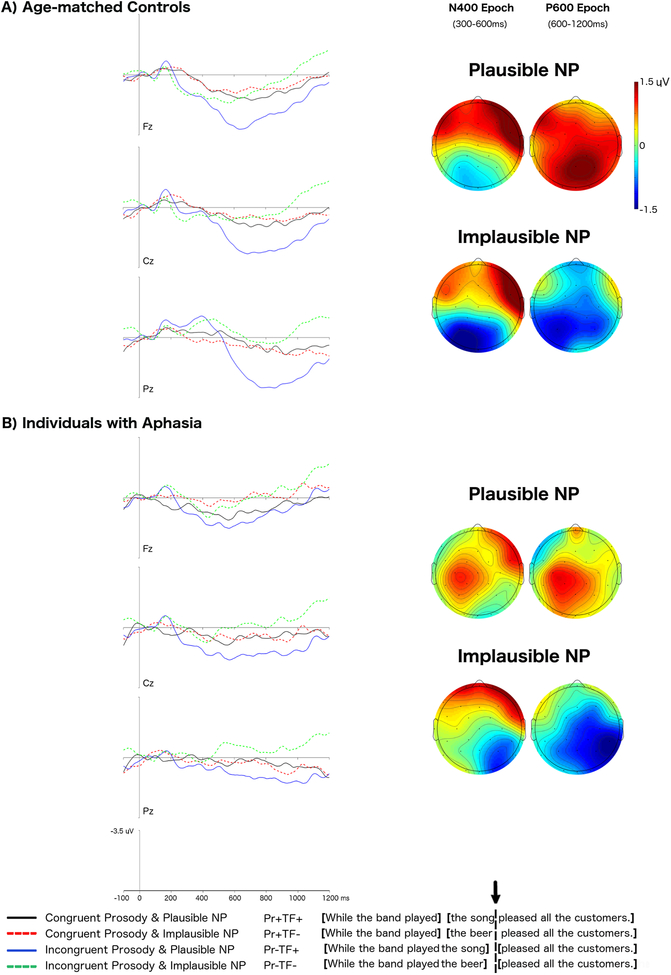
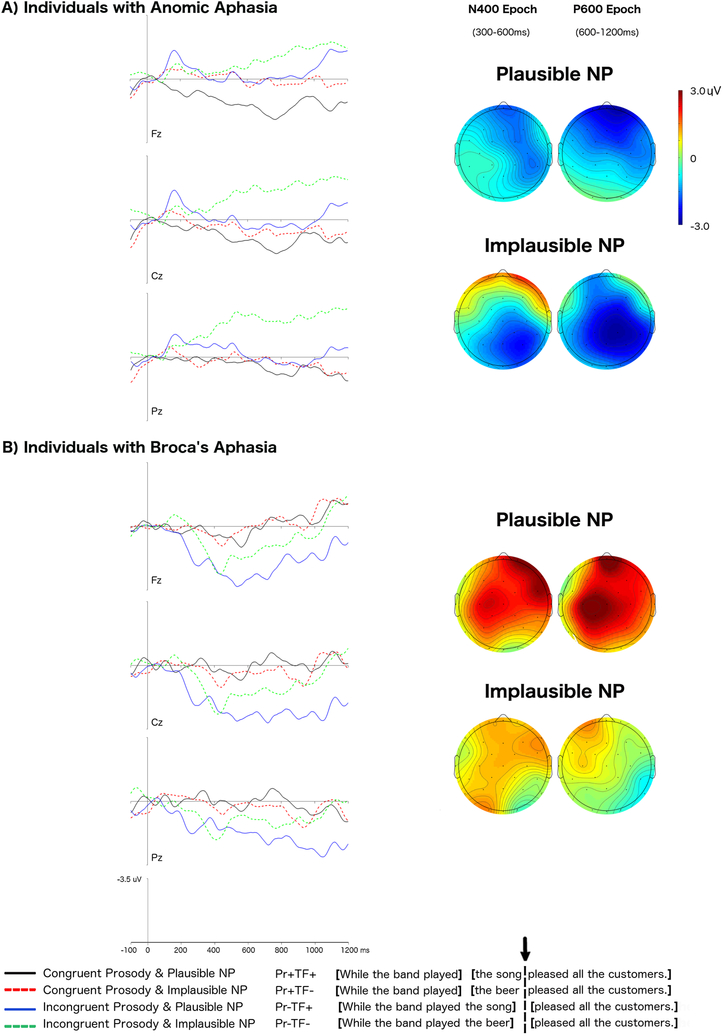
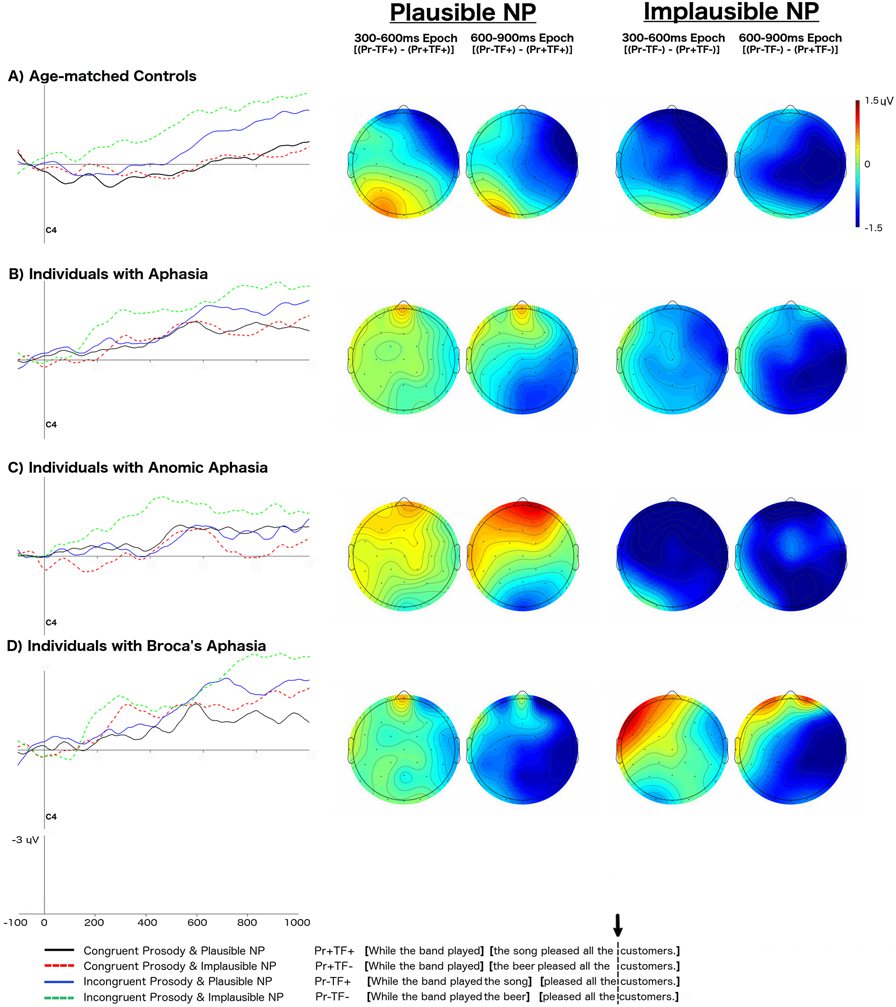
Event-related potentials (ERPs) were used to examine how individuals with aphasia and a group of age-matched controls use prosody and themattic fit information in sentences containing temporary syntactic ambiguities. Two groups of individuals with aphasia were investigated; those demonstrating relatively good sentence comprehension whose primary language difficulty is anomia (Individuals with Anomic Aphasia (IWAA)), and those who demonstrate impaired sentence comprehension whose primary diagnosis is Broca's aphasia (Individuals with Broca's Aphasia (IWBA)). The stimuli had early closure syntactic structure and contained a temporary early closure (correct)/late closure (incorrect) syntactic ambiguity. The prosody was manipulated to either be congruent or incongruent, and the temporarily ambiguous NP was also manipulated to either be a plausible or an implausible continuation for the subordinate verb (e.g., "While the band played the song/the beer pleased all the customers."). It was hypothesized that an implausible NP in sentences with incongruent prosody may provide the parser with a plausibility cue that could be used to predict syntactic structure. The results revealed that incongruent prosody paired with a plausibility cue resulted in an N400-P600 complex at the implausible NP (the beer) in both the controls and the IWAAs, yet incongruent prosody without a plausibility cue resulted in an N400-P600 at the critical verb (pleased) only in healthy controls. IWBAs did not show evidence of N400 or P600 effects at the ambiguous NP or critical verb, although they did show evidence of a delayed N400 effect at the sentence-final word in sentences with incongruent prosody. These results suggest that IWAAs have difficulty integrating prosodic cues with underlying syntactic structure when lexical-semantic information is not available to aid their parse. IWBAs have difficulty integrating both prosodic and lexical-semantic cues with syntactic structure, likely due to a processing delay.
Keywords: Aphasia; Event related potentials; N400; P600; Prosody; Sentence processing.
Copyright © 2017 Elsevier Ltd. All rights reserved.
Figures
References
-
- Altmann G (1999). Thematic role assignment in context. Journal of Memory and Language, 41, 124–145.
-
- Altmann GT, & Kamide Y (1999). Incremental interpretation at verbs: Restricting the domain of subsequent reference. Cognition, 73(3), 247–264. - PubMed
-
- Arai M, & Keller F (2013). The use of verb-specific information for prediction in sentence processing. Language and Cognitive Processes, 28(4), 525–560.
-
- Baum SR, & Dwivedi VD (2003). Sensitivity to prosodic structure in left-and right-hemisphere-damaged individuals. Brain and Language, 87(2), 278–289. - PubMed
-
- Blodgett AR (2004). The interaction of prosodic phrasing, verb bias, and plausibility during spoken sentence comprehension. The Ohio State University.
MeSH terms
Grants and funding
LinkOut - more resources
Full Text Sources
Other Literature Sources
Medical
Miscellaneous
