. 2017 Dec 5;372(1735):20160429.
doi: 10.1098/rstb.2016.0429.

Geographic mosaics and changing rates of cereal domestication

Affiliations

Geographic mosaics and changing rates of cereal domestication

Robin G Allaby et al. Philos Trans R Soc Lond B Biol Sci. .

Abstract

Domestication is the process by which plants or animals evolved to fit a human-managed environment, and it is marked by innovations in plant morphology and anatomy that are in turn correlated with new human behaviours and technologies for harvesting, storage and field preparation. Archaeobotanical evidence has revealed that domestication was a protracted process taking thousands of plant generations. Within this protracted process there were changes in the selection pressures for domestication traits as well as variation across a geographic mosaic of wild and cultivated populations. Quantitative data allow us to estimate the changing selection coefficients for the evolution of non-shattering (domestic-type seed dispersal) in Asian rice (Oryza sativa L.), barley (Hordeum vulgare L.), emmer wheat (Triticum dicoccon (Shrank) Schübl.) and einkorn wheat (Triticum monococcum L.). These data indicate that selection coefficients tended to be low, but also that there were inflection points at which selection increased considerably. For rice, selection coefficients of the order of 0.001 prior to 5500 BC shifted to greater than 0.003 between 5000 and 4500 BC, before falling again as the domestication process ended 4000-3500 BC. In barley and the two wheats selection was strongest between 8500 and 7500 BC. The slow start of domestication may indicate that initial selection began in the Pleistocene glacial era.This article is part of the themed issue 'Process and pattern in innovations from cells to societies'.

Keywords: China; Near East; archaeobotany; archaeology; niche construction; origins of agriculture.


Conflict of interest statement

We declare we have no competing interests.

Figures
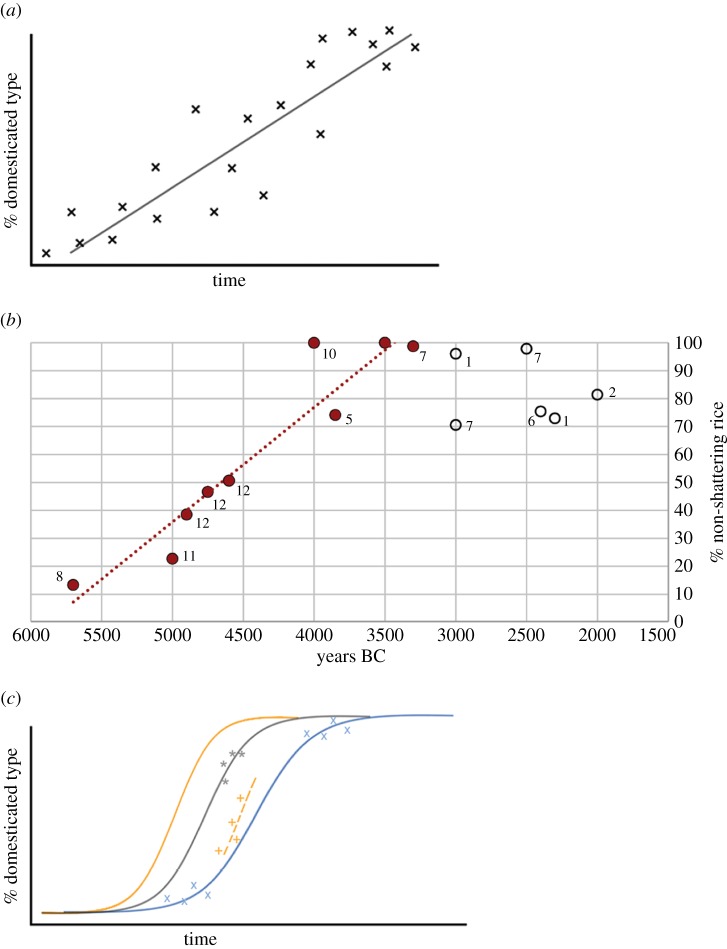
Figure 1.
Figure 1.
Models of domestication rate and rate estimates. (a) Hypothetical series of archaeobotanical data for non-shattering plotted against time with a least-squares linear regression as an estimate of rate of change [12,25,26]. (b) The example of rice spikelet bases from the Lower Yangtze and later northern China (n = 30 912); data points numbered by sites in figure 2a (data: electronic supplementary material, table S1). (c) Hypothetical series of archaeobotanical data points forming selection chains fitted to closest logistic curves of differing rates (method developed in this paper).
Figure 2.
Figure 2.
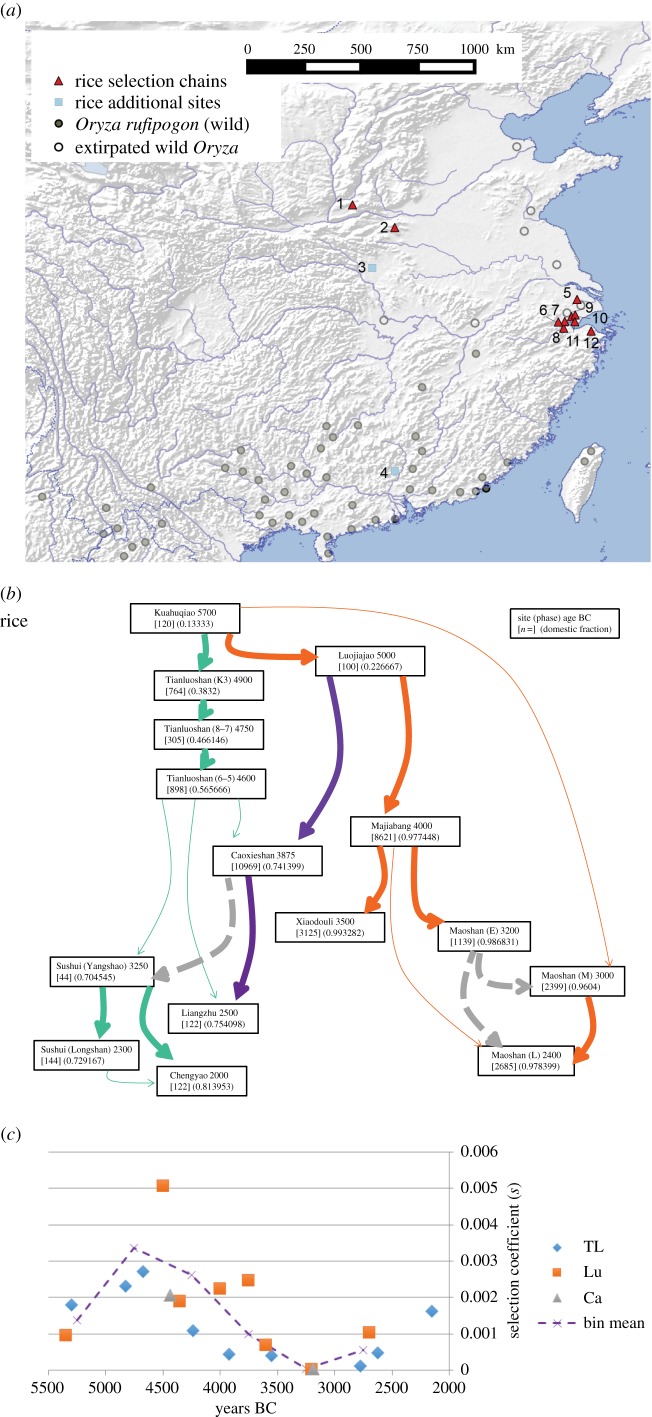
The evidence for the evolution of non-shattering Asian rice (O. sativa). (a) Map of evidence for rice domestication, indicating wild populations [40], and archaeological sites with spikelet base data, and additional sites: 1. Sushui valley, 2. Chengyao, 3. Baligang, 4. Shixia, 5. Caoxieshan, 6. Liangzhu, 7. Maoshan, 8. Kuahuqiao, 9. Luojiajao, 10. Majiabang, 11. Xiaodouli, 12. Tianluoshan. (b) Selection chains for rice taking into account Lower Yangtze and central Chinese finds; negative selection events, dashed grey line. Boxes indicate site name, median age, sample size and proportion of non-shattering form. (c) Estimated selection coefficients (s) for different links in the selection chains in (b), and averages in 500-year bins; TL, Tianluoshan chain; Lu, Luojiajao chain; Ca, Caoxieshan chain.
Figure 3.
Figure 3.
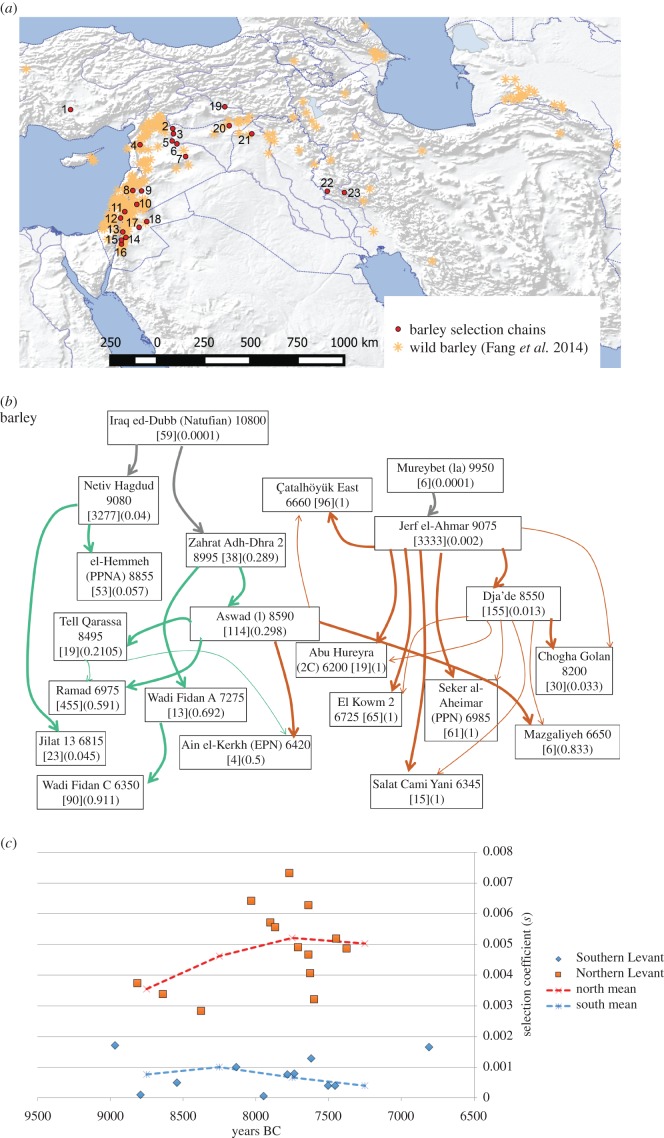
The evidence for the evolution of non-shattering in barley (Hordeum vulgare). (a) Map of evidence for barley domestication, indicating distribution of wild populations [44], and archaeological sites with rachis remains; sites numbered: 1. Çatalhöyük, 2. Dja'de, 3. Jerf el Ahmar, 4. Ain el-Kerkh, 5. Mureybet, 6. Abu Hureyra, 7. El Kowm 2, 8. Ramad, 9. Aswad, 10. Tell Qarassa, 11. Iraq ed-Dubb, 12. Netiv Hagdud, 13. Zahrat Adh-Dhra, 14. el-Hemmeh, 15. Wadi Fidan A, 16. Wadi Fidan C, 17. Jilat 7 and 13, 18. Azraq 31, 19. Salat Cami Yani, 20. Seker al-Aheimar, 21. Mazgaliyeh, 22. Chogha Golan, 23. East Chia Sabz. (b) Selection chains for barley. Boxes indicate site name, median age, sample size and proportion of non-shattering form. (c) Estimated selection coefficients (s) for different links in the selection chains in (b), indicating southern and northern averages for 500-year bins.
Figure 4.
Figure 4.
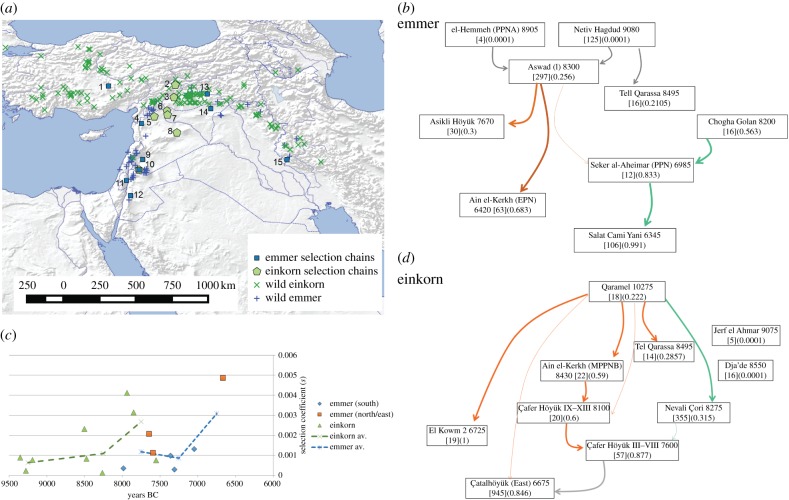
The evidence for the evolution of non-shattering in wheats. (a) Map of evidence for wheat domestication, indicating the distribution of wild Triticum dicoccoides [34], wild Triticum boeticum [35], and archaeological sites with spikelet base remains; sites numbered: 1. Çatalhöyük, 2. Çafer Höyük, 3. Nevali Çori, 4. Ain el-Kherkh, 5. Qaramel, 6. Dja'de, 7. Jerf el Ahmar, 8. El Kowm 2, 9. Aswad, 10. Tell Qarassa, 11. Netiv Hagdud, 12. el-Hemmeh, 13. Salat Cami Yani, 14. Seker al-Aheimar, 15. Chogha Golan. (b) Selection chains for emmer and einkorn wheat, negative selection shown in grey in the case of einkorn. (c) Estimated selection coefficients (s) for emmer and einkorn wheats, showing averages in 500-year bins. (d) Selection chains for einkorn wheat. In (b) and (d), boxes indicate site name, median age, sample size and proportion of non-shattering form.

References

    1. Larson G, et al. 2014. Current perspectives and the future of domestication studies. Proc. Natl Acad. Sci. USA 111, 6139–6146. ( 10.1073/pnas.1323964111) - DOI - PMC - PubMed
    1. Rindos D. 1984. The origins of agriculture. An evolutionary perspective. London, UK: Academic Press.
    1. Purugganan MD, Fuller DQ. 2009. The nature of selection during plant domestication. Nature 457, 843–848. ( 10.1038/nature07895) - DOI - PubMed
    1. Zeder MA. 2015. Core questions in domestication research. Proc. Natl Acad. Sci. USA 112, 3191–3198. ( 10.1073/pnas.1501711112) - DOI - PMC - PubMed
    1. Allaby RG, Kistler L, Gutaker RM, Ware R, Kitchen JL, Smith O, Clarke AC. 2015. Archaeogenomic insights into the adaptation of plants to the human environment: pushing plant–hominin co-evolution back to the Pliocene. J. Hum. Evol. 79, 150–157. ( 10.1016/j.jhevol.2014.10.014) - DOI - PubMed

LinkOut - more resources