


Review
doi: 10.1104/pp.17.01236.
Epub 2017 Oct 23.
Dynamics of Autophagosome Formation
Affiliations
- PMID: 29061903
- PMCID: PMC5761814
- DOI: 10.1104/pp.17.01236
Item in Clipboard
Review
Dynamics of Autophagosome Formation
Plant Physiol.
2018 Jan.
Abstract
Environmental stress activates autophagy and leads to autophagosome formation at the endoplasmic reticulum.
Figures
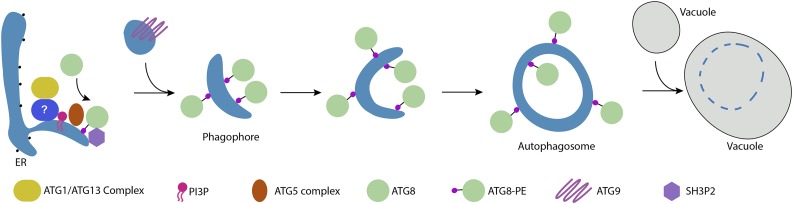
A proposed model for autophagosome formation in plant cells. Once autophagy is induced, a crescent-shaped isolation membrane named a phagophore is assembled on its membrane origin (e.g. ER). During this process, the ATG1 complex is activated, and downstream regulators (question mark) are recruited onto the initiation site. PI3P is generated on the phagophore assembly site, and ATG8 is conjugated onto the membrane to become the ATG8-PE form. Also, ATG5 and SH3P2 have been shown to localize on the phagophore structures. In addition, ATG9 vesicles are required for the efficient budding of the phagophore from the ER platform. In the subsequent steps, more ATG8 lipidation occurs, and the isolation membrane will elongate and close to form the completed double-membrane autophagosome. Finally, the autophagosome will deliver the cargos into the vacuole by fusion with the vacuole. With the help of the acidic environment and hydrolysis enzymes within the vacuole, the cargos will be degraded. Other regulators involved in the later steps after phagophore initiation are not listed.

TOR-dependent and -independent regulatory pathways for autophagy in plants. Autophagy can be activated by abiotic stress, including osmotic, nutrient, salt, oxidative, and ER stress. This activation can be regulated in a TOR-dependent or -independent manner. A, Upon osmotic, nutrient, or salt stress, the SnRK1 complex can inhibit TOR, leading to activation of the ATG1 complex or deactivation of S6K and Tap46, in turn activating autophagy. SnRK1 can also activate the ATG1 complex by phosphorylation of ATG1, leading to activation of autophagy. B, Upon oxidative or ER stress, SnRK1 activates the ATG1 complex, leading to the activation of autophagy. Upon ER stress, unfolded proteins accumulate and activate IRE1b, leading to autophagy. Ovals represent kinase complexes, hexagons represent TOR targets, and octagons represent components of the ER stress response pathway.
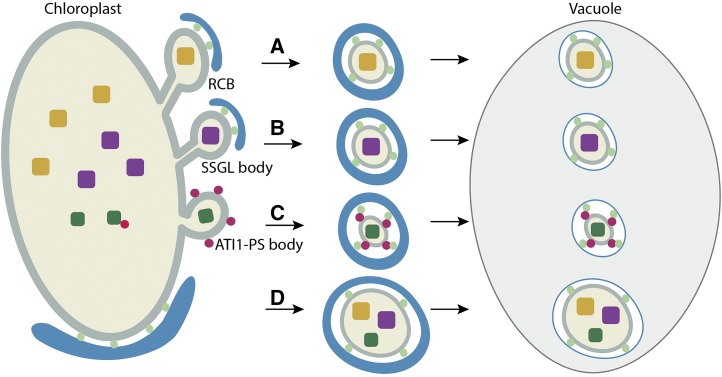
Summary of the characterized autophagy-mediated pathways for chloroplast material degradation. Three types of structures, RCB (A), SSGL body (B), and ATI1-PS body (C), bud off from chloroplasts with different cargos and are sequestered into ATG8-coated membranes (blue color). The receptors for engulfment of RCB and SSGL into autophagosomal membranes are presently unidentified. In addition, when cells are exposed to light-induced damage, whole damaged, dysfunctional chloroplasts can be targeted by ATG8-decorated autophagosome structures (D) to be delivered into the vacuole, but the underlying mechanism remains unknown. ATG8 and ATI1 are labeled with green and red dots, respectively.

References
Publication types
MeSH terms
Grants and funding
LinkOut - more resources
Full Text Sources
Other Literature Sources
