


TMAO is Associated with Mortality: Impact of Modestly Impaired Renal Function
- PMID: 29061990
- PMCID: PMC5653802
- DOI: 10.1038/s41598-017-13739-9
TMAO is Associated with Mortality: Impact of Modestly Impaired Renal Function
Abstract
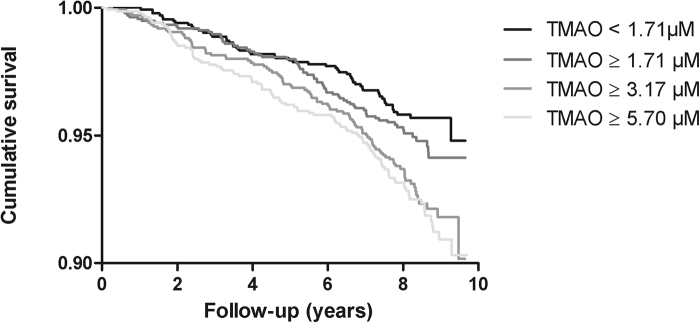
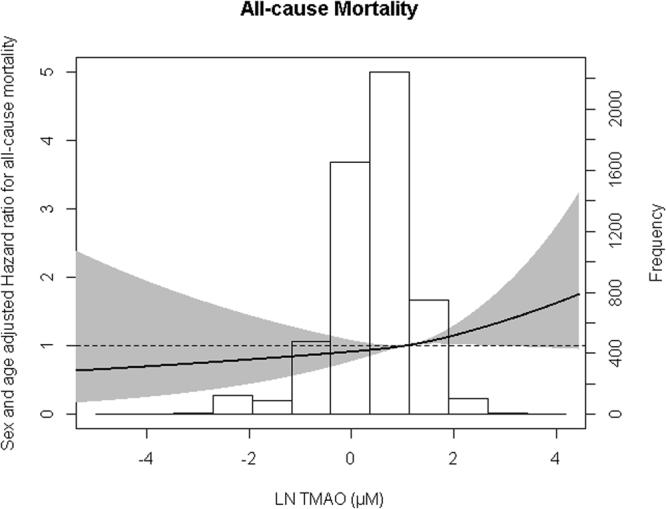
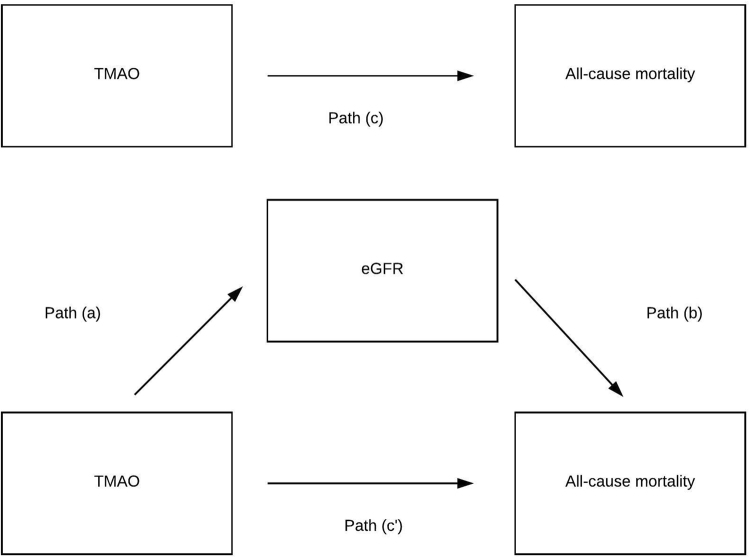
Trimethylamine-N-Oxide (TMAO) is a microbiome-related metabolite that is cleared by the kidney and linked to renal function. We explored the relationship between TMAO and all-cause mortality, and determined whether this association was modified by renal function. A prospective study was performed among PREVEND participants to examine associations of plasma TMAO with all-cause mortality. After median follow-up of 8.3 years in 5,469 participants, 322 subjects died. TMAO was positively associated with age, body mass index, type 2 diabetes mellitus and inversely with estimated glomerular filtration rate (eGFRcreatcysC)(all P < 0.001). Subjects in the highest versus lowest TMAO quartile had a crude 1.86-fold higher mortality risk (Ptrend < 0.001). After adjustment for several risk factors, TMAO remained associated with all-cause mortality [HR:1.36 (95% CI, 0.97-1.91),Ptrend = 0.016]. This association was lost after further adjustment for urinary albumin excretion and eGFR [HR:1.15 (95% CI, 0.81-1.64),Ptrend = 0.22]. The association of TMAO with mortality was modified by eGFR in crude and age- and sex-adjusted analyses (interaction P = 0.002). When participants were stratified by renal function (eGFR < vs. ≥90 mL/min/1.73 m2), TMAO was associated with all-cause mortality only in subjects with eGFR <90 mL/min/1.73 m2 [adjusted HR:1.18 (95% CI, 1.02-1.36),P = 0.023]. In conclusion, TMAO is associated with all-cause mortality, particularly in subjects with eGFR <90 mL/min/1.73 m2.
Conflict of interest statement
E.G., M.A.C., E.J.J. and J.D.O. are employees of LabCorp.
Figures
References
MeSH terms
Substances
LinkOut - more resources
Full Text Sources
Other Literature Sources
Medical
Research Materials
Miscellaneous
