. 2017 Oct 23;7(1):13773.
doi: 10.1038/s41598-017-12602-1.

Bone Marrow Mononuclear Cells Combined with Beta-Tricalcium Phosphate Granules for Alveolar Cleft Repair: A 12-Month Clinical Study

Affiliations

Bone Marrow Mononuclear Cells Combined with Beta-Tricalcium Phosphate Granules for Alveolar Cleft Repair: A 12-Month Clinical Study

Fengzhou Du et al. Sci Rep. .

Abstract

Alveolar cleft is the most common congenital bone defect. Autologous iliac crest bone graft (ICBG) is the most widely adopted procedure for alveolar cleft repair, but the condition is associated with door-site morbidities. For the first time, this study used bone marrow mononuclear cells (BMMNCs) combined with beta-tricalcium phosphate (β-TCP) granules to repair alveolar bone defect. The effectiveness of this technique was compared with autologous ICBG after 12 months of follow-up. The bone formation volume was quantitatively evaluated by three-dimensional computed tomography and computer aided engineering technology. BMMNCs/β-TCP granule grafting was radiographically equivalent to ICBG in alveolar cleft repair. Although considerable resorption was observed up to 6 months after surgery, no significant differences were noted in the Chelsea score and bone formation volume between groups. These finding indicate that BMMNCs/β-TCP grafting is a safe and effective approach for alveolar bone regeneration.


Conflict of interest statement

The authors declare that they have no competing interests.

Figures
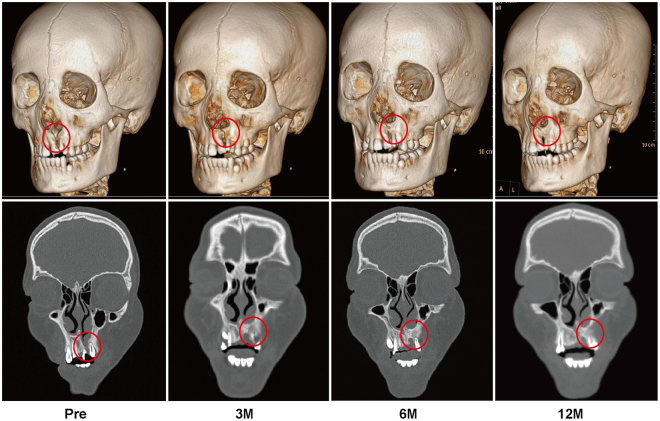
Figure 1
Figure 1
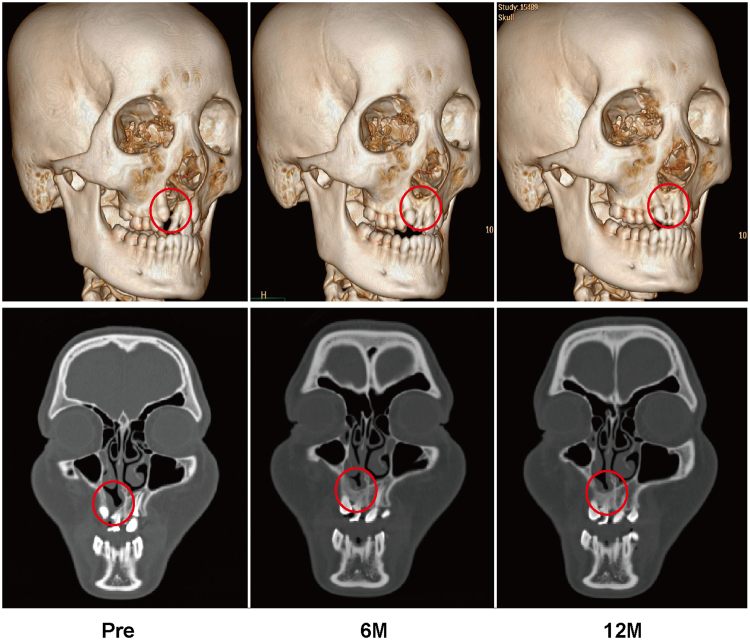
Typical three-dimensional and coronal computed tomographic images of a patient who underwent BMMNCs/β-TCP grafting. From left to right, images taken preoperatively and at 3, 6, and 12 months postoperatively.
Figure 2
Figure 2
Typical three-dimensional and coronal computed tomographic images of a patient who underwent ICBG grafting. From left to right, images taken preoperatively and at 6 and 12 months postoperatively.
Figure 3
Figure 3
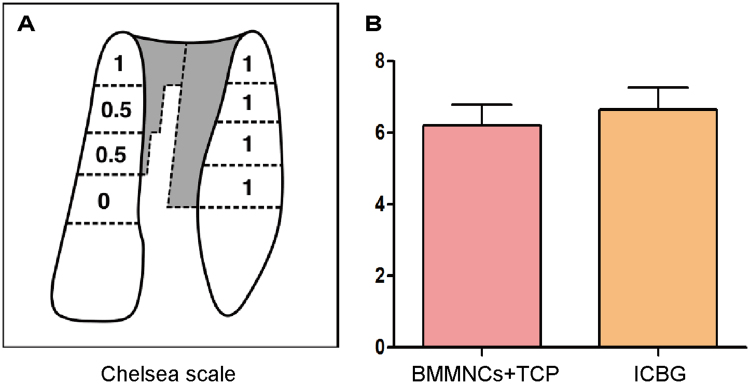
Chelsea scale analysis. (A) Chelsea scale quantifies bone formation at the cleft site using a score that ranges from 0 to 8. Note, a score of 0.5 indicate a partial fill without bony bridge. (B) Comparison of mean Chelsea scores based on procedure. The mean scores of the BMMNCs/β-TCP and ICBG groups are 6.2 ± 0.57 and 6.7 ± 0.61, respectively. The difference is not statistically significant.
Figure 4
Figure 4
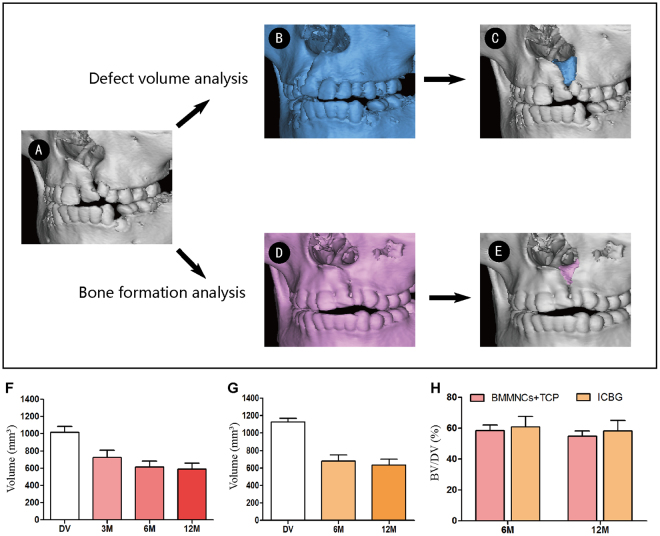
Volumetric analysis using CAE. (A) Non-cleft side data were mirrored (blue), and then the original cleft data were subtracted to identify cleft morphology and volume. Postoperative data (pink) was registered with the original cleft to identify the graft and newly formed alveolar bone. Postoperative graft volume changes of patients who underwent BMMNCs/β-TCP and ICBG grafting are presented in (B) and (C), respectively. (D) Bone formation ratio of the two groups at 6 and 12 months postoperatively. DV, defect volume; BV, bone volume.
Figure 5
Figure 5
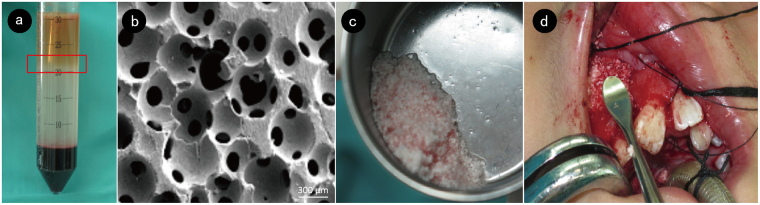
Operative process. (a) Bone marrow aspirate after centrifugation. The red frame indicates the layer of BMMNCs. (b) Porous structures of β-TCP observed by scanning electron microscope. (c) BMMNCs mixed with β-TCP granules. (d) Alveolar cleft filled with BMMNCs/β-TCP graft.

References

    1. Jia YL, Fu MK, Ma L. Long-term outcome of secondary alveolar bone grafting in patients with various types of cleft. The British journal of oral & maxillofacial surgery. 2006;44:308–312. doi: 10.1016/j.bjoms.2005.07.003. - DOI - PubMed
    1. Boyne PJ, Sands NR. Secondary bone grafting of residual alveolar and palatal clefts. J Oral Surg. 1972;30:87–92. - PubMed
    1. Schnitt DE, Agir H, David DJ. From birth to maturity: a group of patients who have completed their protocol management. Part I. Unilateral cleft lip and palate. Plastic and reconstructive surgery. 2004;113:805–817. doi: 10.1097/01.PRS.0000105332.57124.89. - DOI - PubMed
    1. Seike T, Hashimoto I, Matsumoto K, Tanaka E, Nakanishi H. Early postoperative evaluation of secondary bone grafting into the alveolar cleft and its effects on subsequent orthodontic treatment. The journal of medical investigation: JMI. 2012;59:152–165. doi: 10.2152/jmi.59.152. - DOI - PubMed
    1. Koole R. Ectomesenchymal mandibular symphysis bone graft: an improvement in alveolar cleft grafting? The Cleft palate-craniofacial journal: official publication of the American Cleft Palate-Craniofacial Association. 1994;31:217–223. doi: 10.1597/1545-1569(1994)031<0217:EMSBGA>2.3.CO;2. - DOI - PubMed

Publication types