. 2017 Oct 23;7(1):13771.
doi: 10.1038/s41598-017-14145-x.

Propensity-score-matched evaluation of the incidence of radiation pneumonitis and secondary cancer risk for breast cancer patients treated with IMRT/VMAT

Affiliations

Propensity-score-matched evaluation of the incidence of radiation pneumonitis and secondary cancer risk for breast cancer patients treated with IMRT/VMAT

Pei-Ju Chao et al. Sci Rep. .

Abstract

Propensity score matching evaluates the treatment incidence of radiation-induced pneumonitis (RP) and secondary cancer risk (SCR) after intensity-modulated radiotherapy (IMRT) and volumetric-modulated arc therapy (VMAT) for breast cancer patients. Of 32 patients treated with IMRT and 58 who received VMAT were propensity matched in a 1:1 ratio. RP and SCR were evaluated as the endpoints of acute and chronic toxicity, respectively. Self-fitted normal tissue complication probability (NTCP) parameter values were used to analyze the risk of RP. SCRs were evaluated using the preferred Schneider's parameterization risk models. The dosimetric parameter of the ipsilateral lung volume receiving 40 Gy (IV40) was selected as the dominant risk factor for the RP NTCP model. The results showed that the risks of RP and NTCP, as well as that of SCR of the ipsilateral lung, were slightly lower than the values in patients treated with VMAT versus IMRT (p ≤ 0.01). However, the organ equivalent dose and excess absolute risk values in the contralateral lung and breast were slightly higher with VMAT than with IMRT (p ≤ 0.05). When compared to IMRT, VMAT is a rational radiotherapy option for breast cancer patients, based on its reduced potential for inducing secondary malignancies and RP complications.


Conflict of interest statement

The authors declare that they have no competing interests.

Figures

Figure 1
Figure 1
The process profile for this study. Abbreviations: LASSO, least absolute shrinkage and selection operator; IMRT, intensity-modulated radiotherapy; VMAT, volumetric-modulated arc therapy; RP, radiation-induced pneumonitis; IV5: the volume of the ipsilateral lung receiving at least 5 Gy; the following parameters are similar; IV10∼IV50; NTCP, normal tissue complication probability; MD, mean dose to the ipsilateral lung; LKB, Lyman-Kutcher-Burman; OED, organ equivalent dose; EAR, excess absolute risks; OARs, organs at risk.
Figure 2
Figure 2
Two representative treatment plans (a,b); RP-diagnosed at 3 months after RT (c,d); RP-diagnosed images merged with the original isodose curves (e,f). Abbreviations: RT, radiotherapy; RP, radiation pneumonitis; IMRT, intensity-modulated radiotherapy; VMAT, volumetric-modulated arc therapy.
Figure 3
Figure 3
Average dose volume histograms for the mean doses delivered to the ipsilateral lung in the groups (a) with/without RP and (b) the IMRT/VMAT, respectively. The self-fitted dose-response LKB RP NTCP curve (c). Scatter plots for the IV40 and NTCP between the IMRT and VMAT cohorts (d). Abbreviations: IMRT, intensity-modulated radiotherapy; VMAT, volumetric-modulated arc therapy; RP, radiation-induced pneumonitis; IV40: the volume of the ipsilateral lung receiving at least 40 Gy; the following parameters are similar; IV5∼IV50; DF, degrees of freedom; MD, mean dose to the ipsilateral lung; NTCP, normal tissue complication probability; LKB, Lyman-Kutcher-Burman; TD25, the dose predicting a 25% risk of complications; n, a parameter that considers the volume effect; m, a dimensionless model parameter for describing the slope of the dose-response curve.
Figure 4
Figure 4
Differential dose volume histograms of the same two representative patients for irradiation of the ipsilateral and contralateral lung and contralateral breast for IMRT/VMAT breast radiotherapy (a,b,c). OED/EAR of 30 patients (mean and standard deviation) using Schneider’s full model for 6 OARs for IMRT and VMAT (d,e). Accumulated EARs for 6 OARs at age of 70 years (f). The EAR has units of excess cases per 10,000 person-years (PY)/Gy. Abbreviations: IMRT, intensity-modulated radiotherapy; VMAT, volumetric-modulated arc therapy; OED, organ equivalent dose; EAR, excess absolute risks; SC, spinal cord; C-Breast, contralateral breast; I-Lung, ipsilateral lung; C-Lung, contralateral lung; OARs, organs at risk.
Figure 5
Figure 5
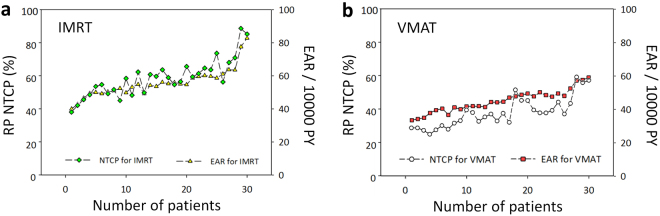
The trends between RP NTCP and EAR of ipsilateral lung for patients treated with (a) IMRT or (b) VMAT. The EAR has units of excess cases per 10,000 person-years (PY)/Gy. Abbreviations: IMRT, intensity-modulated radiotherapy; VMAT, volumetric-modulated arc therapy; NTCP, normal tissue complication probability; EAR, excess absolute risk.

References

    1. Lee B, Lee S, Sung J, Yoon M. Radiotherapy-induced secondary cancer risk for breast cancer: 3D conformal therapy versus IMRT versus VMAT. J Radiol Prot. 2014;34:325. doi: 10.1088/0952-4746/34/2/325. - DOI - PubMed
    1. Lee T-F, Chao P-J, Chang L, Ting H-M, Huang Y-J. Developing multivariable normal tissue complication probability model to predict the incidence of symptomatic radiation pneumonitis among breast cancer patients. PloS one. 2015;10:e0131736. doi: 10.1371/journal.pone.0131736. - DOI - PMC - PubMed
    1. Swamy ST, Radha CA, Kathirvel M, Arun G, Subramanian S. Feasibility study of deep inspiration breath-hold based volumetric modulated arc therapy for locally advanced left sided breast cancer patients. Asian Pac J Cancer Prev. 2014;15:9033–9038. doi: 10.7314/APJCP.2014.15.20.9033. - DOI - PubMed
    1. Abo-Madyan Y, et al. Second cancer risk after 3D-CRT, IMRT and VMAT for breast cancer. Radiother Oncol. 2014;110:471–476. doi: 10.1016/j.radonc.2013.12.002. - DOI - PubMed
    1. Group EBCTC. Aromatase inhibitors versus tamoxifen in early breast cancer: patient-level meta-analysis of the randomised trials. Lancet. 2015;386:1341–1352. doi: 10.1016/S0140-6736(15)61074-1. - DOI - PubMed

Publication types