


Female alcohol consumption and fecundability: a systematic review and dose-response meta-analysis
- PMID: 29062133
- PMCID: PMC5653745
- DOI: 10.1038/s41598-017-14261-8
Female alcohol consumption and fecundability: a systematic review and dose-response meta-analysis
Abstract
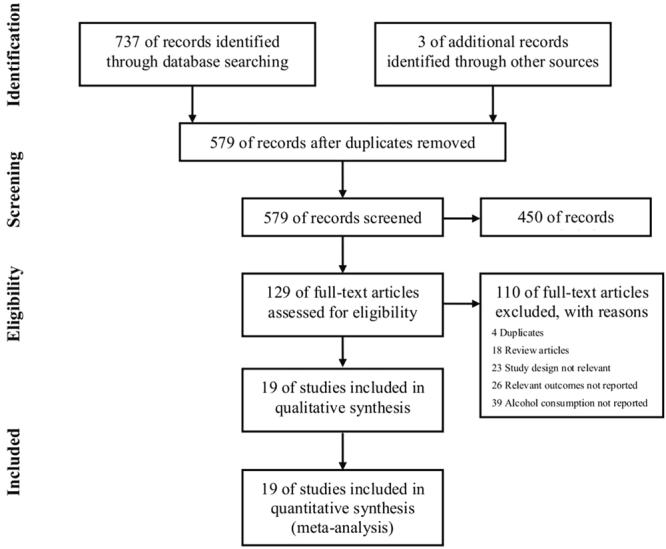
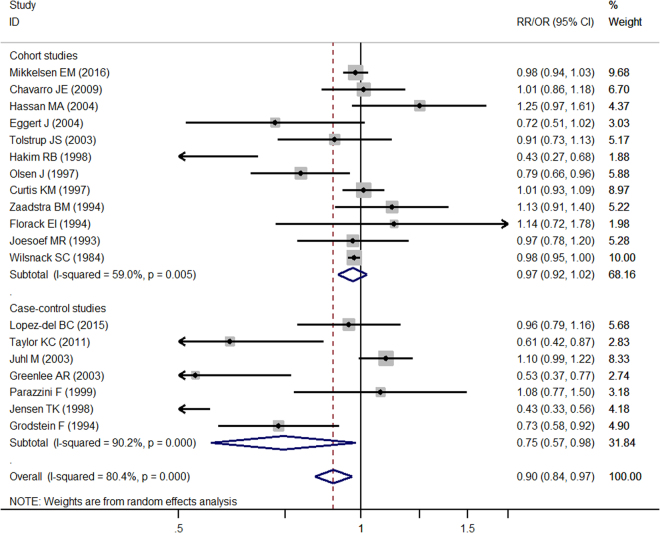
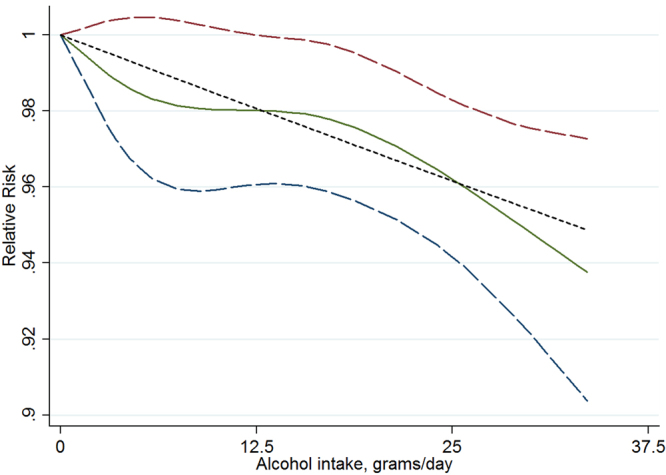
To what extent could alcohol consumption affects female fertility is still unclear. The aim of this study was to quantitatively summarize the dose-response relation between total and specific types of alcohol beverage (beer, wine, and spirits) consumption in female and the fecundability. Four electronic databases were searched. Observational studies (cohort and case-control) that provided female alcohol consumption and fecundity were eligible. Nineteen studies, involving 98657 women, were included in this study. Compared to non-drinkers, the combined estimate (with relative risk, RR) of alcohol consumers on fecundability was 0.87 (95% CI 0.78-0.95) for overall 19 studies. Compared to non-drinkers, the pooled estimates were 0.89 (95% CI 0.82-0.97) for light drinkers (≤12.5 g/day of ethanol) and 0.77 (95% CI 0.61-0.94) for moderate-heavy drinkers (>12.5 g/day of ethanol). Moreover, compared to non-drinkers, the corresponding estimates on fecundability were 0.98 (95% CI 0.85-1.11), 1.02 (95% CI 0.99-1.05), and 0.92 (95% CI 0.83-1.01) for studies focused on wine, beer and spirits, respectively. Dose-response meta-analysis suggested a linear association between decreased fecundability and every 12.5 g/d increasing in alcohol consumption with a RR 0.98 (95% CI 0.97-0.99). This first systematic review and meta-analysis suggested that female alcohol consumption was associated with a reduced fecundability.
Conflict of interest statement
The authors declare that they have no competing interests.
Figures
References
Publication types
MeSH terms
LinkOut - more resources
Full Text Sources
Other Literature Sources
Medical
