


Characterization and zoonotic impact of Shiga toxin producing Escherichia coli in some wild bird species
- PMID: 29062203
- PMCID: PMC5639112
- DOI: 10.14202/vetworld.2017.1118-1128
Characterization and zoonotic impact of Shiga toxin producing Escherichia coli in some wild bird species
Abstract
Aim: Wild birds are considered silent vectors of some zoonotic water and food borne pathogens of public health significance. Owing to the importance of Shiga toxin producing Escherichia coli (STEC) as the most pathogenic among the emerging diarrheagenic E. coli groups that can infect man; the present study was designed to detect the occurrence of STEC among wild birds in Egypt.
Materials and methods: A total of 177 intestinal content swab samples originating from five wild bird species were investigated for the presence of E. coli and STEC by standard culture methods. Suspect STEC isolates were further characterized by serotyping, random amplified polymorphic DNA polymerase chain reaction (RAPD PCR), antimicrobial resistance pattern and PCR detection of stx1, stx2, and eae genes.
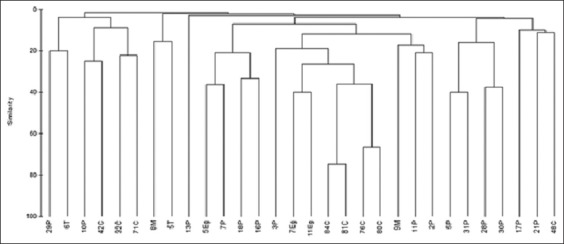
Results: A total of 30 suspect STEC isolates from 30 positive birds' samples were detected and identified on STEC CHROMagar (semi-captive pigeons, 15; house crows, 8; cattle egrets, 3; moorhens, 2; and house teals, 2). 25 isolates were grouped into 13 serogroups (O:20, O:25, O:26, O:27, O:63, O:78, O:111, O:114, O:125, O:128, O:142, O:153, and O:158), while five were rough strains. The distribution of STEC virulence genes among wild birds was as follows: 16 birds carried stx1 gene only (nine pigeons [28.1%], six crows [7.1%], and one cattle egret [5.6%]). Stx1 and stx2 genes together were detected in four birds (one cattle egret [5.6%], two moorhens [6.1%], and one house teal, [10%]). Only one pigeon (3.1%) possessed the three alleles. Disk diffusion test results showed that cefixime was the most effective against STEC serotypes with (93.3%) sensitivity, followed by gentamycin (56.7%), and amoxicillin (50%). On the other hand, all the recovered STEC isolates were resistant to cefotaxime, doxycycline, cephalothin, and sulfisoxazole. RAPD fingerprinting using primers OPA-2 and OPA-9 showed that STEC isolates were heterogeneous; they yielded 30 and 27 different clusters, respectively.
Conclusions: Wild birds carry STEC and may add to the contamination of the surrounding environment.
Keywords: Shiga toxin producing Escherichia coli; antibiotic; eae; random-amplified polymorphic DNA polymerase chain reaction; stx1; stx2; wild birds.
Figures
References
-
- WHO. E. coli Fact Sheet. 2016. [Viewed on 02-02-2017]. Available from: http://www.who.int/mediacentre/factsheets/fs125/en .
-
- Espenhain L.E. Master of Public Health Science, Faculty of the Health and Medical Sciences. Denmark: University of Copenhagen; 2013. Epidemiology and surveillance of Three Diarrheagenic Escherichia coli in Denmark between 2000-2012-Can Surveillance Be Improved?
-
- Garcia A, Fox J.G, Besser T.E. Zoonotic enterohemorrhagic Escherichia coli: A one health perspective. ILARJ. 2010;51(3):221–232. - PubMed
-
- CDC-Centers for Disease Control and Prevention. Multistate outbreaks of Shiga toxin-producing Escherichia coli O26 infections linked to Chipotle Mexican grill restaurants. 2015. [Viewed on 14-05-2016]. Available from: http://www.cdc.gov/ecoli/2015/O26-H11-15/signs-symptoms.html .
LinkOut - more resources
Full Text Sources
Other Literature Sources