Review
. 2017 Oct 9:11:72.
doi: 10.3389/fncir.2017.00072. eCollection 2017.

Monoaminergic Modulation of Motor Cortex Function

Affiliations
Review

Monoaminergic Modulation of Motor Cortex Function

Clément Vitrac et al. Front Neural Circuits. .

Abstract

Elaboration of appropriate responses to behavioral situations rests on the ability of selecting appropriate motor outcomes in accordance to specific environmental inputs. To this end, the primary motor cortex (M1) is a key structure for the control of voluntary movements and motor skills learning. Subcortical loops regulate the activity of the motor cortex and thus contribute to the selection of appropriate motor plans. Monoamines are key mediators of arousal, attention and motivation. Their firing pattern enables a direct encoding of different states thus promoting or repressing the selection of actions adapted to the behavioral context. Monoaminergic modulation of motor systems has been extensively studied in subcortical circuits. Despite evidence of converging projections of multiple neurotransmitters systems in the motor cortex pointing to a direct modulation of local circuits, their contribution to the execution and learning of motor skills is still poorly understood. Monoaminergic dysregulation leads to impaired plasticity and motor function in several neurological and psychiatric conditions, thus it is critical to better understand how monoamines modulate neural activity in the motor cortex. This review aims to provide an update of our current understanding on the monoaminergic modulation of the motor cortex with an emphasis on motor skill learning and execution under physiological conditions.

Keywords: dopamine; histamine; monoamines; motor cortex; norepinephrine; serotonin.


Figures
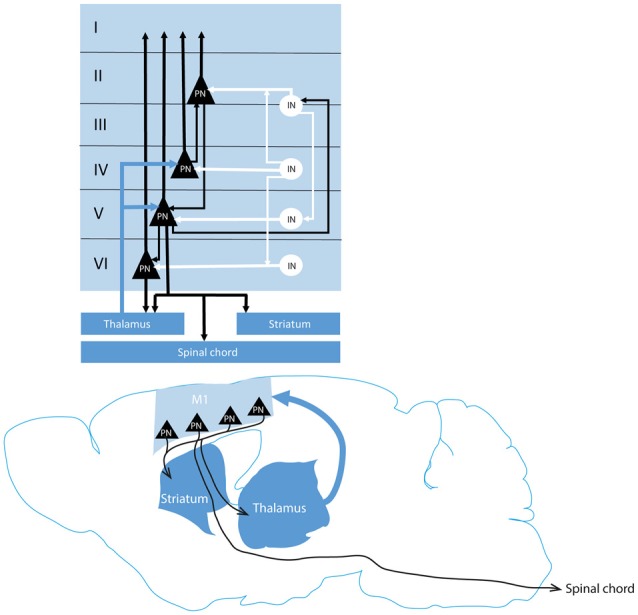
Figure 1
Figure 1
Classical representation of the cortico-subcortical and intracortical motor networks. Thalamic projections to the cortex (blue arrow) reach cortical pyramidal neurons (black triangles) in layer IV and V which contact respectively the layer II/III PN and layer VI PN and inhibitory interneurons (white circle) in the layer II/III. Layer II/III PN contact then PN in the layer V. Layer V and VI PN project to subcortical structures (dark blue). An inhibitory intracortical loop (white) is formed by the inhibitory interneurons in parallel to the excitatory circuitry (black) to prevent epileptiform activity of the cortex. M1, motor cortex; PN, pyramidal neuron; IN, interneuron.
Figure 2
Figure 2
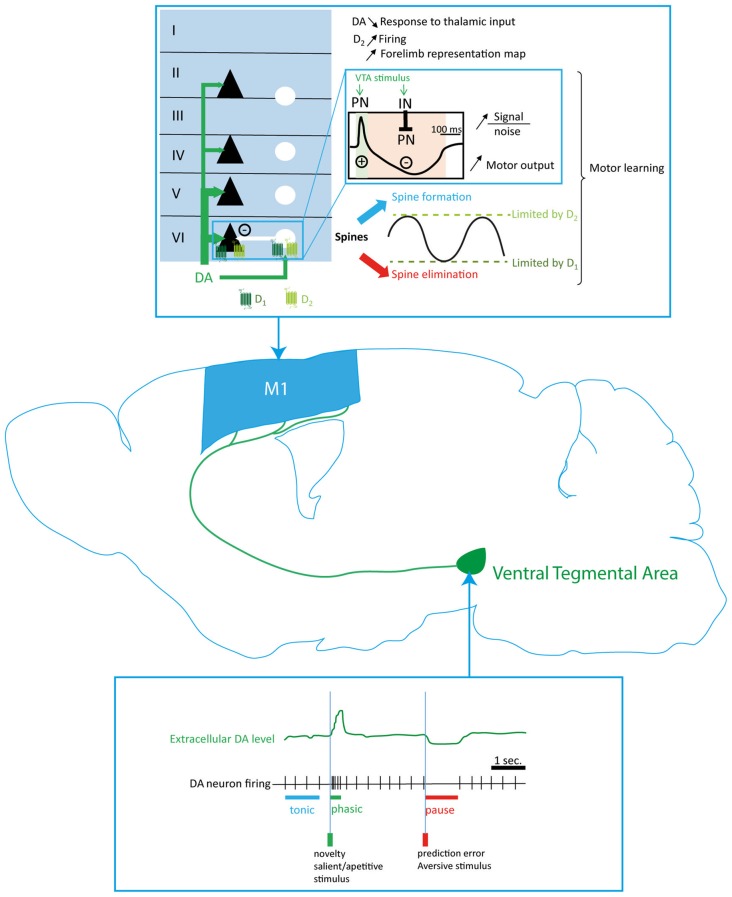
Dopaminergic modulation of the motor cortex function. Dopaminergic innervation of M1 originates in the ventral tegmental area (VTA; green arrows) and preferentially innervates the deep motor cortical layers. Phasic and tonic firing of dopaminergic neurons regulate the dopamine (DA) level in the motor cortex and activate respectively D1 and D2 which are thought to be expressed by the PNs (black triangles) and the INs (white circles) in the motor cortex. Thus, DA innervation exerts a biphasic modulation (blue inlay) of motor cortex neurons to promote motor outputs, increase the signal to noise ratio and regulate the spine turnover necessary to the expression of plasticity and motor learning. DA, dopamine; PN, pyramidal neuron; IN, interneuron.
Figure 3
Figure 3
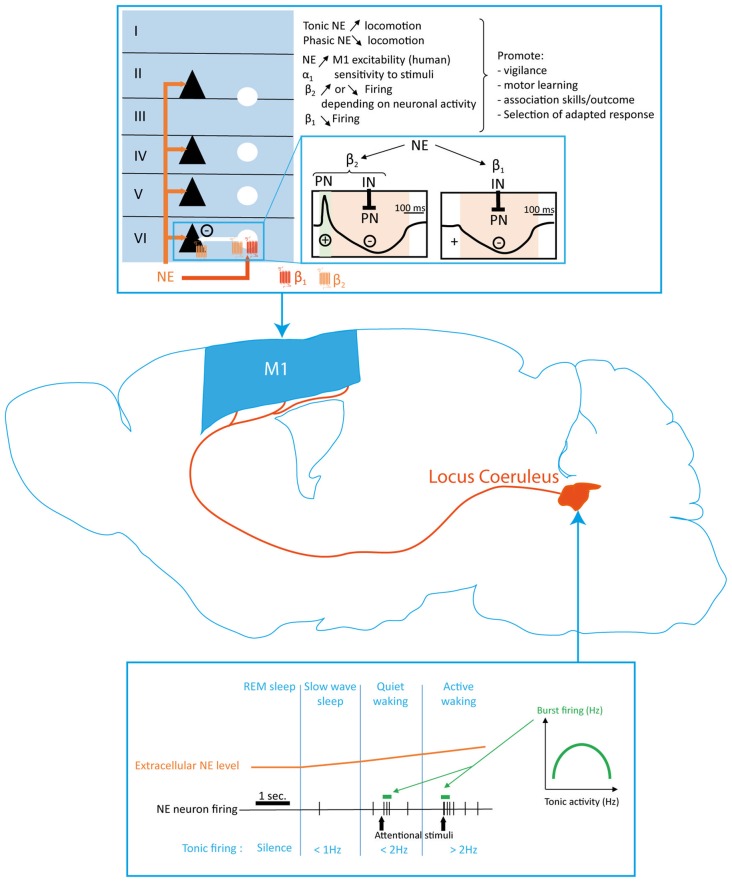
Norepinephrine (NE) modulation of the motor cortex function. NE innervation in M1 originates in the Locus Coeruleus (LC) and terminates homogeneously in all cortical layers. Extracellular NE levels are determined by different neuronal firing frequencies related to the wake/sleep state and firing patterns in response to external stimuli. Tonic and phasic NE release respectively promotes and reduces locomotion. NE exerts its effects in M1 through α1, β1 and β2 receptors located on projection neurons (black triangles) and interneurons (white circles). The differential expression of β1 and β2 receptors by both neuronal populations (blue inlay) results in two different sequence of excitation/inhibition response in M1 projection neurons. NE modulation of M1 plays a key role in modulating motor response in accordance to the level of vigilance and attention required by the behavioral situation. NE, norepinephrine; PN, pyramidal neuron; IN, interneuron.
Figure 4
Figure 4
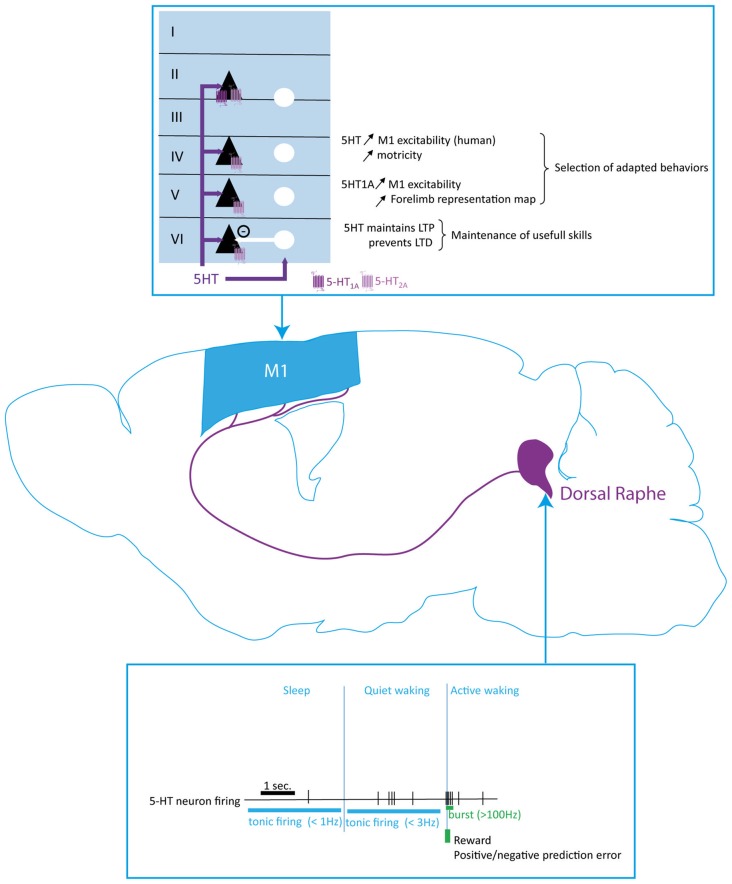
Serotoninergic modulation of the motor cortex function. Serotoninergic neurons from the dorsal raphe (DR) nucleus innervate all cortical layers in M1. The 5-HT neurons different firing frequency and patterns, which are determined by the sleep-wake cycle and response to external stimuli, modifies the extracellular 5-HT level to enhance motor cortex excitability and regulate the maintenance of long term potentiation (LTP). Serotonin plays a key role in the selection of adapted behaviors and maintenance of useful skills. 5-HT, serotonin; PN, pyramidal neuron; IN, interneuron.
Figure 5
Figure 5
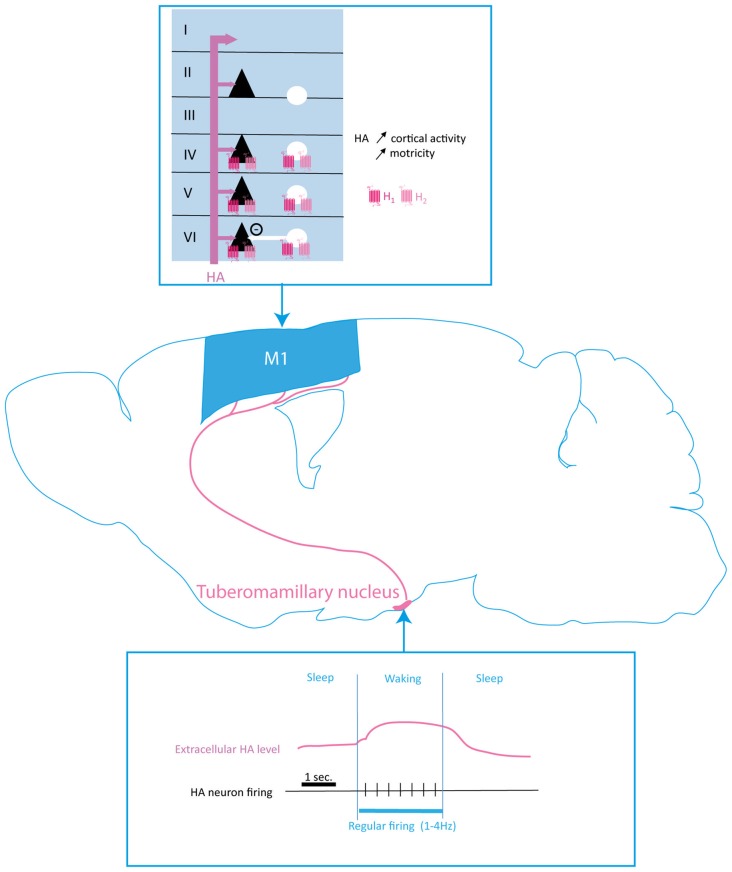
Histaminergic modulation of the motor cortex function. Histamine (HA) input originates in the tuberomamillary nucleus (TMN) and projects to all M1 layers with higher fiber density found in layer I. HA firing and extracellular levels are correlated to sleep/waking rhythm, HA being released tonically during waking. H1 and H2 receptors are both expressed by projection neurons (black triangles) and interneurons (white circles). HA increases cortical activity and motricity. HA, histamine; PN, pyramidal neuron; IN, interneuron.
Figure 6
Figure 6
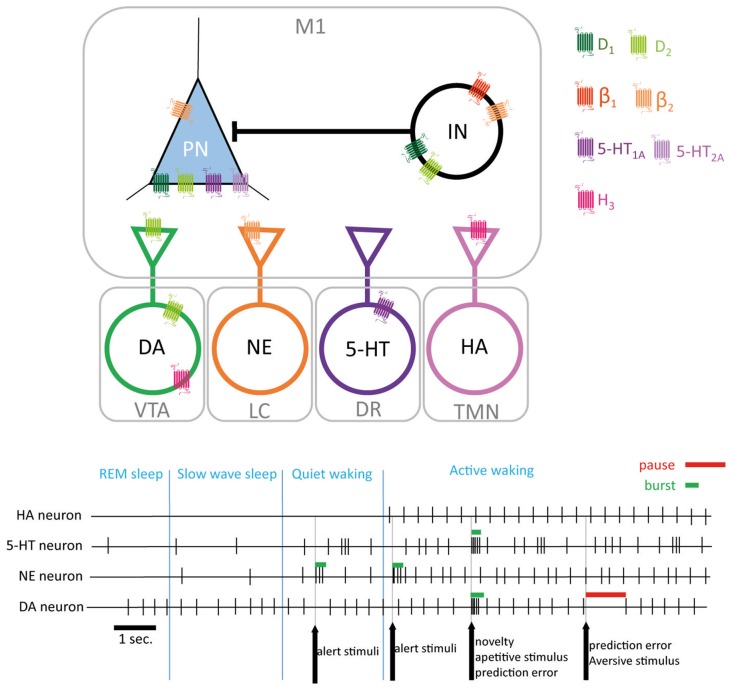
Monoaminergic modulation of M1. Monoamines projecting to M1 interact at pre and post synaptic levels both on pyramidal neurons (PN) and interneurons (IN). Extracellular levels of monoamines are related to sleep/wake states (encoded by tonic firing frequency in HA, 5-HT and NE neurons) and to environmental stimuli supporting attentional/alert information (encoded by bursts or pause in the firing activity by 5-HT, E and DA neurons). DA, dopamine; NE, norepinephrine; 5-HT, serotonin; HA, histamine; M1, primary motor cortex; VTA, ventral tegmental area; LC, locus coeruleus; DR, dorsal raphe; TMN, tuberomamillary nucleus.

References

    1. Agster K. L., Mejias-Aponte C. A., Clark B. D., Waterhouse B. D. (2013). Evidence for a regional specificity in the density and distribution of noradrenergic varicosities in rat cortex. J. Comp. Neurol. 521, 2195–2207. 10.1002/cne.23270 - DOI - PMC - PubMed
    1. Agúndez J. A., Luengo A., Herráez O., Martínez C., Alonso-Navarro H., Jimenez-Jimenez F. J., et al. (2008). Nonsynonymous polymorphisms of histamine-metabolising enzymes in patients with Parkinson’s disease. Neuromolecular Med. 10, 10–16. 10.1007/s12017-007-8017-7 - DOI - PubMed
    1. Allers K. A., Sharp T. (2003). Neurochemical and anatomical identification of fast- and slow-firing neurones in the rat dorsal raphe nucleus using juxtacellular labelling methods in vivo. Neuroscience 122, 193–204. 10.1016/s0306-4522(03)00518-9 - DOI - PubMed
    1. Alvarez V. A., Chow C. C., Van Bockstaele E. J., Williams J. T. (2002). Frequency-dependent synchrony in locus ceruleus: role of electrotonic coupling. Proc. Natl. Acad. Sci. U S A 99, 4032–4036. 10.1073/pnas.062716299 - DOI - PMC - PubMed
    1. Amargós-Bosch M., Bortolozzi A., Puig M. V., Serrats J., Adell A., Celada P., et al. (2004). Co-expression and in vivo interaction of serotonin1A and serotonin2A receptors in pyramidal neurons of prefrontal cortex. Cereb. Cortex 14, 281–299. 10.1093/cercor/bhg128 - DOI - PubMed

Substances

LinkOut - more resources